table of contents
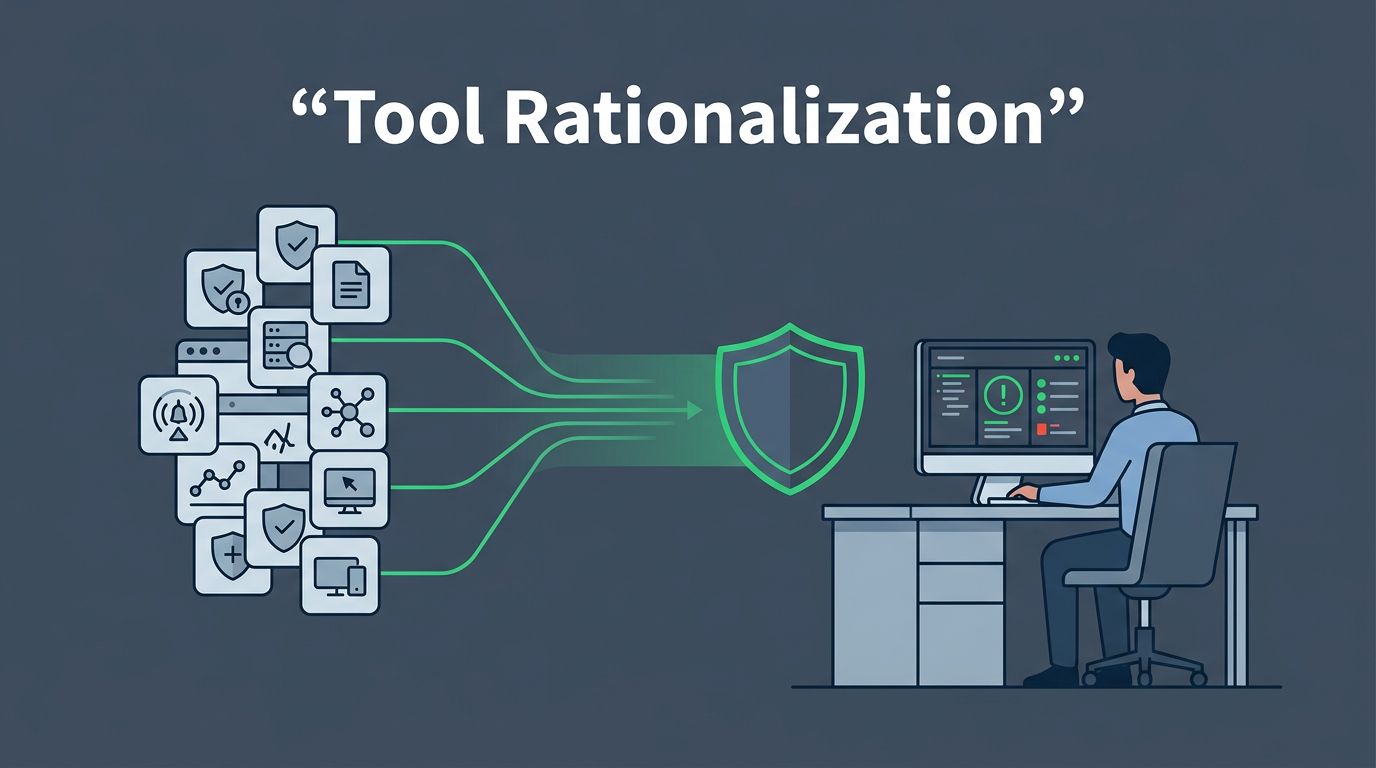
Your security team juggles dozens of tools in a bloated security stack. Alerts flood inboxes. Licenses go unused. Costs climb. You know the drill. It drains resources and slows response times.
Security tool rationalization fixes this. It cuts overlap and boosts efficiency. Teams focus on real threats instead of tool chaos. This guide shares practical frameworks. You get steps, criteria, and metrics to streamline your setup.
Start by mapping your current tools. Then evaluate them against clear standards.
Key Takeaways
- Inventory your security stack to spot overlaps, underused licenses, and integration gaps that drive up costs and complexity.
- Evaluate tools using seven key criteria: coverage, efficacy, cost (TCO), operational burden, integration, user adoption, and risk management; score with a weighted matrix.
- Map tools to frameworks like NIST, MITRE ATT&CK, or CIS Controls to ensure complete coverage while consolidating to platforms.
- Follow a step-by-step process: inventory, score, identify overlaps, POC consolidations, migrate, and monitor KPIs like 20-40% cost savings and reduced alerts.
- Review quarterly or annually to adapt to threats, overcoming challenges like resistance with data and stakeholder buy-in.
The Hidden Costs of Tool Overload
Security stacks grow fast, leading to tool sprawl and vendor sprawl. Teams add point solutions for every new threat. Firewalls stack with endpoint detectors. Cloud scanners join SIEMs. Soon, you have 50+ vendors.
This sprawl hurts. Maintenance eats 30% of budgets, per industry benchmarks. Teams switch contexts hourly. False positives multiply because tools don’t share data well.
Overlaps waste money. Two EDR tools for endpoint security cover the same endpoints. Underused licenses sit idle after mergers. Integration gaps leave blind spots.
Consider a mid-size firm. They ran three vulnerability scanners. Each missed different assets. Total cost: $500K yearly. Rationalization dropped it to one tool. Savings hit 40%.
You face similar issues. High operational complexity slows patches. Poor user adoption means half the features gather dust. Business risk rises when tools conflict.
Rationalization aligns tools to goals. It reduces vendors. It frees budget for threats that matter, easing budget constraints and improving return on security investments.
Assessing Your Current Security Stack
Inventory everything first. List all tools, vendors, licenses, and costs. Note deployment dates and usage stats.
Pull data from procurement records. Check license dashboards. Query teams on daily workflows. You spot redundant security controls quick.
For example, multiple web gateways block the same traffic. Endpoint tools feature overlaps on malware scans. Cloud access brokers duplicate IAM checks.
Teams often miss underused licenses. A tool bought for compliance sits at 20% utilization. Integration gaps show up here too. SIEM feeds from five sources drop events.

This mess is common. Feature overlaps create blind spots. Efficacy drops because data silos persist.
Map tools to controls with a gap analysis and maturity assessment of the environment. Use NIST or MITRE ATT&CK as a mapping framework. Assign owners. Rate maturity. Gaps emerge fast.
Document pain points. High costs? Alert fatigue? Slow queries? This baseline guides decisions.
In short, assessment reveals truth. You see what’s essential. What’s redundant. What’s broken.
Key Criteria for Evaluating Tools
Judge tools on seven factors. Coverage first. Does it protect key assets like endpoints, cloud, and networks, ensuring a strong defense in depth strategy?
Next, cybersecurity effectiveness. Block rates matter. False positives kill momentum. Test in labs or use reports.
Cost includes licenses, support, training. Factor total ownership over three years. Hidden fees add up.
Operational burden counts. Setup time. Staff hours. Alert volume. Simple tools win.
Integration fit seals it. Does it feed your SIEM? API health? Native connectors?
User adoption rates high? Intuitive UIs reduce training. Resistance kills value.
Risk management rounds it out. Compliance gaps? Vendor stability? Support SLAs?
Weigh these. Assign scores. Coverage might rate 30%. Cost 20%. Adjust for your risks.
For instance, a SIEM with poor integrations scores low. Even if coverage shines.
This criteria keeps decisions objective. No vendor bias.
Building Your Evaluation Framework
Frameworks structure choices for security architecture rationalization. Start with a matrix. Rows: tools. Columns: criteria.
Use a data-driven assessment for scoring. Rate 1-5 per cell. 5 means excels. 1 means fails. Weight scores. Total them.
EY outlines a similar approach in their cybersecurity tools rationalization framework. They stress data-driven steps and scorecards.
Tie to standards. Map to CIS Controls or a standardized security framework like ISO 27001. Ensures coverage stays complete.
Prioritize platforms. Multi-tool suites like Microsoft or Palo Alto consolidate functions. Check overlaps.
Build tiers. Keepers stay. Probation for middling. Cut losers.
Review quarterly. Threats shift. So do needs.

Balance pays off. You cut without gaps.
Vendor-neutral stays key. No lock-in. Test alternatives.
This framework scales. Small teams or enterprises both benefit.
Step-by-Step Process for Rationalization
Follow these steps. Repeat yearly.
-
Inventory tools. Use spreadsheets or CMDBs. Include costs and contracts.
-
Map to requirements across the software development lifecycle. List must-have controls. Match tools to them for end-to-end security.
TechTarget details this in their security control rationalization guide. Inventory then assess.
-
Score each tool. Use your matrix. Gather team input.
-
Identify overlapping functionalities. Group similar functions. Pick winners.
-
Test consolidations. POC platforms. Measure integration.
-
Plan migrations. Phase out losers. Train users.
-
Monitor post-cut. Track metrics.
For example, consolidate EDR and XDR. One tool covers both. Savings hit 25%.
Handle stakeholders early. CISOs own vision. Ops flags burdens. Procurement eyes costs.
Budget for change. One-time migration costs offset yearly savings.
This process minimizes disruption. Efficacy holds steady.
Sample Scoring Criteria and Metrics
Make scores concrete. Here’s a table for vulnerability management tools.
| Criterion | Weight | Scoring Guide (1-5) | Example Metric |
|---|---|---|---|
| Coverage | 25% | 5: All assets; 1: Critical gaps | % assets scanned |
| Efficacy | 20% | 5: Low false positives (e.g., breach and attack simulation); 1: Misses | Detection rate |
| Cost | 15% | 5: High cost-effectiveness (under budget); 1: Overspends | TCO per asset/year |
| Ops Burden | 15% | 5: Automated; 1: Manual heavy | Hours/week maintained |
| Integration | 10% | 5: Full API; 1: No connectors | Data flow success % |
| User Adoption | 10% | 5: High usage; 1: Ignored | Login frequency |
| Risk Reduction | 5% | 5: Compliance full; 1: Violations | Audit findings |
Multiply scores by weights. Sum for totals. Top scorers stay.
Apply across categories. Adjust weights for priorities. Cloud-heavy? Boost integration.
Real case: Firm scored three scanners. Leader: 85/100. Cut the rest. Risk stayed covered.
Metrics prove value. Track before and after.
Overcoming Common Implementation Challenges
Security tool rationalization is a core component of essential “security hygiene”.
Resistance pops up. Teams love their tools. Show data. Demo better workflows.
Integration snags happen. Start small. Pilot one consolidation.
Vendor pushback? Contracts bind, especially at license expiration. Use it as a strategic trigger for starting the rationalization process with specific vendors. Negotiate buyouts. Multi-year deals help.
Skills gaps slow you. Train or hire. Bud Consulting fills roles like security architects. Book a Discovery Call with Bud Consulting for talent advice.
AHEAD suggests tying to frameworks like NIST in their tools rationalization perspective. Scope controls first.
Budget crunches? Phase cuts. Savings fund next steps.
Communicate wins. Share dashboards. Buy-in grows.
These fixes keep momentum.
Measuring Success After Rationalization
Track KPIs monthly. Prioritize cost savings first. Aim for a 20-30% drop.
Alert volume falls 40%. Response times shorten.
Coverage holds. Run control audits. Ensure no new gaps.
User satisfaction rises. Surveys hit 80%+.
MTTR drops. Efficacy metrics confirm.
Use dashboards. SIEM or Excel. Compare baseline vs. now.
For example, post-rationalization, one team cut vendors from 45 to 18. Savings: $1.2M. Risk score steady, preserving a strong security posture.
Adjust as needed. Annual reviews enable continuous optimization of the stack to catch drifts.
Success means a simpler, stronger security ecosystem that bolsters your overall security posture.
Frequently Asked Questions
What is security tool rationalization?
Security tool rationalization streamlines bloated stacks by cutting overlaps, redundancies, and underused tools. It frees budgets, reduces alert fatigue, and lets teams focus on real threats. Expect 20-40% savings while maintaining strong coverage.
How do I start assessing my current security stack?
Inventory all tools, vendors, licenses, costs, and usage from procurement and team inputs. Map to controls using NIST or MITRE ATT&CK frameworks for gap analysis. Document pain points like high maintenance and false positives to guide decisions.
What criteria should I use to evaluate tools?
Judge on coverage of assets, efficacy (block rates, false positives), total cost of ownership, operational burden, integration fit, user adoption, and risk management. Assign weights (e.g., coverage 25%) and score 1-5 in a matrix. This keeps choices objective and vendor-neutral.
What are common challenges in rationalization and how to overcome them?
Teams resist change, integrations snag, and vendors push back on contracts. Show data on savings, pilot small consolidations, and time cuts to license renewals for negotiations. Communicate wins via dashboards to build buy-in.
How do I measure success after rationalization?
Track KPIs monthly: 20-30% cost drops, 40% fewer alerts, steady coverage via audits, higher user satisfaction, and lower MTTR. Use dashboards to compare baselines. Annual reviews ensure ongoing optimization.
Conclusion
Rationalization transforms stacks. You cut costs and complexity. Teams respond faster.
Focus on criteria like coverage and integration. Follow the steps. Measure results.
Your security posture strengthens. Budgets stretch further.
Start small. Pick one category. Scale from there. Use automated security checks to maintain the streamlined stack and prevent future sprawl.