table of contents
A mid-market security team can waste months hiring the wrong threat intelligence analyst. The usual problem is scope. The job gets written like a mini intelligence program, then the budget only supports one person with a laptop and a pile of feeds.
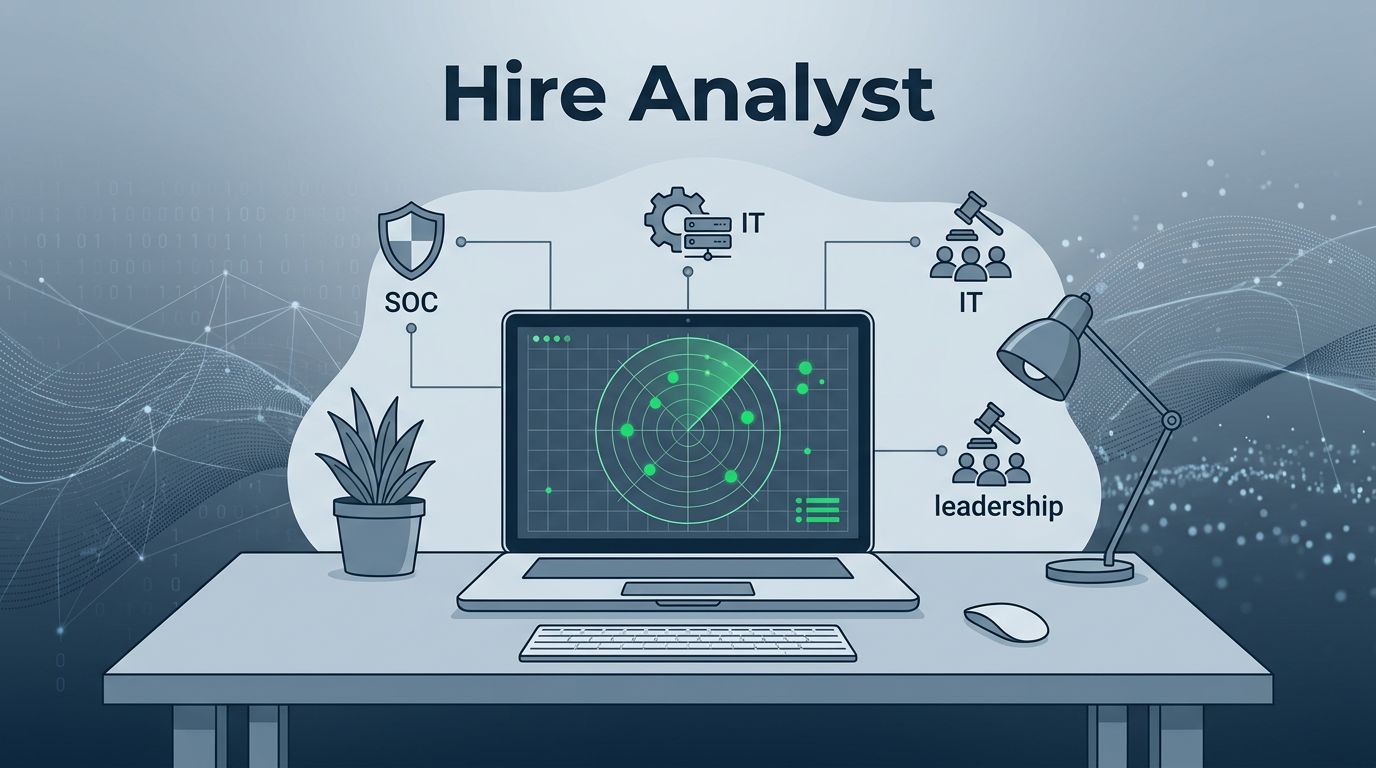
You need someone who turns threat data into actions your SOC, IT team, and leaders can use. That starts with defining the outcomes first, then testing for analysis, communication, and follow-through. The sections below show how to hire for real security work, not a polished resume.
Start with the outcomes this hire must improve
Before you write the job post, decide what this person must change in the business. If you skip that step, the role grows until it becomes impossible to fill.
A mid-market threat intel hire usually exists to make other teams faster and sharper. That might mean reducing noise from feeds, improving detection content, helping incident response, or giving leadership a clear read on which threats matter this quarter. If you cannot name the decisions this person will influence, the role is too vague.
A good test is simple. Ask, “What will be different 90 days after this person starts?” If the answer is “we’ll have more intelligence,” the scope is too broad. If the answer is “phishing tickets get triaged faster, high-risk TTPs get better coverage, and leadership gets one useful briefing each month,” you’re on the right track.
For a small team, three or four outcomes are enough:
- cut time spent triaging noisy threat feeds
- turn threat reports into detection ideas or playbook updates
- brief leaders in plain language
- support incident response with fast context on attacker methods
That list is not a wishlist. It is a filter. A mid-market company does not need an analyst who covers every threat actor on earth. It needs someone who can connect threat data to the company’s own exposure, stack, and risk profile.
The best way to avoid overhiring is to write the role around one clear lane. Some teams need a hands-on analyst who works close to the SOC. Others need a more strategic person who can shape priorities and brief executives. Many need both, but not from the same title.
What the role looks like inside a mid-market team
A practical threat intelligence analyst in a mid-market company spends more time deciding what matters than collecting more data. They watch for new scams, malware, ransomware, credential theft, and actor activity. Then they map that activity to your environment, your control gaps, and your current incidents.
That usually means working across SIEM, EDR, email security, vulnerability management, attack surface tools, and open-source intelligence. Some teams also use a lightweight TIP such as MISP or OpenCTI, while others manage the work with a disciplined spreadsheet and a good case tracker. The tool matters less than the workflow.
A useful benchmark is Recorded Future’s analyst job description, but mid-market teams should trim it hard. The goal is not to copy a large enterprise profile. The goal is to hire for the threats and decisions you face every week.

In 2026, AI-assisted workflows can help with first-pass triage, feed summarization, and entity extraction. That is useful. It saves time on repetitive work and helps a small team move faster. It still needs a human to check source quality, remove duplicates, and decide whether the intelligence is relevant to your company.
A SaaS business may need the analyst to focus on phishing, identity abuse, and cloud exposure. A manufacturer may care more about ransomware crews, supplier compromise, and exposed remote access. A good analyst reads those differences quickly and changes the reporting to fit.
If the person cannot trigger a control change, a ticket, or a crisp escalation, the work is not landing.
That is why the best mid-market hires are part detective, part editor, and part operator. They do not just collect indicators. They help the team act.
A practical skills matrix for hiring
For a lean team, a skills matrix keeps the search honest. It helps you avoid the common trap of asking for a senior strategist when you really need a strong operator.
If you want a rough benchmark for experience bands, this experience guide is useful when you are deciding how much depth you actually need.

Use a table like this to compare candidates against the work, not the title.
| Skill area | What good looks like | How to test it | Red flags |
|---|---|---|---|
| Analytical thinking | Breaks noisy inputs into a clear priority order and explains why | Give a messy feed item and ask for the next three actions | Treats every item as urgent |
| Communication | Gives a short answer, names the risk, and says what to do next | Ask for a 60-second executive briefing | Uses jargon and never lands on a decision |
| Tool fluency | Knows how to work with SIEM, EDR, TIPs, spreadsheets, and source notes | Ask which tools they used and how they used them | Lists tools but cannot explain the workflow |
| Operational follow-through | Turns findings into detections, tickets, or playbook updates | Ask for an example where intel changed a control | Stops at reporting |
| Business context | Connects threats to your industry, assets, and exposure | Ask them to relate a campaign to your environment | Talks only in generic threat actor terms |
| Judgment | Knows what to ignore when time is limited | Give them a time-boxed case study with too much data | Tries to chase every lead |
The strongest candidates do not try to sound like walking encyclopedias. They show judgment. They can tell you what matters, what does not, and what they would do first.
For a mid-market team, that matters more than deep niche knowledge about every adversary group. If the company is small, the analyst must make tradeoffs all day. That takes clear thinking and a calm voice.
The right experience level also matters. A candidate with three to five years of good cybersecurity work can be a strong fit if they already know how to brief people, handle messy data, and work across teams. A very senior profile may be a poor use of budget if you need daily execution more than program design.
Interview for judgment, not jargon
A strong interview for a threat intelligence analyst looks less like trivia and more like problem solving. You want to hear how the candidate thinks when the input is messy and the answer is not obvious.
The best interviews include a live scenario. Give the candidate a phishing report, a short threat feed sample, or a recent incident summary. Then ask what they would do next. You do not need a long simulation. You need to see whether they can sort signal from noise.
For a broader view of how threat intel profiles sit beside adjacent security roles, Cyber Directors’ Hiring Playbook is a useful reference point.
Questions that expose real ability
- “Walk me through the last time you turned a raw alert or feed item into a decision.”
- “How would you decide whether a new ransomware campaign matters to our company?”
- “What would you send to a SOC lead if you found a likely malicious IP linked to our environment?”
- “How do you rank threats when everything looks urgent?”
- “Tell me about a time your analysis changed a detection rule, control, or playbook.”
- “How do you use AI tools in your workflow without trusting them blindly?”
- “If you joined next month, what would you want to learn in your first 30 days?”
Listen for structure in the answers. Good candidates name their sources, state their confidence, and make the next step obvious. Weak candidates give long answers that never land.
A simple work sample also helps. Ask them to write a short briefing, no more than half a page. It should tell a busy manager what happened, why it matters, and what to do next. That tells you far more than a list of certifications.
Operationalize intelligence, or the role will stall
Hiring the analyst is only half the job. The other half is building a path from finding to action.

In a small team, the workflow should be simple. Collect, validate, prioritize, act, then measure. If any step is missing, the work gets trapped in a report folder.
A practical 2026 workflow looks like this:
- Collect from sources that matter to your risk, such as threat feeds, OSINT, vendor intel, email telemetry, EDR, SIEM data, and external attack surface findings.
- Enrich and validate with context, such as your exposed assets, recent incidents, identity risks, and known control gaps.
- Prioritize what your team can act on this week, not what looks interesting in theory.
- Push the result into a ticket, a rule change, a playbook update, a briefing, or an incident review.
- Track whether the work changed anything, such as detection quality, response time, or leadership decisions.
AI helps most in the first two steps. It can group similar alerts, summarize source material, extract names and domains, and draft a first version of a report. It should not make final calls. A strong analyst uses AI to save time, then checks the output against the company’s own risk.
This is also where outsourcing can help. If your team is too small for a full-time intel function, buy support for narrow tasks like feed tuning, external exposure monitoring, or periodic reporting. Keep the analysis close to your own operations, but do not force one person to do everything.
A small company that already runs continuous attack-surface review can get more value here. The analyst can connect what is exposed outside the perimeter to what attackers are actually doing. That makes the work concrete, not abstract.
If you need help deciding where the in-house work should stop and outside support should begin, Book a Discovery Call with Bud Consulting is a practical next step.
When a full-time analyst makes sense, and when support does
Not every mid-market company needs a full-time threat intelligence analyst on day one. Some do. Others need a hybrid model.
Hire full-time when the company has enough incident volume, leadership interest, and threat exposure to justify daily attention. That usually means the analyst will feed the SOC, shape detections, support incident response, and brief stakeholders on a regular cadence. If those needs show up every week, a dedicated role makes sense.
Use a lighter model when the need is narrower. If you mostly want executive summaries, targeted reporting, or periodic threat reviews, a retained consultant or managed service can cover a lot of ground. That is often a better fit when the security team is tiny or when the company is still building basic logging and response maturity.
The key is fit. A full-time hire with no clear operating path gets frustrated. A part-time or outsourced model with no owner gets ignored. The best setup gives the analyst a real audience, a clear backlog, and a way to turn findings into action.
Conclusion
The best mid-market threat intelligence hire is not the flashiest resume. It is the person who can turn threat data into decisions that help a small team move faster.
Start with outcomes, keep the scope tight, and test for judgment, communication, and operational follow-through. If the role needs more strategy than execution, or more execution than strategy, adjust the brief before you post it.
A good threat intelligence analyst should make your team clearer, quicker, and harder to surprise. That is the kind of hire that pays off after month one, not just on day one.