table of contents
A threat intelligence analyst can help a mid-market security team stop chasing noise and focus on what matters. The hard part is that many companies hire for the title before they define the outcome.
If you only want more feeds, you may need a tool or a managed service, not a new hire. If you need better prioritization, cleaner reports for leadership, and faster action from SOC and vulnerability management, the role starts to make sense.
The goal is to hire for decisions, not for curiosity. That difference saves time, budget, and a lot of frustration later.
Do you need a threat intelligence analyst, or a different answer?
Mid-market teams often feel pressure to “do threat intel” because the board asks about ransomware, phishing, and active campaigns. That pressure is real, but the first move is not always a full-time hire.
You probably need the role when intelligence will change actions inside the company. For example, it can help your SOC tune detections, help vulnerability teams rank patching, help IR prepare for likely attack paths, and help leadership understand what deserves attention this quarter.
If your security team is small and the main need is alert handling, an MDR or MSSP may be a better fit. If your main problem is that nobody turns external threats into business decisions, then a threat intelligence analyst can fill a real gap.

The best test is simple. Ask whether the role will lead to faster patching, better detections, better executive briefings, or better incident prep. If the answer is no, the job may be too vague to justify.
What the role should produce in a mid-market team
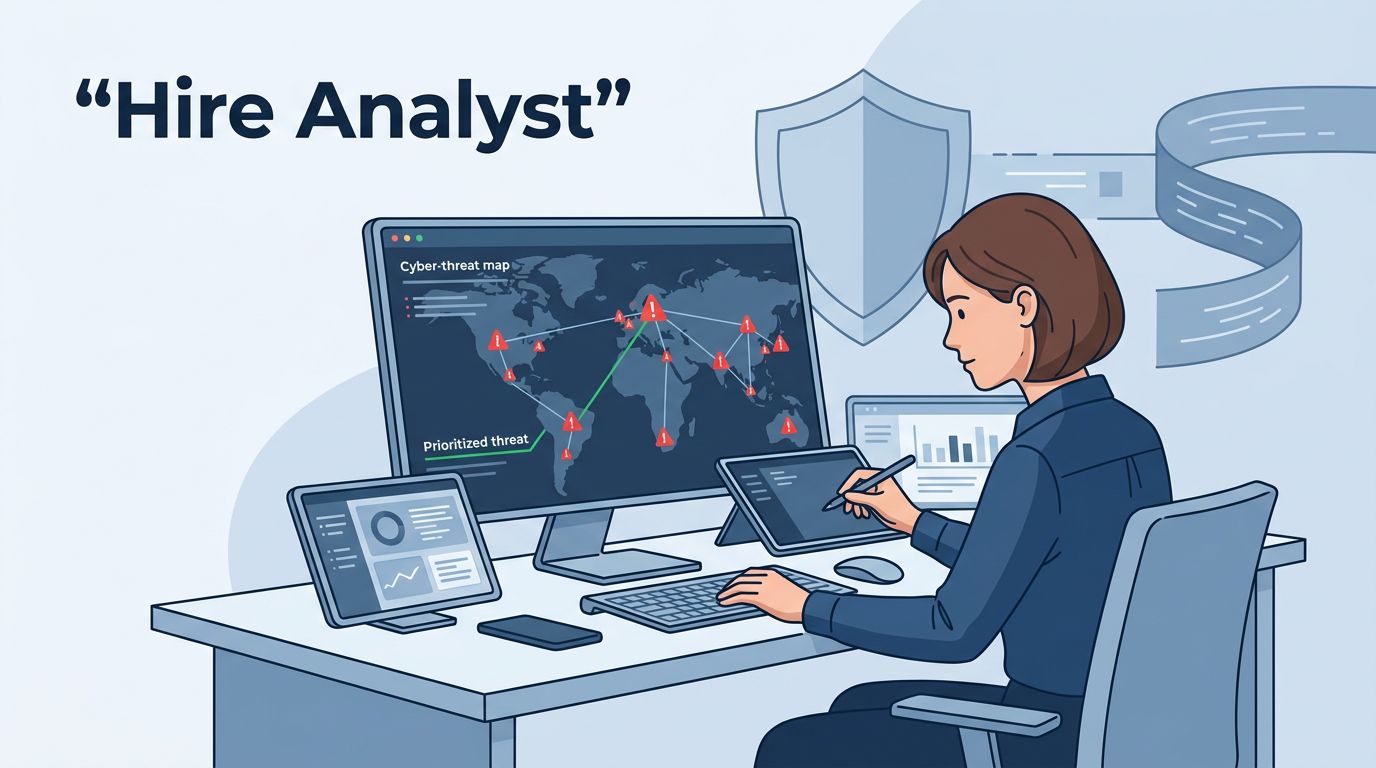
In 2026, a good threat intelligence analyst does more than watch feeds. The person takes scattered signals and turns them into actions that fit your environment.
That usually means tracking threat actors, malware, ransomware groups, phishing infrastructure, and exploit trends. It also means mapping those patterns to your own stack, then telling other teams what to do next. A useful threat intelligence analyst guide from Wiz reflects that mix of research, analysis, and reporting.
For a mid-market company, the output should be practical. Think weekly briefs, high-priority watchlists, detection ideas, exposure notes for vulnerable systems, and short leadership summaries that explain risk in plain language.
The analyst should also work across teams. SOC needs context for alerts. IR needs likely attacker methods. Vulnerability management needs to know which flaws are being used in the wild. Leadership needs a clear view of what deserves money, time, or a policy change.
In other words, you are hiring someone to close the loop between external threat data and internal action. Without that loop, intel turns into a pile of alerts and saved links.
Must-have and nice-to-have skills for 2026
A strong job description makes a clear split between core ability and nice extras. That keeps you from overreaching and helps you spot candidates who can actually do the work.
| Skill area | Must-have | Nice-to-have |
|---|---|---|
| Analysis and prioritization | Can turn noisy threat data into a clear recommendation | Can track campaigns over time and spot trends early |
| Writing and communication | Can write a short brief with a direct call to action | Can brief executives, legal, or business leaders with confidence |
| Security context | Understands phishing, malware, ransomware, and common attack paths | Knows cloud, SaaS, identity, or industry-specific exposure patterns |
| Tool fluency | Has worked with SIEM, ticketing, case management, and enrichment tools | Can build scripts, use APIs, or help shape a CTI platform workflow |
| Collaboration | Can work with SOC, IR, and vulnerability management | Has run hunts, tabletop exercises, or cross-team reviews |
| Sourcing and validation | Can judge source quality and avoid weak claims | Has dark web, OSINT, or language skills that fit your sector |
A current senior cyber threat intelligence lead posting shows how often SIEM, cloud context, and case management sit next to intel work now. That is useful context for mid-market buyers, because the role is no longer a pure research seat.
The cleanest rule is this: if a candidate can name every tool but cannot explain how they changed a decision, keep looking. Tools matter, but judgment matters more.
How to assess candidates without getting fooled by buzzwords
A lot of interviews for this role fail because they reward vocabulary. A candidate can sound smart and still be weak at the actual job.
If a candidate cannot explain how intelligence changed a detection, a patch order, or a leadership brief, they are still describing research, not business value.
Start with questions that force the person to think through tradeoffs. Ask how they decide whether a threat signal is worth action, what makes a source reliable, and how they would explain confidence levels to a SOC lead.
You should also ask about collaboration. A solid analyst knows how to hand off work to IR, how to feed vuln management with better context, and how to brief leadership without drowning them in detail. That is where mid-market teams get value.
A current threat intelligence analyst posting lists automation playbooks, enrichment logic, executive summaries, and threat briefs. That kind of scope is a good reminder that the role blends analysis with delivery.
Watch for a few warning signs during the interview.
- The candidate keeps returning to tool names and source lists, but never reaches a decision.
- The candidate cannot explain how they reduce false positives or useless intel.
- The candidate talks about MITRE ATT&CK, but cannot connect it to a real response action.
- The candidate struggles to write clearly, which is a problem in a role built on briefs.
A strong interview feels less like trivia and more like a work session. You want to hear how the person thinks when the data is messy.
What a strong work sample should look like
A short work sample is the fastest way to see whether a candidate can do the job. It should be practical, not academic.
Give them a small packet with a few clues, such as a suspicious domain tied to phishing, a ransomware note, or a critical vulnerability affecting one of your core apps. Then ask for a one-page brief and a short readout.
Ask them to cover four things:
- What is happening and why it matters.
- Which team should act first.
- What action should happen in the next 24 hours.
- What is still unknown and what they would check next.
That exercise shows more than a resume ever will. It reveals how they prioritize, how they write, and whether they can turn raw data into useful direction.
If you want to make the test closer to real work, include one internal twist. For example, tell them that the vulnerable asset is public-facing, or that the threat is hitting a high-revenue app. Then see whether they adjust the response.
Grade the sample on clarity, business fit, and actionability. Do not overvalue formatting, jargon, or polished graphics. A clear one-page brief beats a pretty deck that says little.
Full-time, fractional, or MDR/MSSP, which fits your budget?
Mid-market teams need to match the hiring model to the size of the problem. A full-time analyst is not always the best first step.

| Model | Best when | Watch out for |
|---|---|---|
| Full-time hire | You have steady intel needs, a mature SOC, and enough internal work to keep the role busy | Higher cost, longer ramp-up, and more pressure to define the job well |
| Fractional analyst | You need leadership, process design, briefings, or coverage during a build-out phase | Limited availability, so someone inside still needs to own follow-through |
| MDR or MSSP | You need monitoring, triage, and response help more than deep company-specific intelligence | The output can feel generic if your business context is thin |
| Vendor or project support | You need help setting up sources, reporting, or workflows before committing to headcount | If the project ends too soon, the process can stall |
For many teams, fractional support is the best bridge. It helps you define the workflow, prove demand, and avoid hiring too early. It also gives you time to see whether the role should sit inside security operations, exposure management, or a broader risk function.
If you want a practical view of which model fits your team, Book a Discovery Call with Bud Consulting and map the need to your budget, current workload, and response process.
The first 90 days and the KPIs that matter
A new analyst should not spend three months collecting feeds. The first 90 days should build trust, workflow, and visible wins.
The first month is for learning the environment. The analyst should meet the SOC, IR, vuln management, and leadership contacts. They should also learn your major assets, top risks, and current reporting cadence.
During days 31 to 60, the person should start shaping repeatable work. That means defining watchlists, setting intel request paths, and making sure the team knows where threat intelligence lives.
By days 61 to 90, the analyst should deliver a first real cycle of value. That could mean a leadership brief, a detection idea, a patch priority list, or a process that saves analysts time.
These KPIs are useful for a mid-market team:
| KPI | What it tells you |
|---|---|
| Time from threat signal to internal brief | Shows whether the analyst can turn data into action fast enough |
| High-risk vulnerabilities enriched with threat context | Shows the link between intelligence and exposure management |
| Detections or hunts created from intelligence | Shows operational value for the SOC |
| Executive briefs delivered on schedule | Shows whether leadership gets useful, readable updates |
| Intel requests closed within agreed time | Shows whether the role is responsive and organized |
Start with baselines, then watch trend lines. You are not looking for perfection in month one. You are looking for evidence that the role changes work for the better.
Common hiring mistakes that waste budget
The most expensive hiring mistakes are usually simple.
One common mistake is hiring for malware analysis when the team really needs prioritization and reporting. That candidate may be talented, but the gap stays open.
Another mistake is treating threat intelligence as feed management. Buying more sources does not help if nobody translates them into action.
Some teams also skip the writing test. That is a problem, because poor writing turns intelligence into clutter. If the analyst cannot write clearly, leaders will ignore the output.
A fourth mistake is failing to define the customer. If the SOC, IR, and vulnerability teams do not know how they will use the work, the analyst will drift.
Finally, some leaders buy a platform before they define the process. Tools can help, but they cannot replace ownership, good questions, and a clean handoff between teams.
Conclusion
The best threat intelligence hire for a mid-market team is the person who turns outside signals into internal action. That means better patch priorities, better detections, better incident prep, and better leadership reports.
If you define the outcome first, test for judgment and writing, and choose the right resourcing model, you avoid a common trap. You get useful intelligence instead of another screen full of alerts.
That is the real standard when you hire a threat intelligence analyst for a lean security team. The role should help your company make sharper decisions, not collect more noise.