table of contents
A completed course record won’t stop an AI-written phishing email. Security awareness training only works when it changes what people do in the moment, when they’re rushed, distracted, and one click away from a bad decision.
That’s the problem many teams still face in 2026. They have high completion rates, yet risky behavior stays the same across hybrid work, SaaS sprawl, and constant social engineering. The fix is simple to describe, but harder to build: train for habits, not attendance.
Why most security awareness training misses the mark
Many programs still treat awareness like a yearly box to tick. Employees sit through a long module, pass a quiz, and move on. A week later, the lesson is gone.
Real attacks don’t look like training. They arrive through email, chat, text, voice calls, file-sharing links, and fake login prompts. They also feel personal now, because AI helps attackers write cleaner, more believable lures at scale.
Completion rates tell you who finished training. They don’t tell you who will stop a real attack.
That’s why behavior-based programs outperform lecture-heavy ones. Recent 2026 benchmarks show frequent, practical training can cut phishing clicks by 40 to 60 percent. Strong programs also reduce human-error breaches by roughly half over time. That shift sits at the center of a human-centric cybersecurity strategy.
A simple scorecard helps teams stop chasing vanity metrics.
| Old metric | Better metric | What it shows |
|---|---|---|
| Course completion | Phishing report rate | Whether people act on suspicion |
| Quiz score | Time-to-report | How fast teams escalate risk |
| One annual pass | Repeat failure rate | Whether habits are improving |
| Company-wide average | Team risk score | Which groups need targeted support |
The point isn’t to drop compliance. It’s to make compliance useful. If your dashboard can’t show fewer risky clicks, faster reporting, and fewer repeat mistakes, the training hasn’t done enough.
Build around real decisions, not generic lessons
Run phishing simulations that teach, not shame
Phishing simulations still matter, but only when they feel like coaching. If employees think the goal is to catch them out, they learn to fear the security team instead of trust it.
Start with realistic scenarios tied to current risk. In 2026, that means AI-generated invoice fraud, MFA push fatigue, fake shared documents, payroll changes, and vendor requests. It also means testing beyond email, because attackers now use voice and SMS more often.

Good simulations have a short feedback loop. When someone clicks, show what they missed and what signal mattered. Then give them a fast follow-up lesson, not a lecture. Teams using this coaching model often get better long-term results than programs obsessed with click-rate alone. For practical design ideas, see these phishing simulation best practices.
Role-based training makes that lesson stick. Finance needs payment fraud examples. HR needs fake candidate and benefits scams. Sales teams need CRM and document-sharing traps. Engineers need source-code and access request scenarios. When training mirrors daily work, people remember it because it feels familiar.
Use microlearning and just-in-time nudges
Long sessions fade fast. Short lessons fit real work.
That’s why microlearning works so well in hybrid settings. A three-minute lesson before quarter-end expense approvals can prevent fake reimbursement fraud. A short reminder before open enrollment can reduce HR-related phishing. A quick nudge when someone first uses a new SaaS app can reduce risky sharing and weak permission choices.

This matters because hybrid employees switch contexts all day. They move from laptop to phone, from office Wi-Fi to home networks, from approved tools to shadow IT. In that setting, short, timely prompts beat a once-a-year training marathon. Recent guidance on microlearning for cybersecurity shows why smaller lessons improve recall and reduce training fatigue.
Create a reporting culture, then reinforce it
The strongest sign of behavior change is simple: people speak up early. If employees report suspicious messages fast, security teams can contain problems before they spread.
That won’t happen if reporting feels risky or annoying. Make it easy. Add a one-click reporting button. Thank people for flagging suspicious messages, even when the alert turns out harmless. Train managers to praise reporting in team meetings. Then close the loop so employees know what happened next.
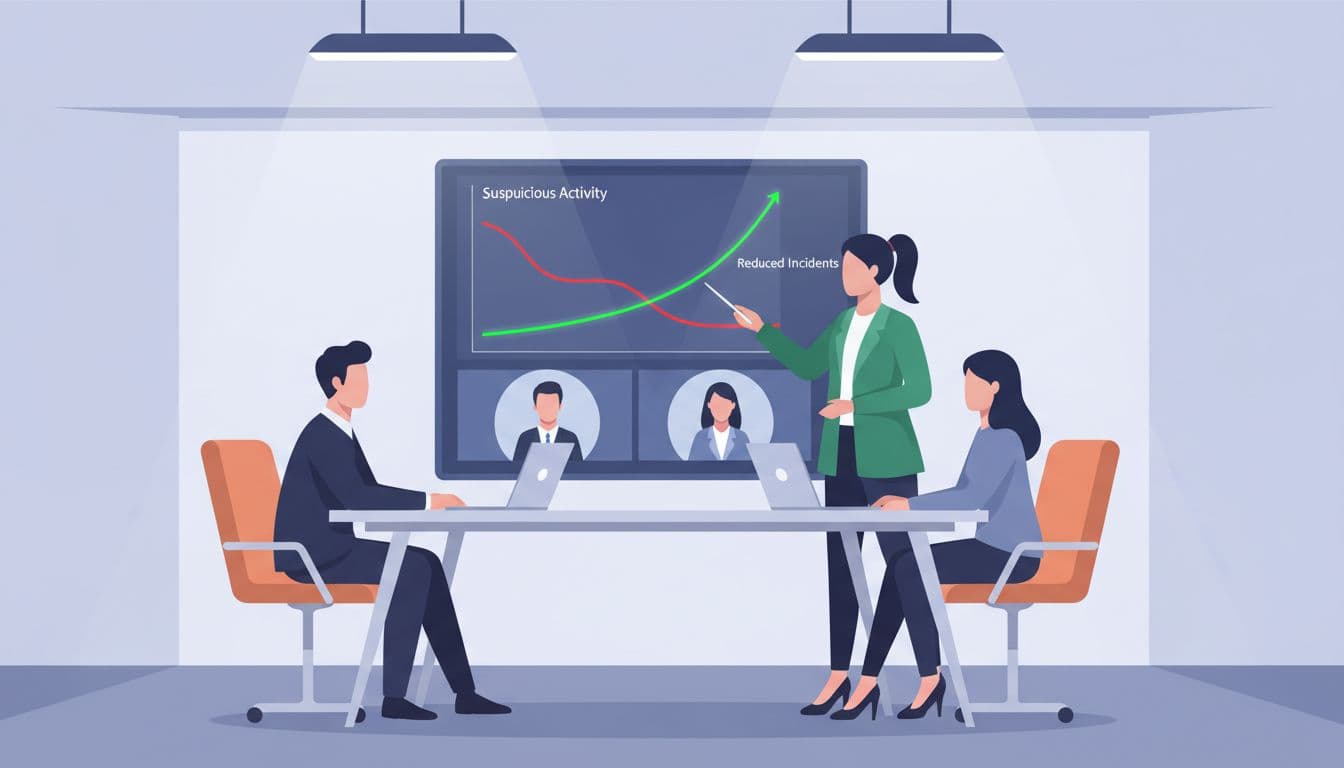
Reinforcement matters because habits fade without repetition. Good programs mix simulations, micro-lessons, manager reminders, and short campaign themes across the year. They also give extra support to repeat offenders instead of blasting the whole company with the same message.
Measure outcomes that show whether the culture is changing:
- Report rate: More employees flag suspicious messages.
- Time-to-report: Reports arrive in minutes, not hours.
- Repeat failures: Fewer people make the same mistake twice.
- Team risk trends: High-risk groups improve after targeted coaching.
If people report faster and fail less often, training is working.
Security awareness training should feel less like school and more like strength training. Small reps, repeated often, build better instincts under pressure.
If your current program mainly tracks completions, start with one question: what behavior changed last quarter? If the answer is fuzzy, redesign the program around decisions, feedback, and reinforcement. That’s how awareness turns into safer action.