table of contents
The riskiest team in your company often doesn’t look risky at first glance. More often, risk sits where pressure, change, access, and weak support overlap.
If you want to identify high-risk employee groups, start with work conditions, not personal traits. The goal is to prevent harm, reduce exposure, and support people early. That means using fair data, clear definitions, and group-level patterns you can act on.
Define the risk before you define the group
A “high-risk” group can mean five different things. A warehouse night shift may face safety risk. A new finance hire with broad system access may face compliance and cyber risk. A stretched engineering team may carry retention and wellbeing risk at the same time.
Before you segment the workforce, define the risk types you care about. That stops teams from lumping unlike issues into one vague label.
Here is a simple way to frame it:
| Risk type | What it looks like | Groups that may face more exposure |
|---|---|---|
| Operational risk | Errors, rework, outages, slow ramp-up | New hires, undertrained teams, temp staff |
| Safety risk | Injuries, near misses, fatigue | Frontline roles, lone workers, night shifts |
| Compliance risk | Missed training, expired certs, policy breaks | Contractors, regulated roles, privileged-access users |
| Retention risk | Early exits, burnout, vacancy strain | Hard-to-fill teams, new managers, overloaded specialists |
| Wellbeing risk | Stress, absence spikes, conflict | Teams in constant change, understaffed groups, care-heavy roles |
Compliance deserves extra care because small gaps can turn into costly problems. Common HR compliance risks often come from weak processes, not bad intent.
That same logic applies everywhere else. Use group labels based on role, task, access, schedule, tenure, and work setting. Don’t build risk groups around age, race, disability, pregnancy, or any other protected trait. Risk should describe exposure, not identity.
How to identify high-risk employee groups with data
Start simple. Group employees by the work they do and the conditions around that work. Good segments often include new hires in their first 90 days, shift-based staff, remote workers with privileged access, contractors with limited onboarding, executives, finance teams, and managers leading short-staffed groups.
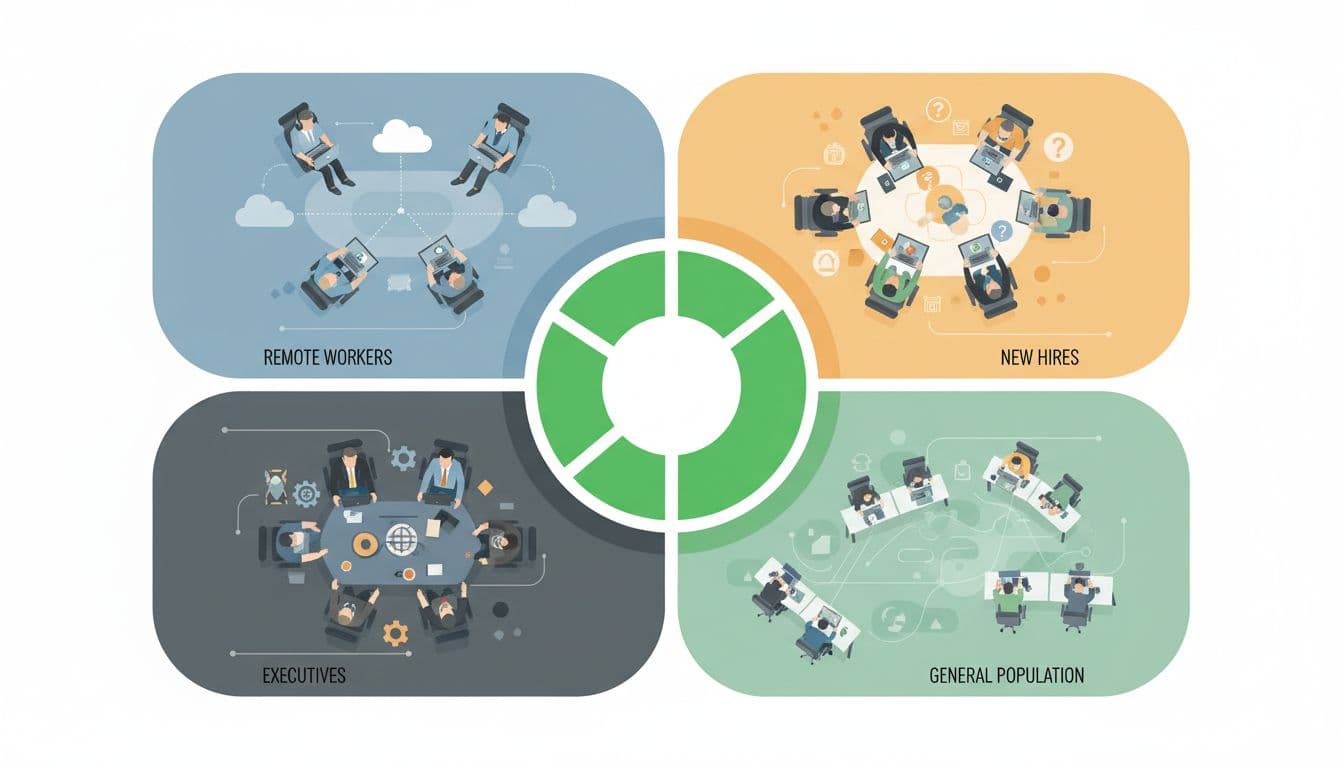
Risk reviews should flag work conditions, not label people as the problem.
Then use a short, repeatable process:
- Segment by exposure: Use role family, site, shift, tenure band, access level, manager span, and employment type.
- Mix leading and lagging signals: Lagging data includes incidents, exits, and policy breaches. Leading data includes overtime, schedule volatility, missed training, access exceptions, and workload spikes.
- Compare to the right baseline: Don’t compare field teams to office teams, or senior engineers to entry-level staff. Measure each group against its own expected range.
- Review outliers with humans: HR, operations, safety, compliance, and security should validate patterns before anyone acts on them.
For example, you might find that first-year field technicians on night shift have more near misses and missed certifications than daytime peers. Another company may see that executives and new finance hires get the most phishing attempts and access-related exceptions. In security-sensitive roles, human risk management in cybersecurity offers a helpful way to think about behavior, access, and attack exposure together.
Keep the first pass at group level. If a deeper review is needed, it should follow a lawful, documented process, not an informal hunt for “risky people.”
Track the right KPIs and act before risk grows
Once a group stands out, track a small set of KPIs each month. Too many metrics create noise. A short scorecard helps leaders see trend lines early.
For operational risk, watch error rate, rework volume, time-to-productivity, and unplanned overtime. For safety risk, track incident rate, near misses, fatigue reports, and lost-time days. For compliance risk, monitor overdue training, expired certifications, access violations, and policy exceptions. For retention risk, use 90-day turnover, regretted loss, open-role days, and internal mobility gaps. For wellbeing risk, look at absence spikes, employee relations cases, pulse survey strain scores, and schedule instability.
For safety teams, even formal HSE KPI reporting shows the value of trend tracking over one-off events. For privacy, keep employee data lean, time-bound, and well governed. Guidance on employee data privacy management is a useful reminder that HR data collection needs a clear purpose and tight access controls.
Most importantly, don’t jump from a risk flag to discipline. Start with support. That may mean stronger onboarding, better staffing, refreshed training, manager coaching, simpler procedures, or narrower access rights. If a group shows cyber exposure, pair coaching with safer defaults and stronger technical controls. If a group shows burnout risk, adjust workload before exits rise.
Document why you chose each KPI. Limit who can see the data. Test your method for bias. Tell employees what data you collect and why. Fairness isn’t a side note, it’s what makes the whole process hold up.
Your highest-risk groups are usually not hidden. They’re the teams where work demands and weak controls meet.
When you define risk clearly, compare like with like, and respond with support, you get something far more useful than a label. You get an early warning system.
Pick one population this month, maybe new hires, shift workers, or privileged-access teams, and build a simple scorecard. That’s how high-risk employee groups become a prevention plan instead of a problem list.