table of contents
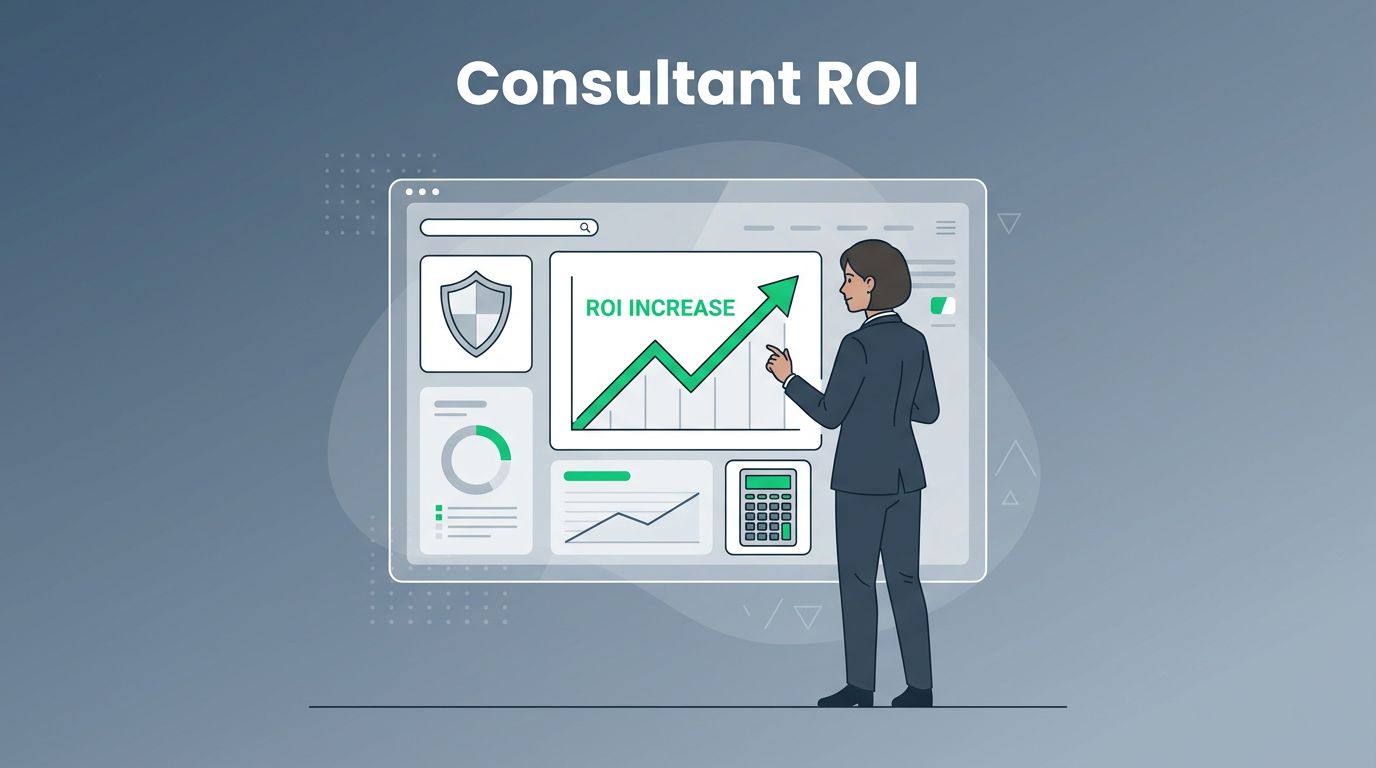
You hire a cybersecurity consultant to stop breaches before they hit your bottom line. But boards demand proof. In 2026, with average US data breach costs at $10.22 million, executives want clear numbers on returns.
Most CISOs struggle here. They track tools, not consultant impact. This leaves budgets vulnerable. You need a simple way to show cybersecurity consultant ROI through hard metrics and real savings.
Let’s break it down step by step. Start with the numbers that matter most.
Track Quantitative Metrics That Drive Savings
Focus on changes before and after the consultant arrives. These show direct financial wins.
Count fewer incidents first. Suppose your team faced 20 alerts monthly pre-consultant. Post-engagement, that drops to 10. Each avoided incident saves fix costs around $100,000, based on industry averages.
Downtime shrinks too. Breaches cause hours of lost productivity. Cut mean time to resolve from 48 to 24 hours, and you save worker wages plus revenue.
Compliance speeds up. Consultants guide audits. Reach readiness in months, not years. This avoids fines up to millions.
Insurance premiums fall with better posture. Stronger defenses mean lower rates, often 20% off.
Here’s a quick KPI table to monitor:
| Metric | Baseline Example | Post-Consultant | Annual Savings Estimate |
|---|---|---|---|
| Incidents per quarter | 15 | 7 | $1.2 million |
| Downtime hours per incident | 40 | 20 | $500,000 |
| MTTD (days) | 14 | 7 | $800,000 |
| Compliance audit time (months) | 12 | 6 | $300,000 |
These tie consultant work to dollars. Track quarterly. For more on metrics, check Praetorian’s cybersecurity ROI framework.

Capture Qualitative Returns for Full Picture
Numbers alone miss the story. Qualitative gains build long-term value.
Consultants cut internal labor. Your team spends less time firefighting. Free them for core work. This boosts efficiency without new hires.
Executive reporting improves. Clear dashboards show risk trends. Boards trust decisions more. That supports bigger budgets next year.
Incident likelihood drops. Better processes mean fewer close calls. Think avoided ransomware, which averages $4.54 million globally.
Culture strengthens too. Training reduces human errors, behind 60% of breaches. Employees spot phishing faster.
Quantify where possible. Survey staff on confidence levels pre- and post-. A 30% uplift signals real change. Pair this with quant data for board talks. See Safe Security’s 2026 framework for executive tips.
These intangibles compound over time. Ignore them, and ROI looks weak.
Calculate ROI with Simple Formulas
Grab a spreadsheet. Plug in real numbers. Keep it straightforward.
Basic formula: ROI = (Net Benefits – Costs) / Costs x 100.
Costs include consultant fees, say $500,000 yearly. Benefits: $2 million in avoided breaches and savings.
Net benefits: $2M – $500K = $1.5M. ROI: ($1.5M / $500K) x 100 = 300%.
Payback period adds clarity. Divide costs by annual benefits: $500K / $1.5M = 4 months.
Adjust for avoided costs. Use your breach baseline times reduction probability. If consultants cut risk 40%, multiply by $10.22M US average.

Test scenarios. Low case: 100% ROI. High: 500%. This proves value. For breach cost details, review DataFeature’s 2026 benchmarks.
Establish Baselines and Time Horizons
No baseline, no proof. Log metrics six months pre-consultant. Incidents, downtime, risks.
Compare post-engagement. Annual reviews work best. Short projects show quick wins in 3-6 months. Culture shifts take 12-18.
Factor trends. 2026 sees AI threats rise, so weigh new defenses heavy.
Use tools like risk calculators. They estimate avoided losses accurately.
Baselines ground your story. Boards see progress clearly.
Avoid Common Pitfalls in ROI Measurement
Many skip baselines. They claim wins without proof. Always compare apples to apples.
Don’t measure tools only. Credit consultant strategy, not just software.
Overlook qualitatives. Pure dollars undervalue labor savings or compliance speed.
Rush timelines. Give changes 12 months to mature.
Ignore externalities. Lower insurance or fines add up.

Spot these early. Your calculations stay credible. BriskInfosec outlines resilience metrics to dodge traps here.
Solid measurement turns consultants from expense to asset. Track quant and qual, use baselines, calculate often. You’ll justify budgets easily.
Ready to apply this? Book a Discovery Call with Bud Consulting for tailored advice. What’s your biggest ROI challenge right now?