table of contents
Industrial plants face more cyber threats than ever in 2026. Ransomware hit manufacturing hardest last year, and state-sponsored hackers now target control systems directly. You need an OT security engineer who gets the stakes: downtime costs millions, and safety hangs in the balance.
Traditional IT pros often miss the mark here. OT protects physical processes in factories, power grids, and refineries. Hire wrong, and you invite disaster. This guide walks you through spotting the right talent.
Grasp OT Versus IT Security First
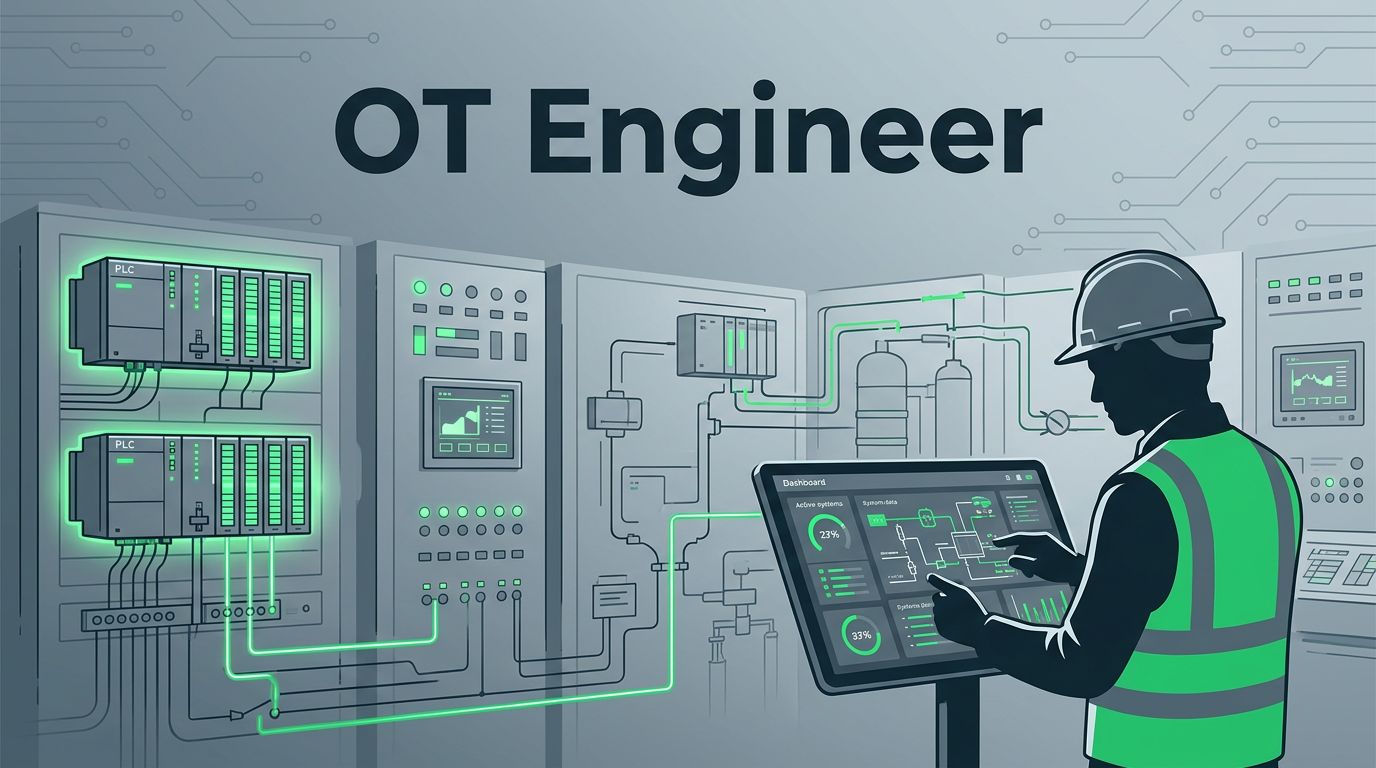
OT means operational technology. It runs machines and sensors in real-time. ICS covers industrial control systems like PLCs that automate pumps or valves. SCADA pulls data from remote sites for oversight.
IT security focuses on data leaks and user access. OT prioritizes uptime and safety. A firewall blocks emails in IT. In OT, it might halt a conveyor belt. Protocols differ too. IT uses TCP/IP everywhere. OT relies on Modbus for simple device talks, DNP3 for utilities, or OPC for factory data sharing.
Familiarity with vendors matters. Siemens S7 PLCs dominate Europe. Rockwell in the U.S. Schneider and Honeywell handle HVAC and processes. An OT engineer knows these inside out. They follow IEC 62443 for layered defenses or NIST CSF adapted for plants. Check this IEC 62443 guide for basics.
Threats evolve fast. Dragos reports show groups like AZURITE mapping your control loops in 2026. Without OT know-how, IT teams blindside operations.
Key Skills and Experience to Prioritize
Look for hands-on OT time, at least five years. They should map assets without disrupting production. Visibility tools reveal hidden PLCs on flat networks.
Strong candidates master network segmentation. Purdue Model zones IT from OT levels. They block lateral moves from a hacked HMI.
Incident response fits industrial needs. No full shutdowns. They isolate a compromised RTU while keeping power flowing. Remote access gets zero trust: MFA plus protocol gateways, not VPNs everywhere.
Vulnerability management adapts. Legacy gear can’t patch easily. They prioritize exploits on exposed DNP3 ports.
Frameworks guide them. IEC 62443 sets security levels for components. NIST CSF helps risk assessments. Salaries run $110,000 to $160,000 now, per postings, due to shortages.

Experience with Siemens, Rockwell, or Honeywell seals it. They tune Nozomi or Claroty sensors for OT noise.
Craft a Targeted Job Description
Generic posts attract IT folks. Tailor yours to filter pros. Highlight industrial realities: 24/7 uptime, air-gapped legacies, convergence risks.
Start with duties. List protocols: secure Modbus traffic, harden OPC UA servers. Mention threats like 2026 ransomware surges.
Require certs sparingly. GICSP or ICS410 beat CISSP alone.
Here’s a sample outline:
| Section | Key Content |
|---|---|
| Summary | Protect ICS/SCADA in manufacturing plant. Focus on asset visibility, segmentation, IEC 62443 compliance. |
| Responsibilities | Map OT assets; segment networks; manage remote access; respond to incidents without downtime. |
| Requirements | 5+ years OT; Modbus/DNP3/OPC; Siemens/Rockwell experience; NIST CSF knowledge. $120K-$150K base. |
| Preferred | GICSP cert; Dragos or Radiflow tools. |
Post on niche boards. Radiflow’s staffing steps offer more tips.

This draws qualified applicants fast.
Create a Candidate Scorecard
Score resumes on must-haves. Use a simple checklist. Award points: 0-5 per category.
| Criterion | Strong Indicators (4-5 Points) |
|---|---|
| OT Experience | 5+ years in ICS/SCADA; named vendors like Honeywell. |
| Protocols | Hands-on Modbus, DNP3, OPC; examples of securing them. |
| Frameworks | IEC 62443 projects; NIST CSF implementations. |
| Key Practices | Segmentation playbooks; OT incident stories. |
| Soft Skills | Plant floor collaboration; clear risk comms. |
Total over 20? Advance them. This cuts bias and speeds decisions.
Ask These Top Interview Questions
Probe deep. Good answers show OT nuance, not theory.
- Walk us through securing Modbus on a legacy PLC. Strong: Mentions read-only modes, VLANs, no patches.
- How do you segment OT networks? Strong: Purdue levels, micro-segmentation examples.
- Describe an OT incident you handled. Strong: Contained without halting production.
- What’s your approach to remote vendor access? Strong: Bastion hosts, protocol translation.
- Explain IEC 62443 security levels. Strong: SL 1-4 tied to zones.
- How do you gain OT asset visibility? Strong: Passive scanners like Claroty.
- Handle a DNP3 exploit? Strong: Firmware checks, IDS rules.
- Vulnerability management in OT? Strong: Risk-based, virtual patching.
- OPC UA versus classic OPC? Strong: Security features in UA.
- Rockwell versus Siemens PLC hardening? Strong: Vendor-specific tools.
- NIST CSF for OT? Strong: Identify-Protect mappings.
- Ransomware in 2026 OT? Strong: Dragos insights, backups off-net.
- AI threats to ICS? Strong: Adaptive malware defenses.

Follow up: “Why that choice?” Listen for plant-savvy replies.
Navigate 2026 Hiring Realities
Demand spikes with threats. Sixty percent of firms faced OT incidents last year. Utilities and energy pay top dollar for multi-site pros.
Shortages hit 30 percent of teams. Post clearly, screen with scorecards.
Right hire bolsters defenses now.
Pick strong now. Your plant depends on it. Book a Discovery Call with Bud Consulting to source vetted talent fast. What’s your next step?