table of contents
Zero Trust has moved from a boardroom idea to an operating model. By 2026, most large enterprises have already started, or are actively planning, some version of it.
That shift has made zero trust consulting a crowded market. The hard part now isn’t finding a firm that says it can help, it’s finding one that can connect identity, devices, networks, cloud access, and policy into something your team can run every day.
The best firms do more than draw target-state diagrams. They help you reduce risk without breaking business flow. That difference matters when you’re comparing partners.
What Zero Trust Consulting Should Solve
Zero Trust is easier to say than to run. In business terms, it means nobody gets trusted by default, even if they sit inside your network or use a company laptop. Every access request should be checked against identity, device health, location, risk, and policy.
That sounds simple, but most environments are messy. You may have legacy VPNs, cloud apps, unmanaged devices, overbroad admin rights, and weak visibility across business units. A good consultant helps you fix the mess in the right order.
The first job is usually to map where trust still leaks into the environment. That can include shared accounts, flat networks, weak MFA coverage, stale service permissions, and cloud roles that grew too fast. The consultant should turn that into a clear roadmap, not a pile of findings.
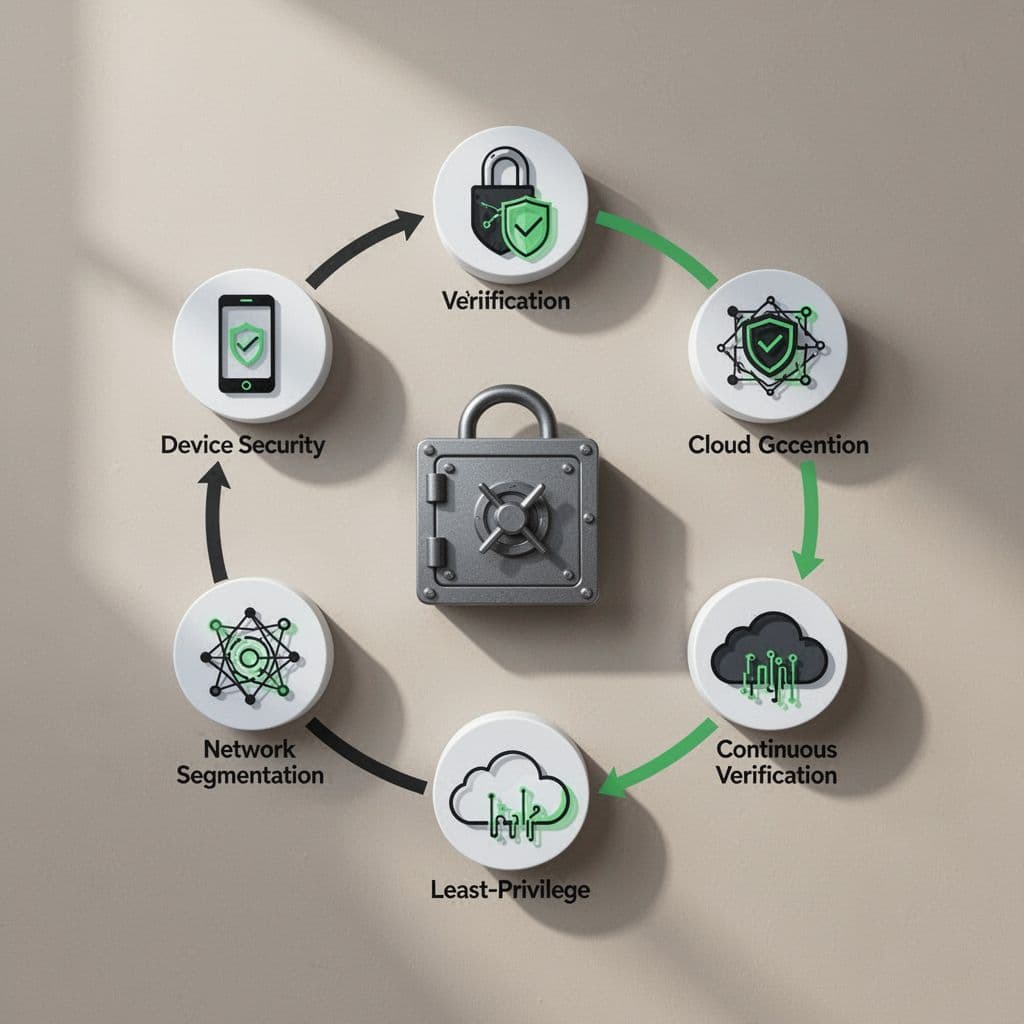
Zero Trust fails when it stays a slide deck. It works when access decisions change in the live environment.
That means the work should touch identity and access management, device posture, network segmentation, cloud access, least privilege, continuous verification, and policy enforcement. If a firm cannot connect those pieces, the program will stall.
What a Strong Consulting Firm Delivers
A serious partner should begin with discovery, but not stop there. Discovery should lead to a target-state architecture, a phased roadmap, and a workable operating model.
Look for deliverables that are useful after the workshop ends. These often include access control mappings, a control gap assessment, a pilot plan, an identity roadmap, and clear success metrics. If you manage regulated data, you also need evidence mapping for auditors and compliance teams.
Public service pages from larger firms, such as Deloitte’s Zero Trust services, show how broad consultancies package this work. More specialist shops, like EDAM Security’s zero trust consulting, tend to focus on hands-on design and implementation. Both models can work, but they serve different needs.
The right firm should also know how to work with what you already have. That includes your IAM stack, endpoint tools, SSO, PAM, SIEM, cloud platforms, and network gear. If the consultant keeps pushing a full rip-and-replace plan, pause and ask why.
A good test is simple. Can the team explain how a user moves from unmanaged access to conditional access, then to policy-based access, without breaking core workflows? If not, the plan may be too abstract.
A Practical Framework for Comparing Firms
A shortlist gets much easier when you compare firms on the same points. A broad 2026 security consulting company roundup can help you see the crowded field, but your own checklist should decide the hire.
Use this table as a simple filter.
| Evaluation area | Strong signal | Weak signal |
|---|---|---|
| Identity and access | Deep IAM and PAM experience, clear MFA and role design | Generic “access control” language |
| Device security | Can use posture checks, EDR, and endpoint policy together | Treats devices as an afterthought |
| Segmentation | Can reduce lateral movement without disrupting apps | Only talks about network diagrams |
| Cloud and SaaS | Knows how to handle roles, tokens, and app access | Focuses only on on-prem tools |
| Compliance and proof | Maps controls to audits and reporting | Leaves compliance for later |
| Delivery model | Gives phased milestones and owners | Presents a big-bang transformation |
The main takeaway is simple. Strong firms talk in terms of controls, dependencies, and rollout order. Weak firms talk in slogans.
When you speak with candidates, ask how they handle legacy apps, remote users, third parties, and admin access. Those are the places where Zero Trust usually breaks first.
Matching the Firm to Your Environment
Not every organization needs the same type of partner. Large enterprises often need a consulting team that can work across regions, business units, and several clouds at once. They also need help with governance, evidence, and executive reporting.
Mid-market teams usually need more hands-on support. They may have one security architect, a small infrastructure team, and a few urgent gaps in IAM or device management. In that case, a firm that can design and implement, not just advise, will save time.
Industry matters too. Finance, healthcare, public sector, and critical infrastructure often need stronger audit support and tighter change control. If your environment has sensitive data or regulated workflows, ask for past work in similar settings.
You should also check how the consulting team fits with internal talent. Many Zero Trust programs fail because the company lacks the right skills in architecture, identity, or cloud security. If that’s your situation, consider a partner that can advise on staffing as well as strategy. You can Book a Discovery Call with Bud Consulting if you need help closing those gaps.

Zero Trust works best when it fits the business, not when it replaces the business. The right consulting firm will show you how to tighten access, reduce trust, and keep work moving.
In a market full of broad promises, the real advantage is practical execution. That’s what separates a useful Zero Trust partner from a polished presentation.