table of contents
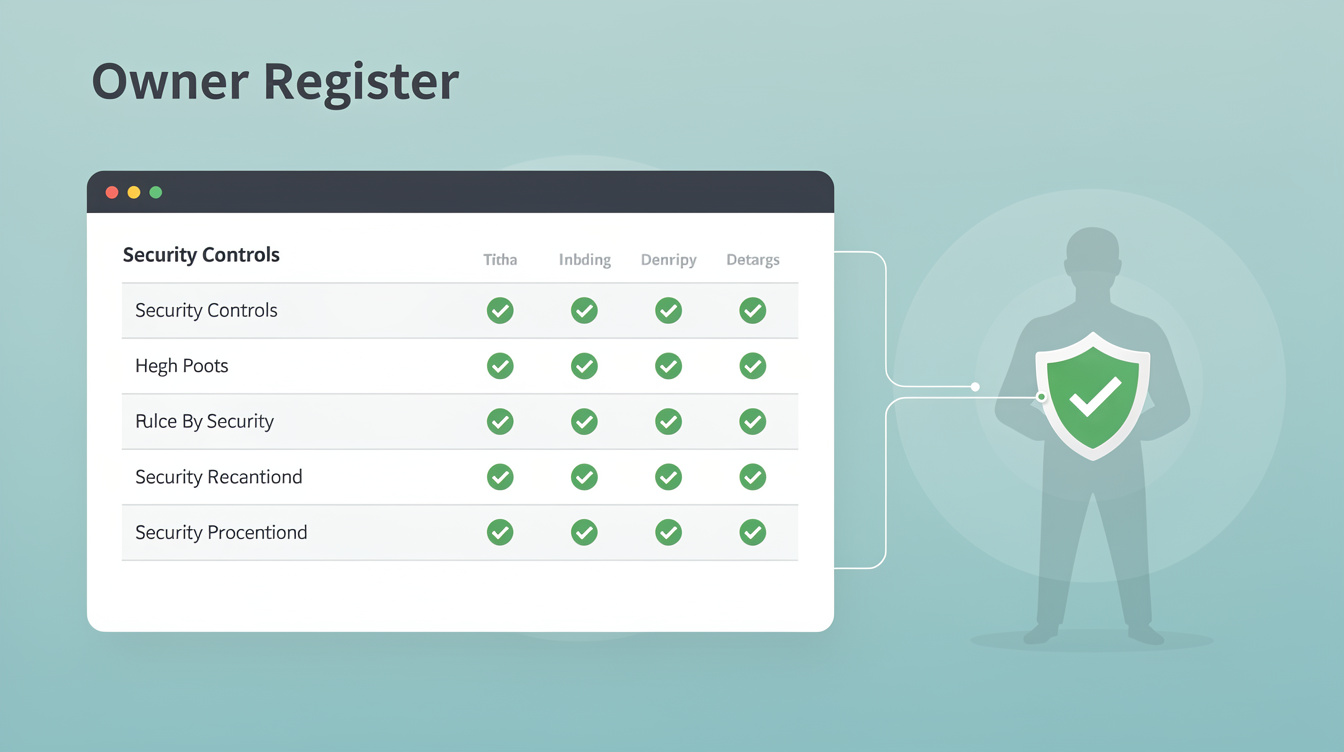
A control with no owner is a blind spot. When auditors ask who manages a security control, vague answers slow everything down. A security control owner register fixes that by tying each control to a named person, a clear duty, and a review path.
It also helps compliance managers, IT leaders, and risk owners stay aligned. If you’re mapping ownership for ISO 27001, this overview of ISO 27001 control accountability is a useful reference. The next step is simple, but it has to be done with care.
Why a register matters before the audit starts
A register does three jobs. It makes ownership visible, it reduces handoff gaps, and it gives you a clean audit trail. Without it, teams rely on tribal knowledge, which breaks as soon as someone leaves or a tool changes.
That gap shows up fast. A control might exist in policy, yet nobody can name the person who checks it each month. Another control might be executed well, but the evidence lives in inboxes and shared drives. A register pulls those pieces into one place.
It also helps you spot weak points early. If one person owns too many controls, or if no one owns evidence, the gap becomes obvious. That matters in SOC 2 and NIST programs, but it also matters in internal governance.
Define the roles before you assign names

The biggest mistake is treating every control role as the same job. They aren’t. A clear split keeps the register useful when work changes hands.
| Role | What they own | Common mistake |
|---|---|---|
| Control owner | Accountable for the control design, performance, and fixes | Assuming they also collect all evidence |
| Control operator | Runs the control day to day | Treating them as accountable for every failure |
| Evidence owner | Collects, stores, and refreshes proof | Leaving evidence in inboxes or chats |
| Approver | Reviews results and signs off | Approving work they also performed |
One person can hold more than one role in a small team. Still, record each duty separately. That makes handoffs easier during audits, vacations, and reorganizations.
Choose fields that hold up in an audit
A strong register answers six questions: what is the control, who owns it, who runs it, what proof exists, how often is it checked, and where is the evidence stored? If a field cannot help someone act or audit, it probably does not belong.

| Field | What to capture | Example |
|---|---|---|
| Control ID | Unique reference tied to policy or framework | AC-07 |
| Control name | Short, plain-language title | Privileged access review |
| Framework mapping | ISO 27001, SOC 2, NIST, or internal reference | ISO 27001 access control |
| Control owner | Person accountable for the control | Priya Shah, IAM Manager |
| Control operator | Team or role performing the task | Service Desk |
| Evidence owner | Person who stores and refreshes proof | Compliance Analyst |
| Approver | Person who reviews and signs off | IT Director |
| Frequency | How often the control runs or is reviewed | Monthly |
| Evidence location | Where proof lives | SharePoint, Controls, AC-07 |
| Status and exceptions | Live, overdue, or exception with expiry | Live, exception ends 30 Jun 2026 |
If a field cannot help someone act or audit, it usually belongs somewhere else.
Keep the register tight. A long form gets ignored. A short one gets updated.
Set governance and review cadence
Ownership only works when someone checks the register on a schedule. A control owner RACI for audit readiness helps separate accountability, execution, and approval. That keeps teams from assuming another group will update the record.

A simple review rhythm works well:
- Monthly for high-risk controls or fast-changing systems.
- Quarterly for stable controls.
- Immediate review after a cloud migration, team change, vendor swap, or framework update.
- Same-week review when a control fails or an exception is approved.
Also define who approves changes. In most cases, the control owner proposes the update, the operator confirms the process, the evidence owner confirms the proof, and the approver signs off. That keeps the record honest.
For evidence-heavy programs, a SOC 2 evidence review cadence is a useful model. It helps prevent the last-minute scramble that too many audit teams know well.
Keep the register current as the business changes
The register loses value when it lags behind real work. Update it when systems move, teams change, or frameworks expand. That’s where many programs drift.
Use clear change triggers:
- A control moves from manual to automated.
- A process shifts to a new team or vendor.
- You add or retire a framework mapping.
- A control fails, gets remediated, or gets an exception.
Version the register too. Keep the last review date, the next review date, and a note for any exception with an end date. That gives internal auditors a clear line of sight.
If ownership gaps come from hard-to-fill senior roles, Book a Discovery Call with Bud Consulting to close those gaps before the register goes stale.
A good register does not sit on a shelf. It helps people make decisions, prove work, and respond fast when something changes. When the next audit starts, the answers are already there.