table of contents
Security teams do not lose ground because they skip one test. They lose ground when validation happens on no schedule at all.
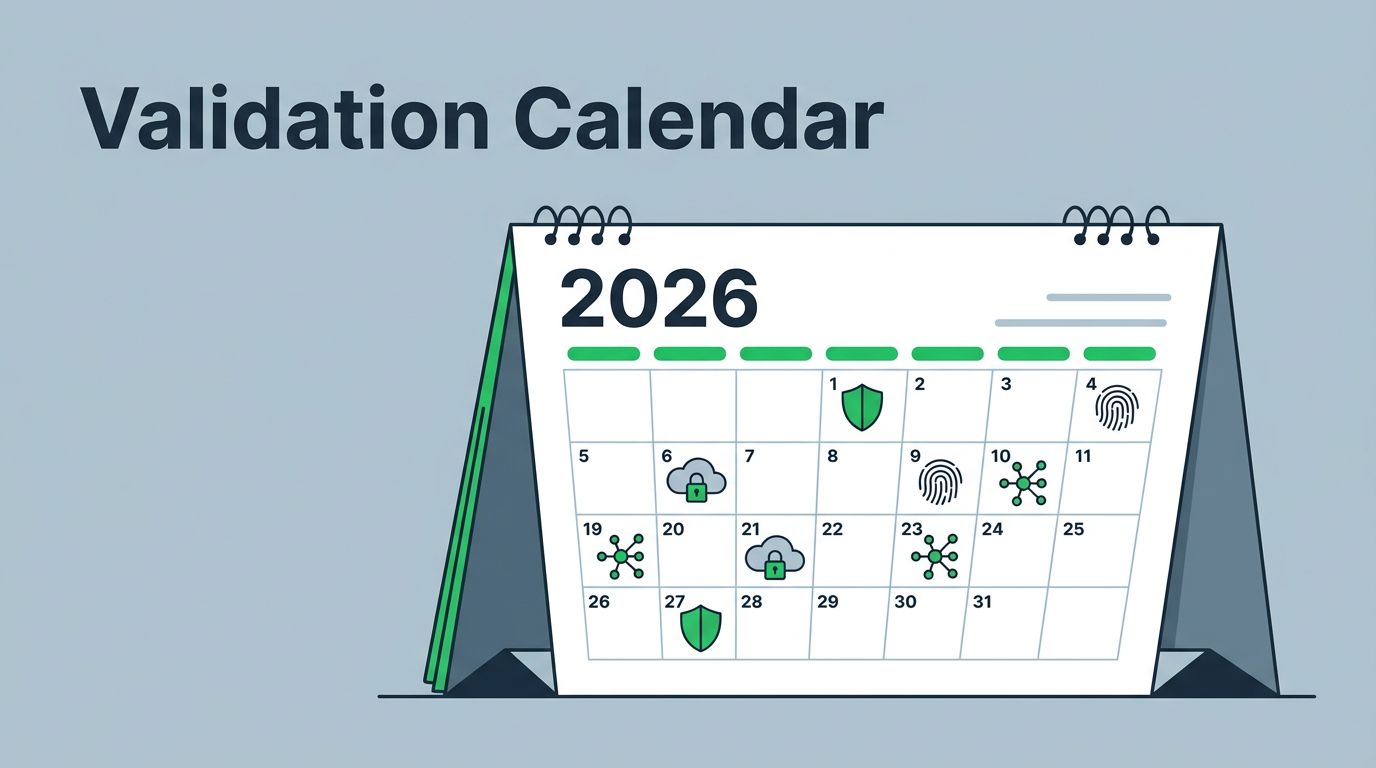
A security validation calendar gives your team a repeatable plan for the year. It helps you test what matters, show evidence, and avoid random fire drills when audit season hits.
In 2026, that matters more than ever. Identity attacks, cloud attack paths, deepfakes, and third-party risk move fast, so your testing plan has to keep up.
Why 2026 needs more than an annual audit
Annual reviews miss too much. By the time a point-in-time test ends, cloud settings have changed, new vendors have connected, and access has shifted.
That is why security validation should focus on live attack paths. A helpful baseline is security control validation, which checks whether controls work in real conditions, not just on paper. For 2026 planning, the threat mix also matters, and these 2026 security priorities line up with what many teams are seeing now.
The biggest change is scope. Your calendar now needs to cover:
- identity paths that can reach admin access
- cloud services that sit outside old perimeter controls
- hybrid networks that connect office, remote, and SaaS systems
- vendors and contractors with real system access
- detection and response steps that prove alerts turn into action

The goal is simple. Test the paths attackers are most likely to use, then test them again after major change.
Start with risk paths, not control lists
Many teams begin with a list of tools. That usually leads to busy work. A stronger start is to map business services, likely attack paths, and the controls that protect them.
Pick the systems that would hurt most if they failed. Then ask three questions. How would an attacker reach them? Which controls should stop that move? Who owns the proof when the control works or fails?
Identity should sit near the top of the list. In 2026, attackers often skip malware and go straight after login access. That means your calendar should include privileged access reviews, phishing-resistant MFA checks, and tests for session hijack or token abuse.
Cloud validation should also be specific. Check exposed storage, risky service accounts, overly broad roles, and paths between cloud and on-prem systems. A hybrid environment only feels separate. Attackers treat it as one route.
If a control changes often, validate it often. If it protects crown-jewel data, test it before the next audit asks for proof.
Build a quarterly security validation rhythm
A year-long calendar works best when it has a clear rhythm. Quarterly planning keeps the load manageable and gives each team a fair share of work. It also creates room for continuous validation between bigger tests.
Use this sample structure as a starting point.
| Quarter | Main focus | Sample validation work | Primary owner |
|---|---|---|---|
| Q1 | Identity and access | MFA testing, privileged access review, cloud role checks | IAM and security ops |
| Q2 | Cloud and hybrid paths | Exposed service scans, segmentation checks, backup restore test | Cloud security and IT |
| Q3 | Third-party and SaaS risk | Vendor reviews, integration checks, access recertification | GRC and procurement |
| Q4 | Resilience and proof | Tabletop exercise, ransomware restore, year-end evidence pack | Security leadership and compliance |
This kind of plan keeps the year balanced. It also stops one area, such as vulnerability scanning, from crowding out higher-value validation.
For threat simulation work, Palo Alto Networks’ purple team exercises are a good reference point. Purple team sessions fit well in Q2 or Q4 because they connect attack simulation with detection tuning.

A quarterly rhythm like this also helps with planning around business cycles. Avoid major tests during peak sales periods, product launches, or change freezes unless the risk is high enough to justify the disruption.
Assign ownership before the calendar starts
A calendar fails fast when ownership is vague. Security can design the tests, but IT, compliance, and leadership need clear roles.
Security teams should own scope, tooling, retest plans, and findings. IT should own access changes, patch windows, and recovery steps. Compliance should map each test to evidence needs and audit dates. Leadership should approve risk tradeoffs when validation conflicts with business timing.
This is also where third-party risk belongs. Vendor access, SaaS integrations, and outsourced support can create hidden attack paths. For broader context, third-party risk compliance is a useful reference when you build vendor checks into the year.
The best calendar works like a shared operating plan. Everyone knows when a test happens, what proof is needed, and who signs off if a control needs more work.
Keep the calendar alive all year
A calendar should not sit still after January. Update it when major cloud changes land, when a new vendor gets access, or when a security incident exposes a weak spot. Those events should trigger a calendar review, not a long debate.
Use continuous validation for the controls that move the fastest. Identity rules, internet-facing assets, and vendor connections need more frequent checks than a static policy document. Bigger items, like disaster recovery or board reporting, can stay quarterly or semiannual.
That balance matters because teams have limits. If your group is small, protect the highest-risk tests first and cut lower-value work before you cut coverage on identity or external exposure. If you need extra help filling skill gaps in cloud, IAM, or offensive testing, Book a Discovery Call with Bud Consulting.
A strong security validation calendar turns scattered testing into a repeatable system. It keeps the year tied to real attack paths, real owners, and real evidence. When 2026 moves faster than expected, that structure is what keeps security work useful instead of reactive.