table of contents
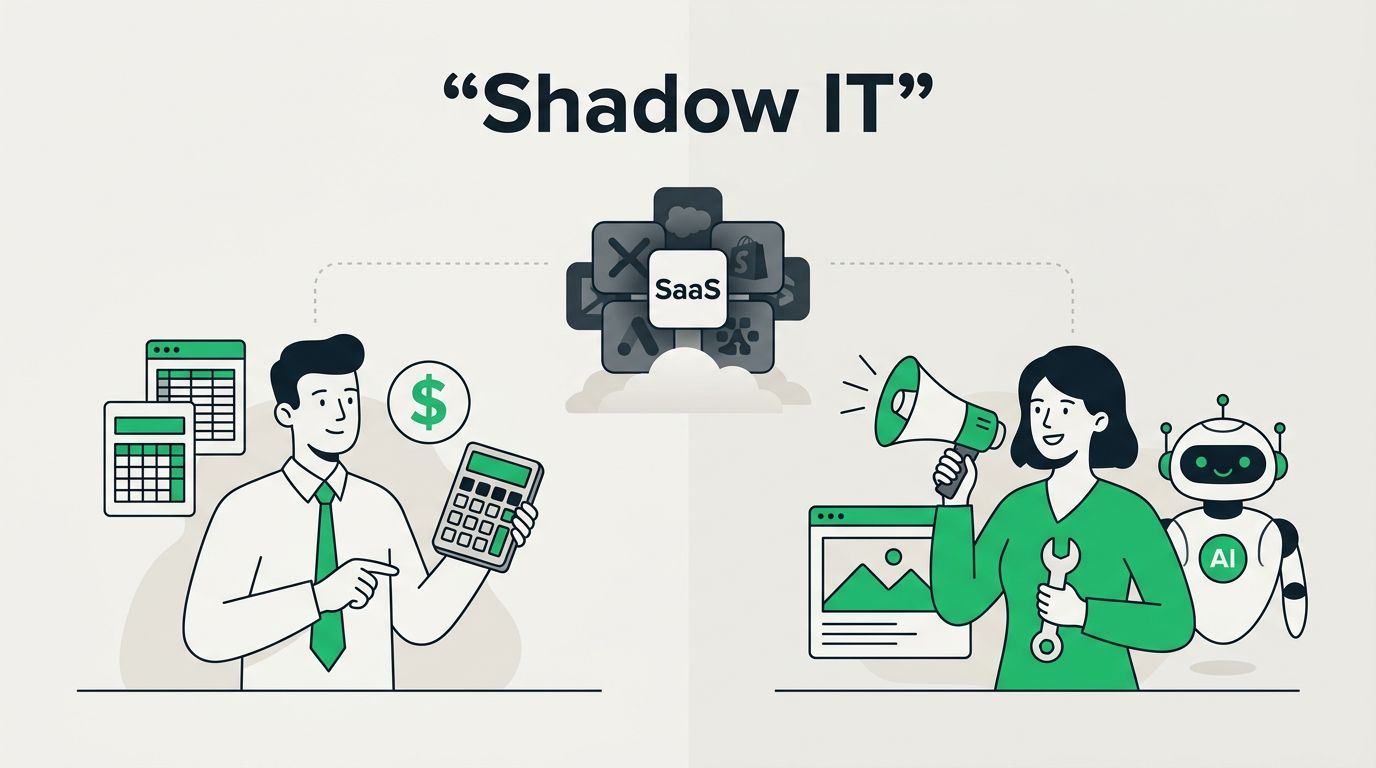
Shadow IT in finance and marketing usually starts with speed, not bad intent. A finance lead needs a faster invoicing flow. A marketer wants an AI copilot that can draft copy before the campaign call ends.
That pressure creates a hidden stack of tools. Some are harmless at first. Others move data, money, or customer records outside the controls you rely on.
Why finance and marketing teams build hidden tool stacks
Finance and marketing work under constant deadlines. Finance has close cycles, payment issues, approvals, and reporting gaps. Marketing has campaign launches, content deadlines, agency handoffs, and channel reporting.
When approved tools feel slow, people fill the gap. They open an unsanctioned SaaS app, copy data into a spreadsheet workflow, or move files through a personal sharing tool. They may also use AI copilots, campaign platforms, analytics tools, or payment and invoicing apps that never passed review.
That behavior is usually practical. It also becomes risky fast. A shared spreadsheet can hide a formula error. A file-sharing tool can expose customer data. A new AI app can store prompts and outputs with a third party. A data export between systems can break traceability.
The pattern is common because the work is specialized. Teams need tools that fit a narrow job. Procurement often moves too slowly. IT may not see the need until the tool is already part of the workflow.

Signals that expose shadow IT
The best way to catch shadow IT in finance and marketing is to use more than one signal. One log source rarely tells the full story. Spend data, identity data, and network data each reveal a different slice.
A practical discovery pass looks like this:
| Signal source | What it can reveal | Common clue |
|---|---|---|
| Expense data | Repeated SaaS charges and card spend | Small monthly charges to unfamiliar vendors |
| SSO logs | Apps that appear outside the approved catalog | Logins to tools IT never reviewed |
| Browser telemetry | Web-only tools and AI copilots | Frequent use of unknown domains |
| DNS and network monitoring | Data sent to unsanctioned services | Uploads to file sharing or AI sites |
| Endpoint inventory | Installed apps and extensions | Sync tools, desktop utilities, or browser add-ons |
| Procurement reviews and employee surveys | Gaps between buying and usage | Teams paying off-cycle or working around blockers |
Use these sources together, then compare the results. That is where the hidden stack shows up. A marketing analyst may buy a tool with a card, sign in through SSO, and move data through a browser export. A finance manager may use a spreadsheet add-in that never hits the procurement queue.
For a broader discovery sequence, the BetterCloud shadow IT detection guide gives a useful model, and Torii’s 2026 detection approach shows how app catalogs and telemetry work together.

Shadow IT becomes visible when you connect spending, identity, and device data, then ask teams what they use to get work done.
Why 2026 makes the risk sharper
In 2026, the biggest shift is shadow AI. Teams now use AI copilots to draft emails, summarize reports, analyze spreadsheets, and reshape campaign content. That can help, but it also creates new questions about third-party data handling.
If a public AI tool sees payroll data, forecast numbers, or customer lists, the risk is no longer limited to convenience. You also need to think about privacy regulations, vendor contracts, retention rules, and who can access the data later. Marketing teams face the same issue when they feed customer segments, ad copy, or campaign performance data into unvetted tools.
Vendor sprawl makes the problem worse. Every new app, plug-in, or AI assistant adds another contract, another login, and another place where data can travel. The more vendors you have, the harder it is to track risk.
For a clear view of those AI-specific risks, BetterCloud’s shadow AI overview is worth a look. Finance teams can also compare their spreadsheet and end-user computing controls with Finantrix’s EUC governance guide.
If a tool touches personal, financial, or campaign data, it needs a review path, even when the team says it saves time.
A framework your team can use this quarter
The goal is control, not punishment. IT, security, procurement, finance, and marketing need a shared process. When those groups work separately, the hidden stack keeps growing.

Use this framework to start:
- Build one list of every paid tool tied to finance and marketing, including cards, reimbursements, and shared subscriptions.
- Match that list against SSO logs, endpoint inventory, DNS data, and browser telemetry.
- Ask department leads which tools they use when approved options feel too slow or too limited.
- Classify each tool as approved, approved with guardrails, or off-limits.
- Review the list every month so new apps do not sit unnoticed for quarters.
If you need a structured way to run that review across teams, Book a Discovery Call with Bud Consulting and map the current risk surface before it grows.
Shadow IT in finance and marketing rarely begins with carelessness. It begins with a business problem that someone tried to solve quickly. The best response is to make hidden work visible, then give teams a safer path.
When you combine expense data, SSO logs, device signals, and honest team input, the picture gets clear fast. That is how you catch shadow IT before it turns into the default way people work.