table of contents
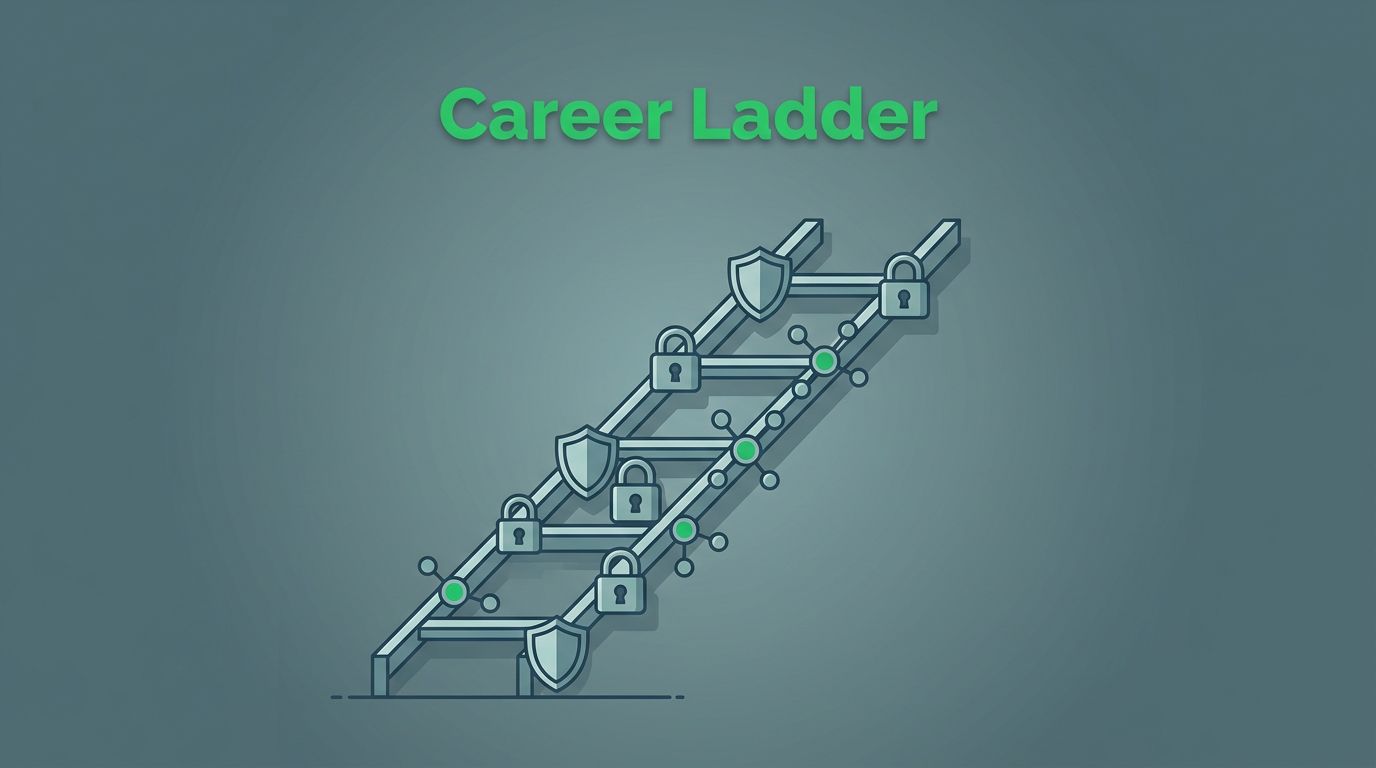
Growing security teams need more than open roles and a promotion calendar. They need security career ladders that show what good looks like at each level.
When levels are fuzzy, managers promote on instinct and pay talks get messy. When the ladder is clear, people know where to focus, and leaders can hire with less guesswork.
A strong ladder also gives room for different paths, because not every strong analyst wants to become a manager. The best ones make growth visible without forcing everyone into the same mold.
Start with the work, not the title
A good ladder describes the work a person owns, the decisions they can make, and the risk they can carry. Start there, before you write titles.
For most growing teams, four to six levels is enough. You can add depth later, but a ladder that starts too wide creates confusion fast. If you want a broad map of common paths, this cybersecurity career map shows how roles split across operations, engineering, architecture, and leadership.

A simple level structure might look like this:
| Level | Scope | Sample level wording |
|---|---|---|
| Junior | Works from runbooks and asks for help on edge cases | “Can triage standard alerts and document findings clearly.” |
| Mid | Owns small projects and makes routine decisions | “Independently delivers control improvements with light review.” |
| Senior | Solves ambiguous problems across teams | “Leads security changes that affect product or infrastructure.” |
| Lead or Manager | Sets direction for a slice of the program | “Turns risk priorities into a roadmap and coaches others.” |
That kind of language helps people see the difference between learning, owning, and leading. It also keeps managers from promoting based on vague seniority.
Write promotion criteria people can test
Promotion criteria should be visible in real work. If two managers read the same rubric and reach different answers, the language is too soft.
Focus on four things. Impact means the person improves risk, speed, or trust. Autonomy means they work without constant oversight. Cross-functional reach means they can move work with engineering, IT, legal, or product. Communication means they explain tradeoffs in plain language.
If a manager cannot point to a work sample, the promotion criterion is too vague.
Avoid criteria like “shows leadership” unless you define it. Instead, write what leadership looks like in the job. For example, “runs incident reviews without support,” “drives a control rollout across two teams,” or “mentors peers through technical reviews.” Those lines are easier to judge and easier to defend.

A fair ladder rewards evidence, not just time served. That matters because tenure alone can hide weak judgment, while strong contributors may still look “junior” on paper.
Match the ladder to company size
Security teams grow in different shapes. A startup needs breadth. A mid-market company needs repeatable standards. An enterprise needs depth and calibration.
Use the ladder to fit the operating model, not the other way around.

| Company stage | What the ladder should reward | What to avoid |
|---|---|---|
| Startup | Broad ownership, fast learning, and hands-on response work | Too many levels and title inflation |
| Mid-market | Clear scope boundaries and repeatable promotion rubrics | One-size-fits-all paths for every team |
| Enterprise | Deep specialization and calibration across orgs | Copying generic engineering ladders without security detail |
In a startup, a senior security engineer may also own policy, tooling, and incident response. In an enterprise, that same level may focus on cloud security, identity, or app sec with sharper scope. The ladder should reflect that difference.
Benchmarks help, too. Coursera’s cybersecurity job-leveling matrix is useful for pressure-testing your language, but your ladder still needs to match your org’s size and risk profile.
Tie levels to cross-functional work
Security rarely moves alone. Good ladders show how a person works with product, IT, engineering, legal, and people teams.
That is where many ladders fail. They describe technical depth well, then go quiet on business influence. A senior person should not only find problems, they should help other teams fix them.
Write level criteria in plain language. For example, a mid-level person might “join risk reviews and flag issues early.” A senior person might “lead security input in release planning.” A staff-level person might “shape standards that multiple teams use.” Those lines tell candidates how the role grows beyond solo work.
If your titles drift across teams, the open-source Security Titles framework can help you compare scope and naming. It is especially useful when one team uses “senior” for hands-on depth and another uses it for people management.
Keep the ladder current as the team grows
A ladder should change as the work changes. Review it at least twice a year, and compare it with the jobs you are hiring for now.
- Check whether promotions reflect actual scope, not manager preference.
- Calibrate levels across teams so one manager does not grade harder than another.
- Add new specialty tracks when the work appears, such as cloud security, IAM, DevSecOps, or AI security.
- Remove wording that no longer matches how the team operates.
A ladder that never changes gets stale fast. One that changes too often loses trust. The balance is simple, update it when the work changes, then explain why.
If you need help defining roles, calibrating seniority, or hiring hard-to-fill security talent, Book a Discovery Call with Bud Consulting.
Security teams grow faster when people can see the path ahead. The best ladders make promotion fair, hiring clearer, and career talks calmer.
When the work is defined well, security career ladders stop being paperwork and start becoming a real management tool.