table of contents
Security interviews often drift when each panelist uses a private scoring system. One interviewer values polished answers, another rewards deep technical detail, and a third remembers one strong story. The result is uneven hiring, and in security that can mean missing the person who can protect systems, lead incidents, or improve controls.
Security hiring panel calibration fixes that problem by aligning what good looks like before the final decision. It also makes interviews easier to defend, because the team can point to evidence instead of gut feel. The difference matters when you hire a security engineer, detection engineer, GRC analyst, incident responder, or security manager.
What panel calibration actually does
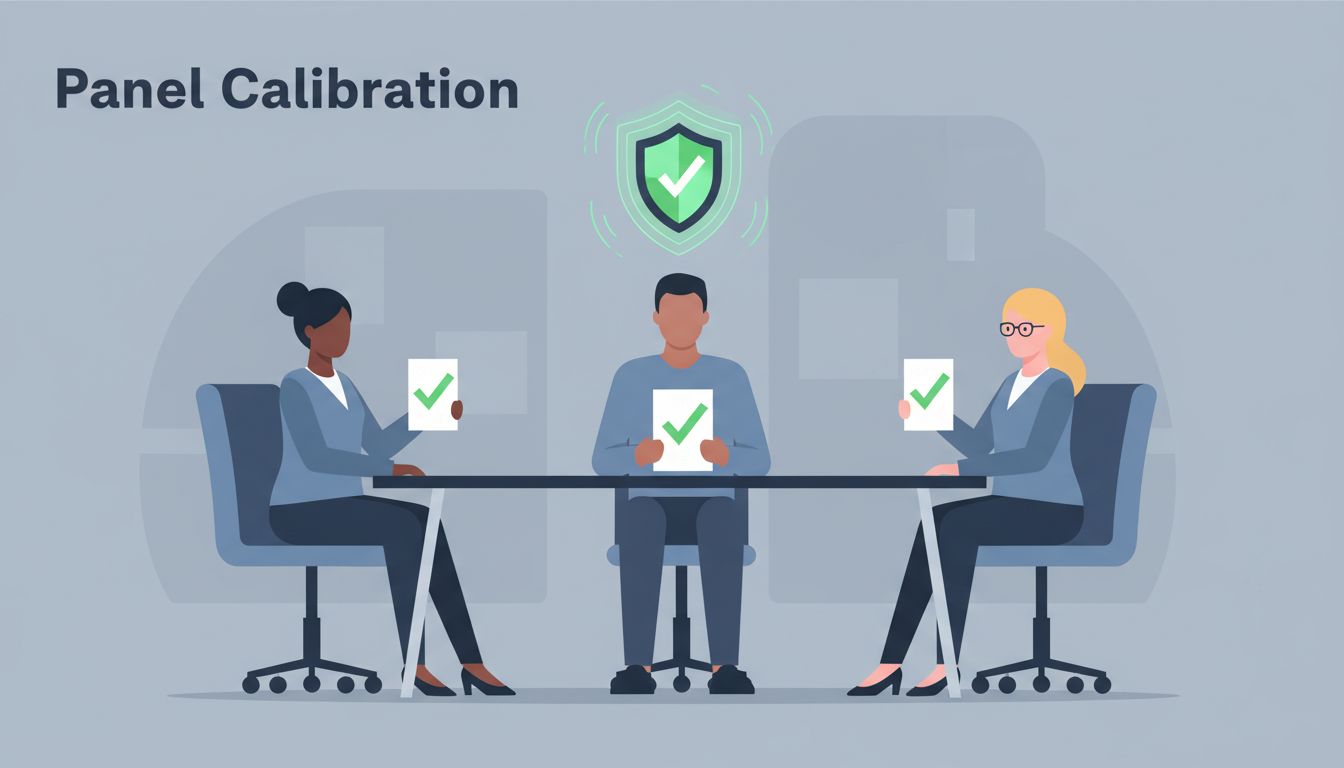
Panel calibration is not the same as interview training. Training teaches people how to ask fair, job-related questions. Calibration teaches them how to score the answers the same way.
A trained panel can still disagree if one person thinks “strong” means deep theory and another thinks it means clean judgment under pressure. Calibration removes that drift by setting shared score anchors, shared evidence rules, and a shared pass bar. For a useful baseline on structure and bias reduction, see structured interviews that reduce bias.
That matters because security hiring often mixes hard facts with subjective readouts. A panel can review the same incident response story and still rate it differently unless the rubric tells them what to look for.
Why security roles need calibration more than most
Security teams hire for different kinds of risk. A security engineer may need cloud design skill and secure coding habits. A detection engineer needs log logic, tuning skill, and alert judgment. A GRC analyst needs evidence quality and control mapping. An incident responder needs calm triage and good containment choices. A security manager needs prioritization, coaching, and stakeholder judgment.
Without calibration, each interviewer may score the candidate against a different target. One panelist may reward broad confidence. Another may focus on one weak answer and ignore the rest. As a result, the same candidate can look “great” in one room and “average” in another.

That is where a bias-aware process helps. ISC2’s bias toolkit is useful here because it reminds panels to judge evidence, not familiarity, style, or seniority signals.
Build a rubric the panel can actually use
A good rubric is simple enough to use in real time. It should focus on 4 to 6 competencies, with clear anchors for each score. This is the same logic behind structured scoring rubrics, where the goal is consistency, not guesswork.
Here is a practical starting point:
| Role | Sample competencies to score |
|---|---|
| Security engineer | Secure design, cloud controls, debugging, collaboration |
| Detection engineer | Log analysis, detection logic, tuning, incident context |
| GRC analyst | Control mapping, evidence quality, risk judgment, writing |
| Incident responder | Triage speed, containment choices, documentation, calmness |
| Security manager | Prioritization, coaching, stakeholder influence, hiring judgment |
The point is to score the job, not a generic idea of talent. If a candidate gives a weak answer on one topic but shows strong evidence in the real work area, the rubric should make that clear.
You can also add behavior anchors. A score of 5 for incident response might mean, “names the right first actions, explains trade-offs, and knows when to escalate.” A 3 might mean, “identifies the issue but misses timing or containment detail.” That gives every panelist the same frame.
Run a short calibration meeting before interviews
A calibration meeting does not need to be long. Thirty minutes is often enough if the panel comes prepared. Training helps interviewers ask better questions. Calibration helps them score answers the same way.

Start with a shared rubric, then walk through one or two sample answers. Use a candidate from a past search, or a fictional example that sounds close to the role. Then follow a simple process:
- Define the must-have competencies before interviews begin.
- Review sample answers together and assign scores independently.
- Compare the scores and ask what evidence led to each rating.
- Agree on what a 1, 3, and 5 mean for each competency.
- Set tie-break rules for split decisions and keep them written down.
If the panel can’t explain a score with evidence, the score doesn’t belong on the form.
After that, review one real hiring decision each month. If the team keeps disagreeing on the same competency, tighten the rubric. If every score sits in the middle, the anchors are too vague.
Common mistakes that distort security interviews
A few patterns break calibration fast.
- Letting the most senior voice dominate, because junior panelists stop speaking up.
- Using “culture fit” when the team really means communication style or confidence.
- Scoring every answer in the middle, which hides strong and weak evidence.
- Changing the bar after one impressive answer, then ignoring the rest of the interview.
- Debating memory instead of notes, which turns the debrief into a hunch contest.
These mistakes are common in security hiring because the work is technical and high-stakes. Still, the fix is straightforward. Write the rubric, use it live, and make panelists defend scores with examples from the interview.
Fair decisions start with shared standards
Security teams do not need perfect agreement. They need a shared method that keeps opinions from driving the outcome. When panelists calibrate against the same rubric, fair hiring gets easier and stronger candidates stand out for the right reasons.
If your team is hiring for hard-to-fill security roles and the panel keeps missing the same signals, Book a Discovery Call with Bud Consulting and build a cleaner process around shared standards.
The best security interviews do one thing well, they turn evidence into decisions.