table of contents
Rare cyber roles do not fail because hiring teams are careless. They fail because the search starts too broad. A cloud security architect, IAM lead, or offensive security expert is rarely sitting in a pile of normal applicants.
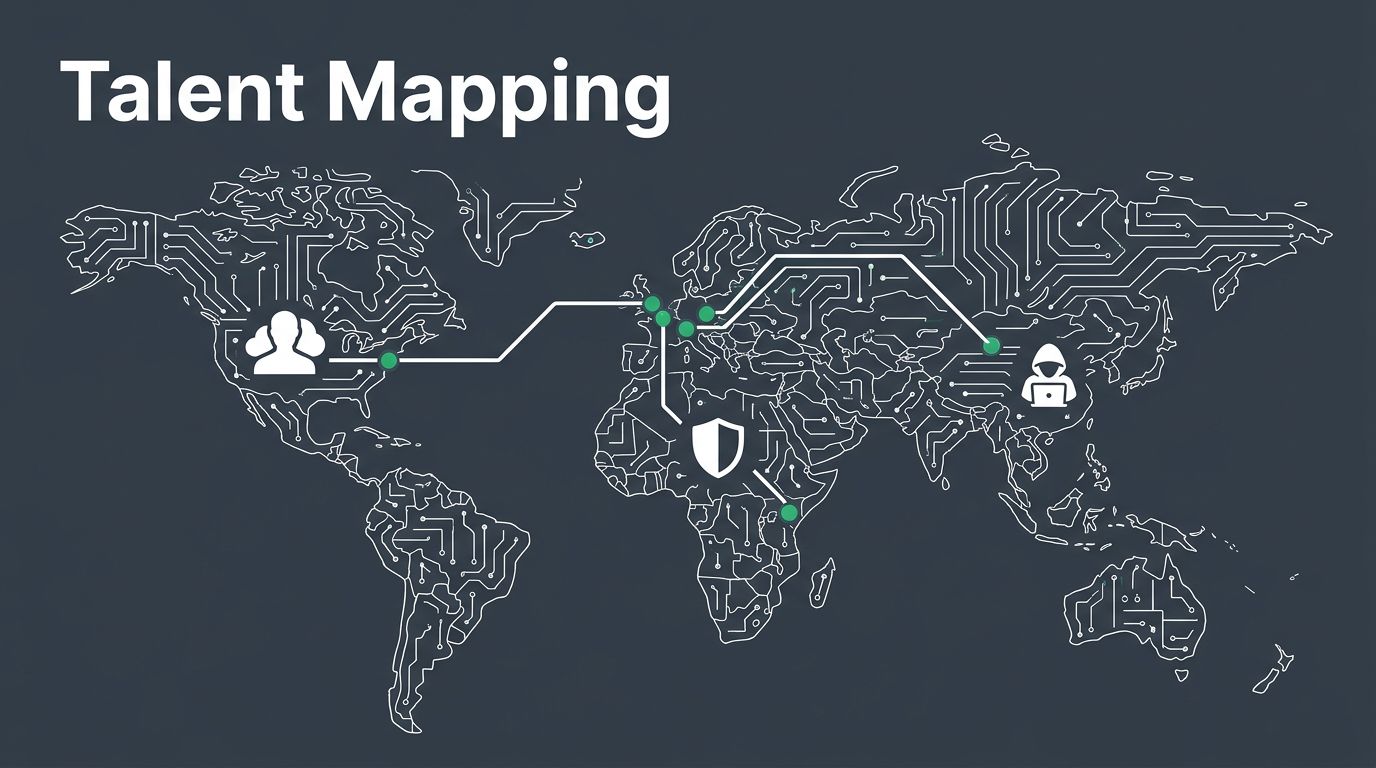
In 2026, the pressure is worse. Teams compete for the same niche people, remote jobs pull candidates across regions, and clearance rules narrow the field even more. That is why cybersecurity talent mapping matters. It turns a vague search into a targeted market view, so you know where talent comes from, which skills transfer, and which trade-offs are real.
The next step is to map the role before you post it.
Why cybersecurity talent mapping matters more in 2026
The shortage story has shifted. SANS reported in March 2026 that 60% of organizations lack the right skills for current threats, and ISC2’s April 2026 analysis points to cloud, AI, application security, and GRC as major pressure points. That is a skills gap, not a simple headcount gap.
For rare roles, broad sourcing wastes time. You need to know whether the market contains two hundred solid candidates or twenty. CyberSeek’s supply and demand heat map helps with that market check. It shows where demand is concentrated and where the pipeline thins out.
It also changes how you talk with hiring managers. Instead of saying, “We need the best person,” you can say, “Here is the real market, here are the skills we can buy, and here are the skills we need to build.” That makes budget talks easier and stops the search from drifting into fantasy.
Calibrate the role before you source
Strong talent mapping starts with role calibration. Without it, recruiters chase titles instead of evidence. A “DevSecOps engineer” in one company may own pipelines. In another, the same title may mean policy, tooling, and release control.
Map the job in four passes:
- Define the day-one outcomes. What must the person fix, own, or launch in the first quarter?
- Separate must-have skills from teachable ones. A cloud security architect may need AWS policy design on day one, while a niche logging platform can be learned.
- Mark the risk flags. Clearance, on-site travel, shift work, and regulated data access all shrink the pool.
- Set the proof standard. Look for shipped work, not just certs. Architecture docs, pull requests, incident write-ups, and automation scripts tell a better story.
A job title without a skill map is just a guess with a salary range.
This is also where stakeholder alignment matters. Security leaders often want breadth, while hiring managers want someone who can land quickly. A good map gives both sides a common language. It shows what the role needs now, what can wait, and where a strong adjacent hire can close the gap.

When the role is calibrated this way, sourcing gets sharper. Hiring managers also argue less about what “qualified” means.
Search for adjacent skills, not perfect matches
Rare roles are easier to fill when you build around adjacent skills. The strongest candidate may not carry the exact title, but they know the same systems, the same risk patterns, or the same workflow.
ISC2’s April 2026 hiring analysis makes this point clear. Teams are struggling most where cloud, identity, app security, and AI overlap. That means the best pipelines often sit next to the target role.
Where adjacent talent usually comes from
- Cloud security architects often come from cloud platform engineering, SRE, or infrastructure security.
- IAM and PAM specialists often come from directory services, identity engineering, or enterprise app administration.
- DevSecOps leaders often come from platform engineering, release engineering, or application security automation.
- Offensive security hires often come from red teams, detection engineering, or secure code review.
The key is to test for transfer, not just exact match. If someone already manages complex access, automation, or production change control, they may move faster than a paper-perfect candidate.
Good mapping also reveals the learning path. For example, a platform engineer may not have written security policy before, but they may already understand containers, IaC, and CI/CD. That gives you a realistic 90-day growth plan. In practice, that is often more useful than waiting six months for a rarer title.

This is where adjacent-skill pipelines pay off. They widen the pool without lowering the bar.
Source where rare candidates already prove themselves
Rare talent usually shows up in places normal sourcing misses. You need to follow the work, not the job board volume.
Look for candidates in cloud communities, open-source projects, conference speaker lists, and vendor ecosystems. For appsec and DevSecOps roles, GitHub activity and CI/CD ownership can matter more than a polished resume. For IAM and PAM, search around identity tooling, directory migrations, and enterprise integration work.
Search logic matters here. Start with the systems the role touches, then move to the people who own them. A cloud security architect might come from a fintech platform team. An IAM lead might come from a large MSP or a hospital network. An offensive security hire might come from product security or a mature internal red team.
If your opening needs a cloud security architect, IAM lead, or security executive, Book a Discovery Call with Bud Consulting. A sharper scope makes the search faster.
Remote hiring and clearance need their own rules
Remote work is now normal for many cybersecurity searches. The latest 2026 data shows location is less of a barrier than skill fit for most private-sector roles. That means you can widen the funnel without weakening the search.
Still, remote hiring needs discipline. Time zones, communication style, and incident response coverage can matter as much as technical fit. A candidate who can lead a zero-trust program across regions may be a better long-term hire than someone local with narrower range.
Clearance roles need a separate plan. Government, defense, and some critical infrastructure jobs still require citizenship, background checks, or active clearance. That does not mean the pool is empty. It means you should map it with extra fields, like clearance level, sponsorship limits, and where the candidate can actually work.

Speed matters here too. Rare candidates move fast when they like the work, but they lose patience with vague interview loops and shifting job scope. A clear map helps you move with purpose.
A better map shortens the search
Cybersecurity hiring for rare roles is no longer about finding more resumes. It is about finding the right path into the market.
When you calibrate the role, track adjacent skills, and separate remote from clearance needs, cybersecurity talent mapping becomes a hiring tool instead of a research exercise. The result is a smaller, sharper funnel and a better chance of landing the person who can do the work on day one.