table of contents
Security hiring gets expensive when leaders only watch open requisitions. A role can look active and still leak talent at every stage.
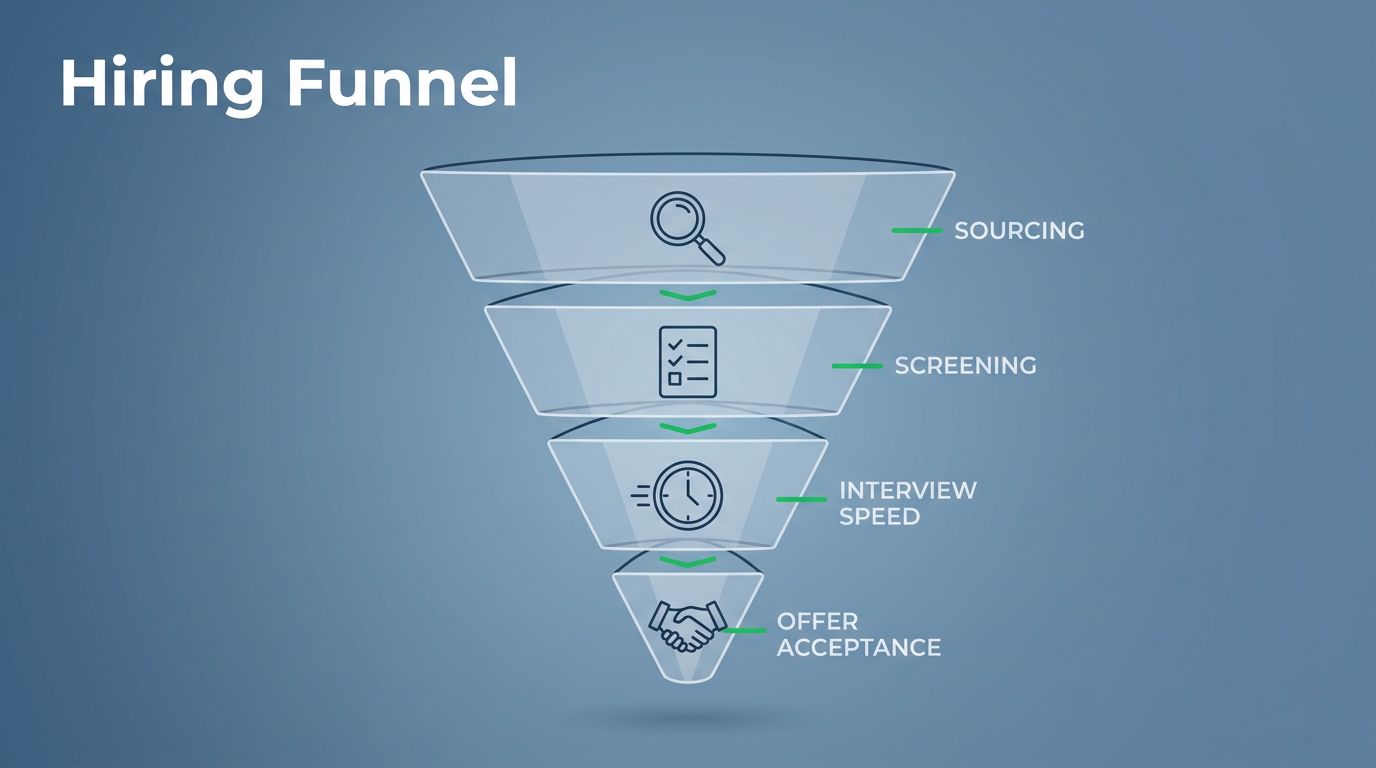
In April 2026, broad recruiting reports still show long hiring cycles and tighter candidate competition, especially for senior security roles. The right security hiring metrics show whether the problem is sourcing, screening, interview speed, or offer acceptance.
Use these numbers to spot friction early, before a hard-to-fill role drags on for months.
Time to fill and time in stage tell different stories
Time to fill measures the days from requisition open to accepted offer. Time in stage measures how long candidates stay in each step.
Time to fill shows the total cost of delay. Time in stage shows where the delay lives. If one stage drags, the fix is often simple, such as fewer interviewers, faster feedback, better scorecards, or quicker background checks.
If time to fill looks low, don’t celebrate too fast. A rushed process can create bad hires and weak retention. For senior security roles, speed only helps when quality stays intact.
For broad 2026 context, Gem’s recruiting benchmarks and Cisive’s time-to-fill guide both point to hiring cycles that still run long. Security jobs often take longer because skills are narrow, senior talent is scarce, and clearance checks add steps.
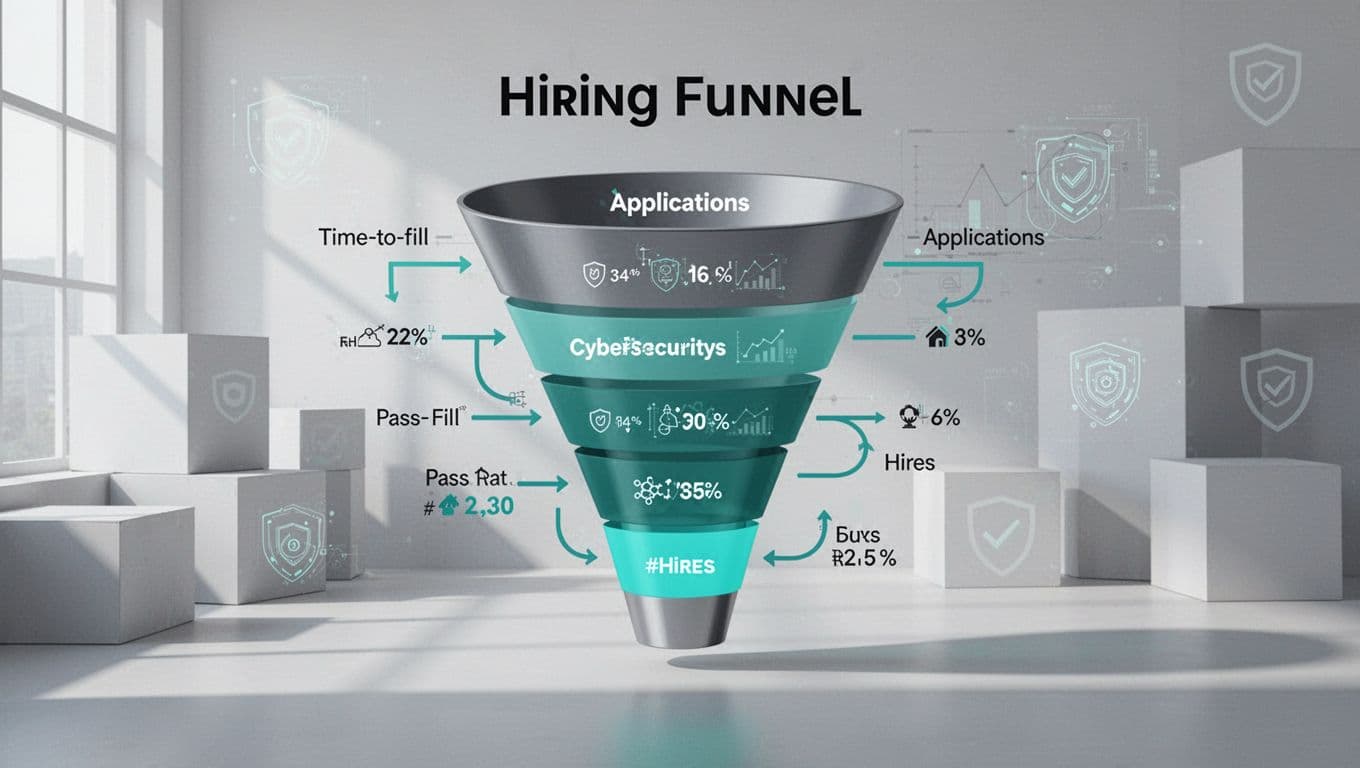
Read the funnel, not the headcount
Headcount tells you how many people applied. Funnel metrics tell you how many were usable.
| Metric | Simple formula | Why it matters | If the number is off |
|---|---|---|---|
| Qualified applicant rate | Qualified applicants / total applicants | Shows whether your job post and sourcing match the role | Low means the sourcing mix or job description needs work; high with few hires can mean later stages are too strict |
| Pass-through rate | Candidates who advance / candidates in the stage | Exposes weak screening or uneven interview standards | Low means the rubric is too loose or too vague; high with weak hires means the panel may be too lenient |
| Candidate drop-off | Candidates who leave / candidates who entered | Catches slow follow-up and poor candidate experience | High means the process is too slow, too long, or poorly explained |
| Source-to-hire conversion | Hires from source / candidates from source | Shows which channels deliver real hires | Low means spend should shift away from that source |
| Offer acceptance rate | Accepted offers / offers extended | Shows whether pay, role scope, and speed are competitive | Low means compensation, process speed, or role pitch needs attention |
| Cost per hire | Recruiting spend / hires | Keeps the budget tied to output | High means the process is wasting money or overusing weak sources |
If a source brings volume but no hires, it is noise, not supply. That matters for niche roles like cloud security architects, IAM leads, and DevSecOps managers.
For broader staffing context, the 2026 RH-ISAC CISO benchmark report is useful when budgets are tight and the hiring plan has to match the security roadmap.
Interviewer calibration keeps the funnel honest
Interviewer calibration means the panel scores candidates the same way. If two interviewers give the same person very different scores, the process is noisy.
You can measure calibration by comparing score spread across interviewers or by checking how often they land within one point on the same competency. Wide gaps usually mean the rubric is vague or the panel has no shared standard.
That matters even more in 2026, when candidates can present polished AI and tool experience well, as Dice’s 2026 hiring guidance shows. Leaders need a clean way to separate real depth from rehearsed language.
If calibration is poor, tighten the scorecard and define each skill with examples. If calibration is too tight, the panel may be rubber-stamping everyone. Then quality of hire becomes the true test.
A practical quality-of-hire score can blend 90-day ramp time, manager satisfaction, and first-year retention. If it drops, revisit screening, interview weights, and the traits of your best hires.
Diversity pipeline health needs stage-by-stage review
Diversity pipeline health is not about a single headcount number. It is about where underrepresented candidates move forward, and where they disappear.
Track representation at each stage, then compare stage-to-stage conversion. If the drop happens after resume screen, fix sourcing language and minimum requirements. If it happens after interviews, review panel mix, interviewer training, and scorecard discipline.
This matters for broader security workforce planning too. A thin early pipeline becomes a thin leadership bench later.

Build a dashboard leaders can act on
A useful dashboard does not bury people in charts. It shows the numbers that drive decisions.
A simple cadence works well:
- Weekly: open req aging, time in stage, and candidate drop-off.
- Monthly: pass-through rate, source-to-hire conversion, offer acceptance rate, cost per hire, and interviewer calibration.
- Quarterly: quality of hire, diversity pipeline health, and 90-day retention.
Tag every metric by role family, seniority, geography, clearance requirement, and remote eligibility. A cleared SOC leader in one market will not move like a remote analyst in another.

If your funnel data is messy or senior roles keep stalling, Book a Discovery Call with Bud Consulting.
Security hiring works best when leaders can see the leaks early. Time to fill matters, but only when it sits next to pass-through, offer acceptance, and quality of hire.
The strongest teams use security hiring metrics as a planning tool, not a report card. They track the funnel by role, market, and clearance need, then change the process when the numbers drift.