table of contents
A single weak link in your incident response can cost millions. You know the drill: alerts pile up, teams scramble, and decisions lag. Incident response tabletop exercises expose those gaps before a real breach hits.
These discussion-based sessions let your team walk through scenarios without live chaos. They reveal how well you detect, respond, and recover. You get hard data on readiness, not just gut feelings.
This guide shows you how to run them right and measure what matters. Start with the basics, then track key metrics.
What Tabletop Exercises Reveal About Your Team
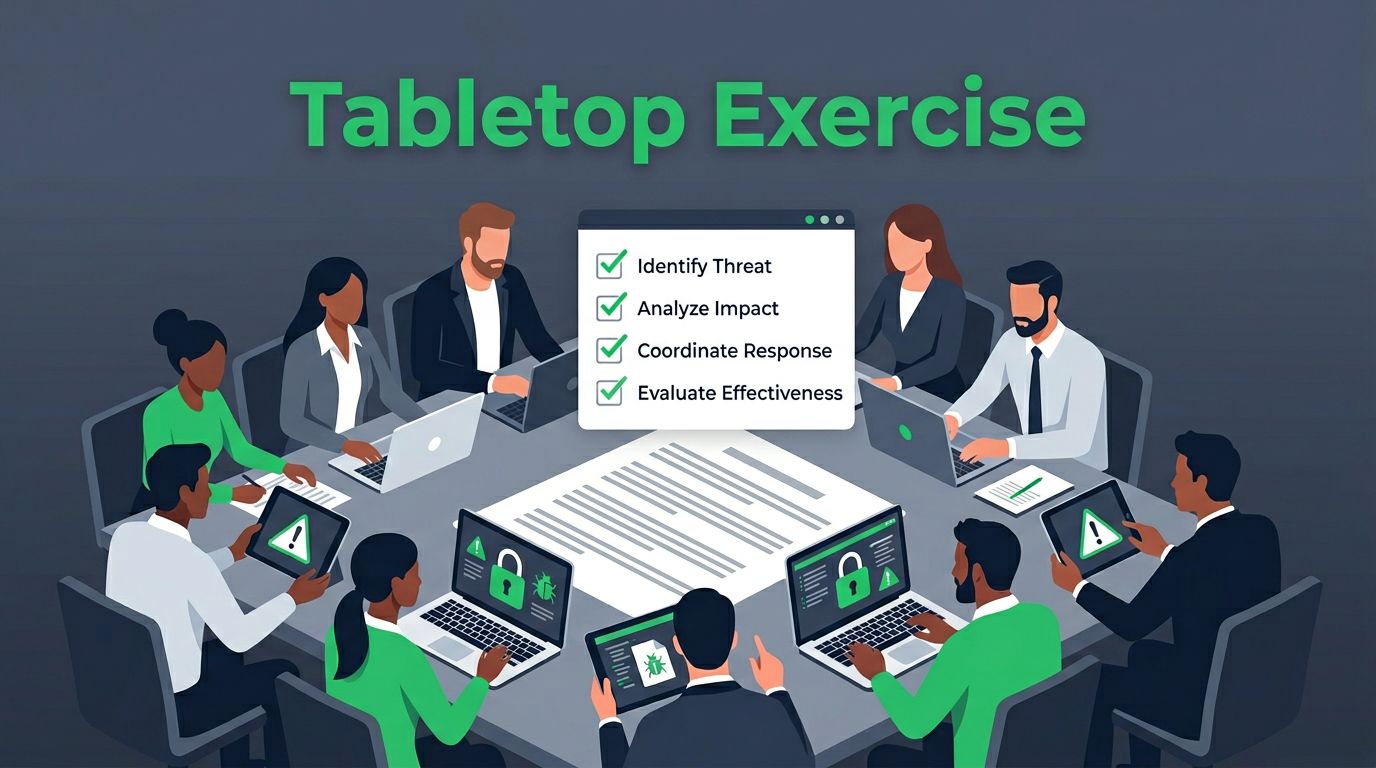
Tabletop exercises simulate cyber incidents in a safe space. Participants discuss roles and actions around a table. No actual systems go down.
NIST outlines this in SP 800-84, Guide to Test, Training, and Exercise Programs. It stresses discussion over hands-on ops. Your group faces a ransomware attack or phishing wave. A facilitator injects twists.
Why bother? Real incidents move fast. Drills test if your plan holds up. They highlight confusion in handoffs or unclear escalation paths.
Teams often overlook cross-team dynamics. Legal, PR, and IT rarely sync in daily work. Tabletops force that interaction. After one drill, you might spot why notifications delay.
Run them quarterly. Keep sessions to two hours. Invite 8-12 people from SOC, IT, leadership. Rotate scenarios based on threats like supply chain attacks.
Results show in metrics. You quantify improvements over time. Next, see which numbers to watch.
Key Metrics That Matter Most
Focus on outcomes you can score. Track eight core areas: detection time, escalation speed, decision quality, cross-functional coordination, communications effectiveness, documentation quality, containment readiness, and recovery preparedness.
Detection time measures how fast the team spots the issue. In a drill, time from scenario start to alert. Aim under 30 minutes.
Escalation speed tracks handoffs. How long from SOC to leadership? Log each step.

Decision quality looks at choices made. Did they follow the plan? Rate on a 1-5 scale: 1 for wrong call, 5 for optimal.
Cross-functional coordination scores team sync. Count resolved conflicts or aligned actions.
Communications effectiveness gauges clarity. Review messages for completeness and speed.
Documentation quality checks logs. Are steps recorded? Use a rubric for detail and accuracy.
Containment readiness tests isolation steps. Did they block spread effectively?
Recovery preparedness evaluates restore plans. Score feasibility and sequence.
For examples, check CybExer on exercise metrics. They cover alert investigation time and false positives. Baseline your first drill, then compare.
How to Run Tabletop Drills for Real Insights
Prep starts with a solid scenario. Base it on NIST SP 800-61 incident handling. Pick a realistic threat, like a compromised admin account.
Assign roles: SOC analyst, incident commander, comms lead. Brief everyone beforehand. No scripts; let discussion flow.

Facilitate actively. Present injects every 15 minutes: “Data exfiltrated. Press calls.” Time responses. Observers note gaps silently.
End with a hot wash: 20 minutes of feedback. Capture raw thoughts.
Debrief in 48 hours. Review recordings. Score metrics live.
Common pitfalls? Dominant voices drown others. Rotate speakers. Or vague scenarios bore teams. Add specifics like “10TB stolen.”
Post-drill, share a one-page summary. Action items get owners and due dates.
Sample Scoring Rubric for Quick Assessment
Use this adaptable framework. Score each metric 1-5 post-drill. Average for overall readiness.
Set context: Tally scores across eight metrics. Total under 25 signals major gaps; 35+ means solid.
| Metric | Criteria (1=Poor, 5=Excellent) | Score |
|---|---|---|
| Detection Time | >1hr (1); <15min (5) | |
| Escalation Speed | Multiple delays (1); Instant (5) | |
| Decision Quality | Ignores plan (1); Optimal (5) | |
| Cross-Functional Coord | Silos persist (1); Seamless (5) | |
| Comms Effectiveness | Confusing (1); Clear/fast (5) | |
| Documentation Quality | Missing (1); Detailed (5) | |
| Containment Readiness | No steps (1); Full isolation (5) | |
| Recovery Preparedness | Vague (1); Tested plan (5) |
After scoring, multiply by participation rate. For instance, 80% attendance boosts confidence.
Adapt weights for your org. SOC-heavy? Prioritize detection.
Steps to Build Drill Maturity Over Time
Start simple. Run one drill per quarter. Track trends in your rubric.
After three, analyze patterns. Slow escalation? Train handoffs.
Involve leadership early. They set tone and fund fixes.
Survey participants: “Did this build confidence?” Track score lifts.
For gaps in talent or process, book a discovery call with Bud Consulting. They vet senior IR experts.
Scale up. Add hybrid formats or unannounced mini-drills.
Reference CISA tabletop packages for free scenarios.
Maturity shows in faster baselines. Your team turns talk into action.
Key Takeaways
Tabletop exercises deliver measurable proof of readiness. Track those eight metrics, score with a rubric, and iterate.
You spot weaknesses now, not during a breach. Teams get sharper; leaders see ROI.
Run your first drill this month. Watch detection times drop and coordination click. Your response will hold when it counts.