


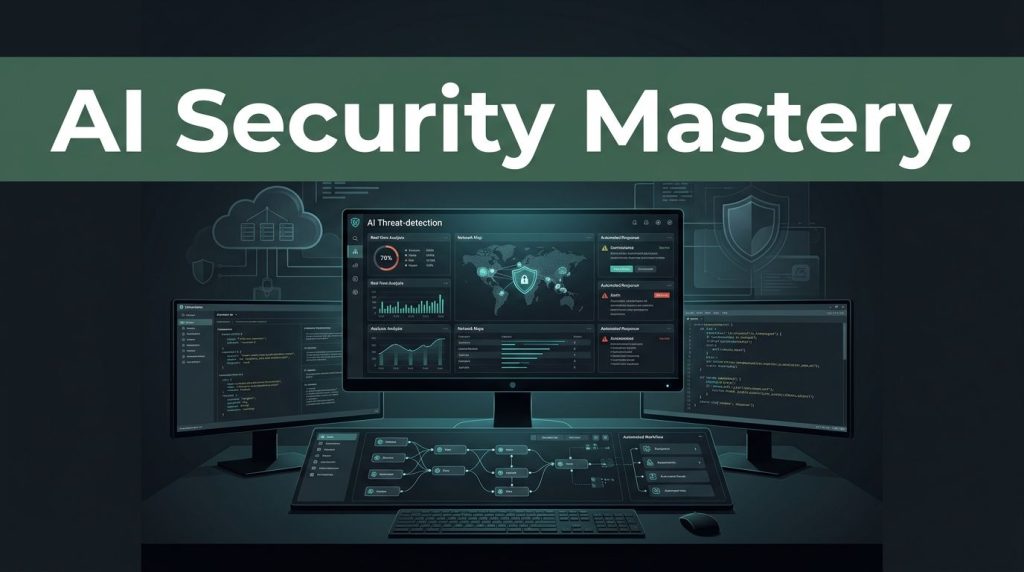
Security operations teams face constant alert fatigue and rising attack volumes. Traditional manual analysis doesn’t scale against modern threat actors. Organizations need technical professionals who can bridge artificial intelligence and defensive operations.
Becoming a GIAC AI security automation engineer validates your ability to build automated workflows, deploy machine learning models, and secure cloud environments. This credential proves you possess practical skills across offensive and defensive domains.
What Is a GIAC AI Security Automation Engineer?
The security industry demands faster response times and reliable automation. Security automation engineers build the pipelines that connect threat intelligence to automated remediation. The GIAC AI security automation engineer credential measures your competence in these exact tasks.
This certification focuses on practical execution rather than theoretical knowledge. Candidates must demonstrate hands-on capability in Python scripting, API integrations, and security orchestration. Organizations look for this certification to verify that engineering teams can handle complex toolchains.
The exam evaluates your grasp of automated attack simulation and host artifact analysis. Security leaders use the certification to filter candidates who understand modern security workflows. You don’t just study security concepts; you build functional automation.
Modern enterprises generate millions of telemetry events every single day. Security analysts cannot investigate every alert manually without burning out. Automation engineers build the logic that filters noise and escalates genuine threats.
SANS SEC598 and Core Exam Objectives
Training forms the foundation of most certification attempts. SANS maps this credential directly to the SANS SEC598 training course. The course covers red, blue, and purple team automation techniques over six intensive days.


The exam covers several core technical domains. You must understand how to automate asset discovery and configure cloud infrastructure securely. The official official GIAC GASAE certification page outlines the specific competency targets for test takers.
Candidates encounter questions and practical labs covering automated vulnerability discovery. The testing environment also verifies your knowledge of breach-and-attack platforms. You need to show that you can orchestrate multi-step security workflows without human intervention.
The GIAC testing style utilizes CyberLive hands-on testing environments. You prove your skills by completing real tasks in simulated infrastructure. Memorizing multiple-choice answers won’t help you pass this practical exam.
Practical Skills in Python, APIs, and SOAR
Automation requires code. Security professionals cannot rely solely on commercial GUIs when building resilient detection pipelines. You must write clean Python scripts to parse logs and query endpoints.
APIs serve as the glue between disparate security tools. Your scripts need to pull threat data from one platform and push remediation commands to another. Security orchestration, automation, and response platforms handle the heavy lifting.
The certification requires mastery of SOAR tools and webhook integrations. You build playbooks that react to anomalies in real time. These playbooks isolate compromised hosts and notify administrative staff automatically.
Engineers also study container security and infrastructure as code. Automation scripts must deploy securely without introducing new vulnerabilities. Testing your code against misconfigurations is a core requirement of the role.
Writing efficient scripts means understanding error handling and rate limiting. External APIs often reject poorly constructed queries during high-volume incidents. Your automation code must remain stable under pressure.
AI Integration, Prompt Safety, and Agentic Workflows
Artificial intelligence changes how teams write detection rules and triage alerts. Modern security systems use large language models to summarize threat reports and generate queries. Security automation engineers manage these models safely.

Prompt injection represents a major risk in AI-driven environments. You must validate inputs before feeding untrusted data into automated parsers. Retrieval-augmented generation architectures require strict access controls to prevent data leakage.
Agentic workflows allow autonomous systems to take corrective actions during an incident. You build guardrails that keep autonomous agents within safe operational boundaries. The curriculum addresses these security challenges directly.
Professionals who complement this credential often explore adjacent cloud domains, such as the GIAC Cloud Security Automation credential. Combining cloud automation with artificial intelligence creates a formidable engineering skill set.
Model safety also involves monitoring token usage and response latency. Security automation pipelines cannot afford slow inference times during active attacks. Engineers optimize prompt structures for speed and accuracy.
Exam Format, Pricing, and Renewal Policies
Knowing the logistical details helps you plan your study schedule effectively. The exam consists of one proctored test with 82 questions. You have three hours to complete the questions and practical labs.
The minimum passing score is 70 percent. GIAC applies this cutoff to all exam versions released recently. You can take the exam online through remote proctoring or onsite at authorized testing centers.
The standard exam attempt costs $999. If you need a retake, the fee is $899, while practice exams cost $399 each. Certifications require renewal every few years to maintain active status and prove continuing education.
Budgeting for both the SANS training and the exam attempt requires careful planning. Employers often sponsor these costs when security teams need specific automation capabilities. Check your training budget before registering for the exam.
Scheduling your exam window properly ensures you have adequate study time. Most candidates spend several weeks reviewing course materials and practicing lab scenarios. Preparation requires consistent hands-on repetition.
Evaluating Career ROI and Next Steps
Career advancement depends on proving your technical abilities to hiring managers. Security automation roles command competitive salaries in the current market. Organizations value engineers who can reduce manual toil in the SOC.
Preparing for the exam demands significant time and discipline. You need access to lab environments where you can test Python scripts and API calls. Hands-on practice remains the best predictor of exam success.
If your organization struggles with alert fatigue, automation provides an immediate answer. Building reliable pipelines transforms reactive security teams into proactive defenders. You can start planning your certification path today.
If you need guidance on sourcing security engineering talent or evaluating team skills gaps, Book A Call With Us to discuss your organization’s hiring and advisory needs.
Conclusion
Securing modern infrastructure requires more than standard firewall rules. Automation and artificial intelligence provide the speed needed to stop sophisticated threats. The GIAC AI security automation engineer certification validates the exact engineering skills required for this work.
Mastering Python, API integrations, and SOAR workflows prepares you for the challenges of modern security operations. Plan your study schedule, build hands-on labs, and test your skills before exam day. Strong automation engineering protects enterprise networks when every second counts.