


Most leadership teams treat cybersecurity funding as a guessing game. They take last year’s total, add five percent, and distribute the remainder based on internal politics and departmental lobbying.
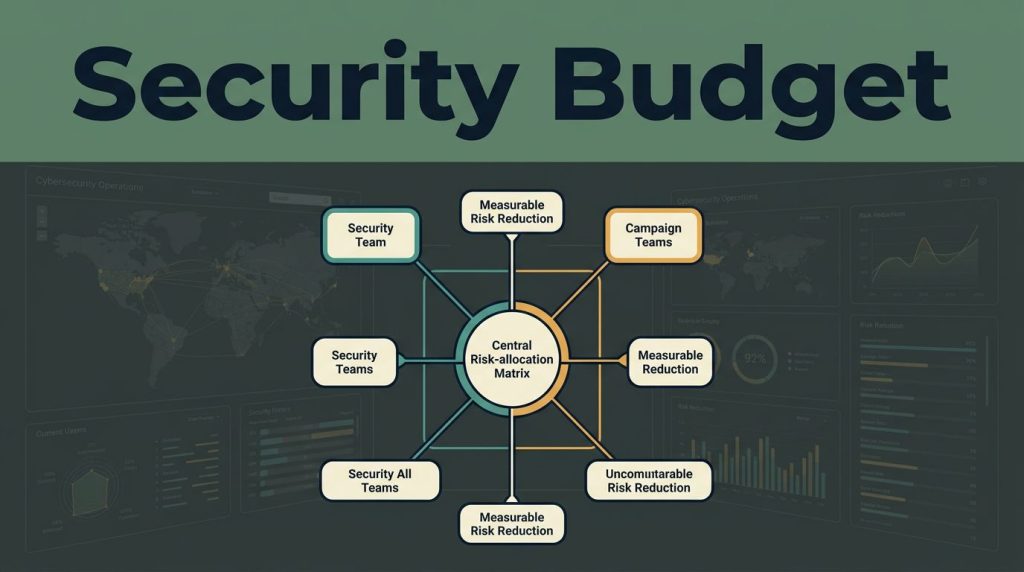
Effective security budget allocation requires a disciplined, data-driven approach. CISOs and finance directors need to tie every dollar to measurable risk reduction instead of relying on gut feelings or arbitrary historical baselines.
Moving Beyond Arbitrary Percentages in Security Budget Allocation
Many organizations fixate on universal benchmark numbers. Industry data shows that enterprises typically allocate between eight and twelve percent of their IT budget to cybersecurity. High-threat sectors like healthcare and financial services often push higher, sometimes reaching fifteen percent. However, applying a flat percentage across every department creates severe inefficiencies and misallocates resources.
A generic baseline doesn’t reflect actual risk profiles. Engineering teams building cloud applications face entirely different threat vectors than corporate finance departments processing wire transfers. Your security budget allocation must mirror operational reality rather than rigid macroeconomic ratios. For a detailed breakdown of how enterprises approach these ratios, review this cybersecurity budget planning benchmarks.
When you distribute funds evenly without context, you underfund critical technical gaps while overfunding mature departments. Finance partners want predictability, but security leaders need agility. Bridging this gap demands transparency, clear visibility into asset exposure, and rigorous cross-functional alignment.
How to Divide the Pie Without Breaking Teams
Dividing funds across security, IT, engineering, and business units requires a structured framework. Industry norms suggest that software and platforms consume the largest share of the security budget, often hovering near forty percent. Personnel takes another significant slice, while outsourced services and hardware make up the remainder of the portfolio.


Yet, software licenses alone don’t stop threat actors. If your engineering team lacks the headcount or skills to configure cloud security tools correctly, those licenses sit dormant. Effective security budget allocation accounts for the total cost of ownership, including specialized training, talent acquisition, and ongoing operational maintenance.
Organizations planning their spending cycles benefit from examining broader enterprise frameworks. You can read more about these investment strategies in this 2026 enterprise cybersecurity budget planning guide. Leaders must balance automated tooling with human risk advisory services to ensure that technology investments actually close technical skills gaps.
Shared Ownership With IT And Engineering
Security is not an isolated department operating in a vacuum. IT and engineering teams own the infrastructure, write the code, and manage user identities. Funding security entirely within the standalone security department creates friction and slows down product delivery cycles.

Budget allocation must support shared accountability. When engineering owns application security tooling as part of their standard DevSecOps pipelines, security leaders can fund enablement rather than policing. This collaborative model reduces friction and accelerates vulnerability remediation.
Operational decision-makers should allocate specific lines for developer security training and automated vulnerability discovery directly within engineering budgets. Shared ownership ensures that security controls scale alongside infrastructure growth. When everyone shares the risk, everyone participates in the defense.
Quantifying Risk Reduction and Measurable Outcomes
Finance partners and board members evaluate investments through return on investment and risk mitigation metrics. Vague assurances about enterprise resilience no longer satisfy executive scrutiny. Your security budget allocation needs clear data showing how specific expenditures reduce attack surfaces.
Continuous threat exposure management changes this dynamic. By deploying automated attack surface discovery and red team testing, security teams can demonstrate exactly which vulnerabilities pose immediate business risk. You can Book A Call With Us to discuss how continuous testing validates your security posture and justifies targeted team investments.
When you tie budget requests to concrete exposure data, budget defense becomes straightforward. Finance directors approve expenditures faster when they see a direct correlation between tool deployment and verified risk reduction. Hard metrics replace subjective debates.
Periodic Rebalancing as Threats and Business Priorities Shift
Threat landscapes evolve continuously. Cloud migrations, artificial intelligence adoption, and shifts in remote work alter organizational risk profiles overnight. A static budget set at the beginning of the fiscal year quickly becomes obsolete.
Successful organizations implement quarterly budget reviews. If cloud asset expansion outpaces on-premise infrastructure, leadership shifts funds toward cloud security posture management. For additional insights on structuring these adjustments, explore this cybersecurity budget allocation guide.
Periodic rebalancing keeps security investments aligned with actual business operations. Security leaders must remain flexible, moving capital away from legacy appliances toward high-priority areas like identity governance and continuous exposure management.
Conclusion
Effective security budget allocation requires moving away from arbitrary percentages and hidden assumptions. Tying investments to cross-functional ownership and measurable risk reduction builds lasting institutional trust.
Aligning your security spending with operational reality protects both technology and people. Evaluate your exposure, share ownership with engineering, and rebalance your resources as business priorities demand.