


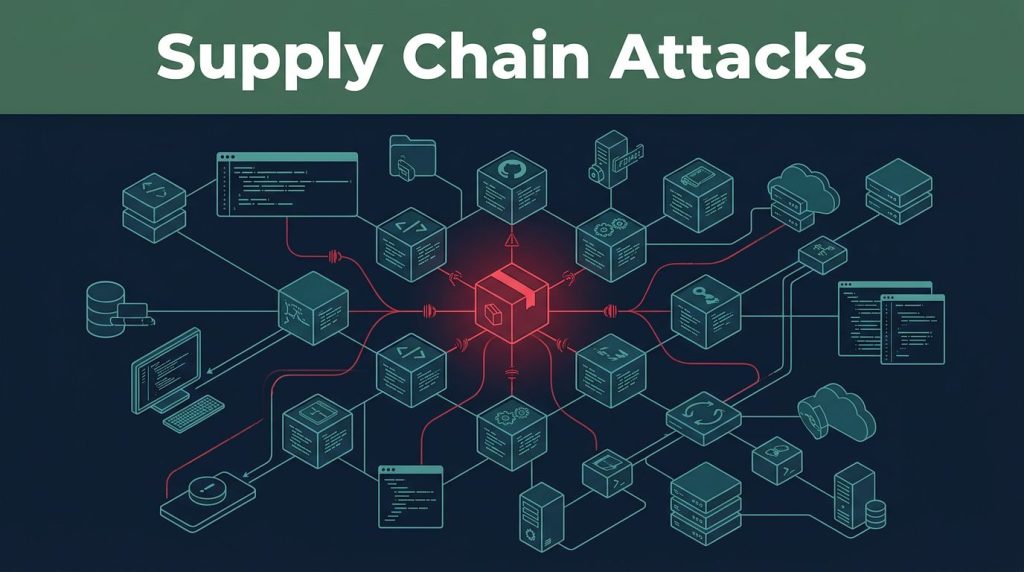
Modern software development relies heavily on external libraries, extension marketplaces, and automated deployment pipelines. Attackers now target these foundational components directly in every sophisticated supply chain attack. A single compromised package can grant unauthorized access across thousands of downstream corporate networks. Security teams face unprecedented exposure when external vendors and open-source maintainers experience breaches.
Every organization must treat third-party dependencies as active threat vectors rather than trusted internal assets. The May 2026 security landscape exposed severe vulnerabilities in developer tooling and package distribution networks. United States federal agencies and private security firms documented rapid exploitation waves across multiple software ecosystems. Organizations require immediate visibility into their external dependencies and third-party integrations to prevent widespread compromise.
The Mechanics of a Modern Supply Chain Attack
Adversaries are moving beyond simple typosquatting and targeting legitimate developer infrastructure. Recent campaigns demonstrate sophisticated abuse of trusted publishing workflows, automated update channels, and integrated development environment extensions. Threat actors know that developers maintain elevated access credentials and direct repository integration. This access allows attackers to inject malicious code directly into legitimate build artifacts without triggering standard perimeter alerts.
In May 2026, the Cybersecurity and Infrastructure Security Agency added several critical software vulnerabilities to its Known Exploited Vulnerabilities catalog. These included flaws affecting widely used packages and official installer distributions. For instance, the TanStack ecosystem faced a coordinated breach affecting forty-two npm packages. Attackers abused GitHub Actions workflows and trusted publisher configurations to publish malicious versions containing credential-stealing malware designed to target enterprise pipelines.
Another high-profile incident involved the Nx Console extension for Visual Studio Code. A malicious version of this extension was briefly distributed through official update channels. This poisoned extension exfiltrated internal repository data and developer credentials across multiple cloud providers. Official installer downloads for utility software like DAEMON Tools Lite also suffered compromises on vendor distribution sites. These events show that trusted channels provide ideal entry points for attackers seeking high-value institutional access.
Additional details on these evolving threats are available in the Software Supply Chain Security Report. Developers and security leaders must examine how build pipelines execute external code. Maintaining strict control over developer workstations stops unauthorized publishing operations across enterprise networks.
Assessing Third-Party Software Risks
Third-party risk management requires continuous validation rather than annual vendor questionnaires. Security teams must map every software bill of materials and track every external dependency. External code runs with the permissions granted by the host environment, making compromised dependencies exceptionally dangerous. Attackers exploit blind spots in supply chain visibility to deploy persistent backdoors into enterprise servers.


Organizations often lack complete visibility into transitive dependencies. A direct dependency might be secure, but the ten libraries it pulls in could introduce severe vulnerabilities. Automated inventory tools help map these hidden relationships before exploitation occurs. Security teams must evaluate each third-party component against strict internal risk thresholds to maintain operational integrity.
Security teams should review guidance published in the CISA defending against software supply chain attacks resource. Proper risk assessment uncovers blind spots in build pipelines and repository access controls. Organizations can explore further context regarding these trends in the Panorays cyber security supply chain attacks guide. Continuous asset discovery keeps security baselines accurate across complex cloud environments.
Federal Mandates and CISA Known Exploited Vulnerabilities
Federal oversight has intensified as supply chain compromises accelerate across commercial and government sectors. CISA issued urgent directives requiring federal civilian agencies to remediate specific supply chain flaws under strict deadlines. The agency added vulnerabilities like CVE-2026-8398 in DAEMON Tools Lite and CVE-2026-45321 in TanStack to its mandatory exploitation catalog.
These KEV additions carry strict federal compliance windows, often forcing remediation within weeks of publication. Federal agencies had to patch or isolate affected systems by June 10, 2026. Private enterprises face similar pressure from cyber insurance providers and regulatory bodies. Ignoring federal advisory notices exposes organizations to rapid exploitation by advanced threat groups seeking institutional credentials.
Comprehensive breakdowns of these incidents appear in the analysis of five of the biggest supply chain attacks of 2026. Security leaders must align internal remediation schedules with federal emergency directives. Timely patching stops automated exploitation waves before attackers establish persistent access. Regulatory compliance acts as a baseline, but internal security posture requires continuous validation.
Incident Response Checklist
When a compromise hits an organization, security teams need a structured response protocol. Quick containment prevents lateral movement across internal development servers and cloud environments. An effective incident response plan isolates affected repositories and revokes compromised tokens immediately. Time is critical when dealing with automated credential harvesting malware.

Security administrators should follow specific operational steps during a suspected event:
- Isolate all build agents and developer workstations connected to compromised repositories.
- Revoke and rotate all API keys, SSH keys, and cloud deployment secrets associated with the affected pipeline.
- Audit package registries and lock files for unauthorized version modifications or unexpected dependency additions.
- Review access logs for anomalous authentication requests originating from automated CI/CD workflows.
- Notify legal and compliance stakeholders while preserving forensic artifacts for root cause analysis.
Additional operational guidelines are available in the Singapore CSA advisory on securing the software supply chain. Structured response protocols minimize downtime and reduce the blast radius of third-party breaches. Clear procedures ensure rapid recovery during active security incidents.
Strengthening Vendor and Code Pipeline Defenses
Defending code pipelines requires rigorous access controls and continuous monitoring. Organizations must enforce multi-factor authentication across all repository management systems and package registries. Developers should never use unverified external packages without prior code review and cryptographic verification. Secure coding standards must govern every stage of the software development lifecycle.
Automated scanning tools must integrate directly into integrated development environments and CI/CD pipelines. These tools flag anomalous package signatures and known vulnerabilities before code reaches production environments. Security teams should also limit the permissions granted to third-party automation tools and GitHub Actions workflows. Restricting token permissions stops lateral movement if a single tool is compromised.
Organizations navigating complex security requirements can Book A Call With Us to discuss threat exposure management and talent solutions. Strengthening vendor security protects institutional assets against sophisticated third-party threats. Operational resilience depends on proactive risk management and continuous vulnerability validation.
Final Operational Takeaways
Third-party software vulnerabilities will remain a primary vector for sophisticated intrusions. Organizations must treat external dependencies and developer tools with the same scrutiny applied to internal infrastructure. Continuous monitoring and strict access controls reduce the likelihood of catastrophic compromise. Security teams must maintain constant vigilance across all deployment channels.
Review your dependency inventories today and verify that all automated build pipelines enforce rigorous authentication standards. Proactive security management protects your organization against emerging supply chain threats. Continuous validation ensures operational integrity across every layer of your software ecosystem.