table of contents
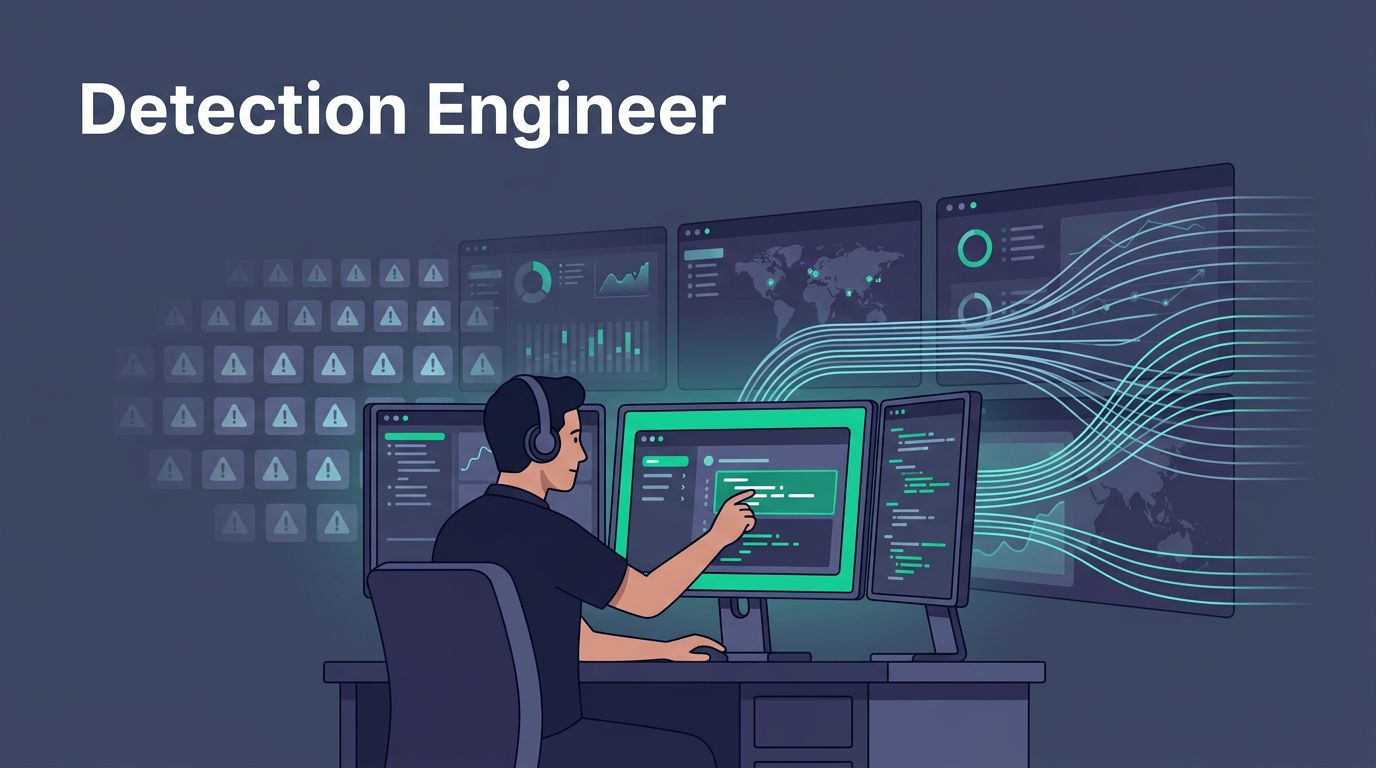
A noisy SOC does not need more alerts. It needs someone who can turn alert volume into signal.
If your analysts spend half the day closing false positives, the hiring mistake is usually the same. The team hired for triage, but the real problem is detection quality, coverage, and poor telemetry. A strong detection engineer changes that balance.
The best candidates think in terms of attacker behavior, data quality, and analyst time. They know when to tune a rule, when to retire it, and when the fix belongs with the platform team. That’s the kind of hire this article helps you find.
Why high-noise SOCs need a different kind of hire
A high-noise SOC is not just busy. It is expensive to run and hard to trust.
When alerts keep firing for the wrong reasons, analysts get slower and less confident. They start treating detections like background noise. Once that happens, even decent alerts lose value because nobody wants to stop and investigate them.
That is why the role matters. A detection engineer does more than write rules. They work on alert quality, coverage, validation, and lifecycle management. They look at what fired, what got ignored, and what never showed up at all. That aligns with the way Splunk describes detection engineering, where good detections are built, tested, and improved over time.
In a noisy SOC, the job often starts with questions like these:
- Which alerts waste the most analyst time?
- Where are the false positives coming from?
- Which attack paths are still under-covered?
- Which logs are missing or unreliable?
- What can be tuned without opening a blind spot?
A good hire answers those questions with evidence. They do not just ask for more alerts or more tooling. They look for the real cause, whether that is weak logic, poor thresholds, bad normalization, or telemetry gaps.
A strong detection engineer lowers noise without lowering trust. If analysts stop believing alerts, coverage does not matter much.
That is also why this role matters more in organizations with cloud, identity, SaaS, and endpoint data spread across many systems. The job is part detection design, part data review, and part internal diplomacy.
Detection engineer vs SOC analyst, threat hunter, SIEM engineer, and detection content engineer
These roles overlap, so hiring teams blur them. That creates confusion during interviews and weak job scopes.
A SOC analyst investigates alerts. A detection engineer designs and improves what gets alerted on. A threat hunter looks for activity that tools missed. A SIEM engineer keeps the logging and query platform healthy. A detection content engineer usually sits closer to writing and maintaining detection logic inside a product or platform.
Here is the cleanest way to separate them:
| Role | Main job | What success looks like |
|---|---|---|
| Detection engineer | Build, tune, test, and maintain detections | Fewer false positives, better coverage, faster triage |
| SOC analyst | Triage and investigate alerts | Accurate escalations, solid case handling, quick response |
| Threat hunter | Search for hidden or missed activity | Useful hypotheses, new findings, hunt-to-detection handoff |
| SIEM engineer | Maintain the SIEM and data pipeline | Reliable ingestion, parsing, retention, and search performance |
| Detection content engineer | Write and maintain detection content in a platform | Clean logic, working signatures, repeatable packaging |
The difference matters when you hire. If the team needs better alert quality, do not hire a general analyst and hope they figure it out. If the team needs logging fixes, do not ask a detection engineer to become a SIEM admin by default. Scope drives results.
Real job posts show this split. A senior detection engineer role description stresses noisy environments, multiple data sources, and close work with SOC, IR, and engineering partners. A modern detection engineer posting calls out Sigma, KQL, and security operations as code. Those are useful clues about what the market expects.

The best detection engineers sit between operations and engineering. They need enough depth to write good logic and enough context to know when logic is the wrong fix.
Signals you are talking to a real detection engineer
A strong candidate talks about outcomes, not just tools.
They can explain how they reduced false positives without hiding real attacks. They can also describe what they measured after a change. That might be alert volume, true positive rate, mean time to triage, or analyst feedback. If they only talk about rule count, they may be closer to a content writer than an engineer.
This table helps separate strong signals from weak ones:
| Strong signal | Weak signal |
|---|---|
| Talks about alert volume, analyst time, and false positives | Talks only about how many rules they wrote |
| Explains how they tested detections before rollout | Assumes a rule is good because it deployed cleanly |
| Maps logic to attacker behavior and not just one event | Treats every alert as a standalone signature |
| Names telemetry gaps that break coverage | Wants more logs without saying which ones matter |
| Works well with SOC, IR, and platform teams | Treats tuning as someone else’s problem |
| Uses queries, code, or version control in their workflow | Keeps all logic in slides or spreadsheets |
The best candidates also know when to retire a detection. That matters more than many teams expect. Old rules can create noise, burn analyst trust, and hide newer attacks under a pile of stale alerts.
When you hear a candidate say, “I removed this rule because it kept firing on approved admin activity, then I replaced it with context-aware logic,” you are probably talking to someone with real experience. That answer shows judgment, not just technical skill.
A useful mental check is simple. Would this person improve your queue in 30 days, or would they just add another ticket stream? That question cuts through a lot of interview fog.
Interview questions that reveal real skill
The right questions show whether the candidate has tuned real detections in a real SOC.
- “How would you reduce noise on one of our top alerts?”
Listen for context, thresholds, exclusions, baselines, and a plan to measure the change. Good answers usually mention how to avoid creating a blind spot. - “How do you map a detection to attacker behavior?”
Strong candidates talk about behavior sequences, not just one suspicious field. They may reference MITRE ATT&CK or a similar framework, but they should explain it in plain language. - “What telemetry gaps have caused you the most pain?”
You want concrete examples, such as endpoint logs, identity events, cloud audit data, SaaS logs, or proxy data. Good answers show they know how weak data breaks strong logic. - “Tell me about a detection you retired or replaced.”
This question reveals maturity. A solid engineer knows that not every alert deserves to live forever. - “How do you work with incident response after a detection fires?”
The best answer includes feedback loops, case review, and fast tuning after a real incident. Detection engineering and IR should feed each other. - “What would you build first in the first 30 days here?”
Strong candidates rank by risk and noise. They usually start with the highest-volume alerts, the worst telemetry gaps, or the biggest blind spots.
If the person answers every question in product terms, keep probing. Tools matter, but the role is about reasoning. A detection engineer should be able to explain why a rule exists, how it fails, and how it gets better.
Assessment ideas that work in a noisy SOC
Interviews can sound good and still miss the point. A short practical exercise shows how a candidate thinks under messy conditions.
Cymulate’s detection engineering overview is a useful reminder that validation belongs in the workflow, not after the hire. That same idea should shape your assessment.
| Assessment | Time | What it shows |
|---|---|---|
| Noisy alert tuning exercise | 45 to 60 minutes | Can they cut false positives while keeping useful coverage? |
| Behavior-to-detection mapping | 30 to 45 minutes | Do they think in attacker steps and data sources? |
| Telemetry gap review | 30 minutes | Can they spot missing logs and route fixes to the right team? |
| Small take-home with redacted logs | 2 to 3 hours | Can they structure a response and explain trade-offs clearly? |
Use a small, realistic dataset if you can. Give them a noisy alert, a few sample events, and one or two known-good cases. Then ask what they would change and why.
You are not grading whether they know one exact query syntax. You are grading judgment. A candidate who understands the trade-off between coverage and noise is far more useful than someone who memorizes terms.
Live assessments also expose communication style. A strong engineer talks through assumptions, asks for context, and explains the cost of each change. That matters because this role sits in the middle of SOC pressure and engineering constraints.
A simple scorecard for the final hiring decision
Gut feel is a bad way to hire for a role this technical and cross-functional. A scorecard keeps the process honest.
Use a 1 to 5 scale for each area, then weight the categories below.
| Category | What a strong answer looks like | Weight |
|---|---|---|
| Alert tuning and noise reduction | Can explain how they lower false positives and track the result | 25 |
| Telemetry and coverage thinking | Spots gaps in endpoint, identity, cloud, or SaaS visibility | 20 |
| Attacker behavior mapping | Ties detections to real adversary steps, not just one event | 15 |
| Collaboration with SOC, IR, and platform teams | Works cleanly across teams and knows who owns what | 15 |
| Hands-on query and code skill | Can work in Sigma, KQL, SPL, or your stack of choice | 15 |
| Ownership and judgment | Knows what to build, fix, retire, or leave alone | 10 |
A scorecard like this keeps the conversation focused on the work that matters. If someone scores well on queries but poorly on collaboration, that is a warning sign in a noisy SOC. If they score high on tuning and telemetry but can’t explain their choices, keep digging.
If you want help tightening the role profile, interview loop, or shortlist, Book a Discovery Call with Bud Consulting.
Conclusion
When you hire a detection engineer for a high-noise SOC, you are not filling a generic security seat. You are hiring someone to protect analyst time, improve trust, and turn noisy data into useful detections.
The right person understands false-positive reduction, attacker behavior mapping, and telemetry gaps. They also know how to work with IR and platform teams when the fix sits outside the rule itself. That mix is what lowers noise without lowering coverage.
If a candidate can show that in the interview, you probably found the person who will make your SOC better, not busier.
FAQ
What is the biggest mistake when hiring a detection engineer?
Hiring for broad SOC experience instead of detection depth is the most common mistake. A person can be strong at triage and still be weak at tuning, coverage, and validation.
Should a detection engineer know how to code?
Yes, but the level depends on your stack. They should be comfortable with query logic, version control, and repeatable detection work. Syntax matters, but judgment matters more.
How is a detection engineer different from a threat hunter?
A threat hunter looks for activity that alerts missed. A detection engineer turns useful findings into durable detections and keeps those detections healthy over time.
How do I know if my SOC needs this role?
You probably need one if analysts are buried in false positives, if detections fire too often without value, or if you keep finding telemetry gaps after incidents. That is a sign the detection layer needs ownership.