table of contents
You invest in security training because humans cause most breaches. Yet without clear numbers, budgets get cut. In 2026, programs deliver up to 366% ROI by slashing phishing success rates 50% to 80%.
Security leaders face pressure to prove value. Boards want dollars saved, not just checkmarks. This guide shows you how to track real returns from training.
Start with the right metrics. Then apply a simple formula. You’ll see exactly what your program delivers.
Why Track ROI for Security Training
Security training pays off when you measure it right. Phishing causes 32% of breaches. Training cuts those risks and saves millions.
Focus on ROI, not just risk reduction or ROE. ROI means net financial gain: (benefits minus costs) divided by costs. Risk reduction lowers odds of loss. ROE meets softer goals like culture shifts.
In 2026, average breaches cost $4.45 million. Training avoids $2 million per incident. Programs also speed reporting. Mean time to report drops, so teams fix issues faster.
You need baselines. Track phishing clicks before training starts. Log incidents. Note compliance scores. These feed your calculations.
Boards approve budgets with proof. Show avoided costs from fewer clicks. Tie it to business outcomes. That’s how you secure next year’s funds.
Key Metrics for Security Training Success
Pick metrics that matter. Phishing click rates top the list. Strong programs drop them 70% to 80%. Simulations work best because they mimic real attacks.

Incident reports follow close. Count security events per quarter. Training cuts them by building habits. One firm saw 50% fewer after six months of drills.
Mean time to report suspicious activity shrinks too. Employees spot fakes quicker. This halves damage from early threats.
Compliance scores rise. Audits pass easier with trained staff. Behavior changes stick: more two-factor use, fewer weak passwords.
Quiz results track knowledge. But pair them with actions. High scores mean little without lower clicks.
Use tools for data. Phishing sims give click stats. SIEM logs incidents. HR tracks completion rates.
For deeper metrics, check this framework for 2026 decision-makers. It stresses control effectiveness.
Set targets. Aim for 70% click drop in year one. Adjust based on your baseline.
The ROI Formula for Security Training
ROI boils down to one equation. ROI = (gains – costs) / costs x 100%. Gains come from avoided losses.
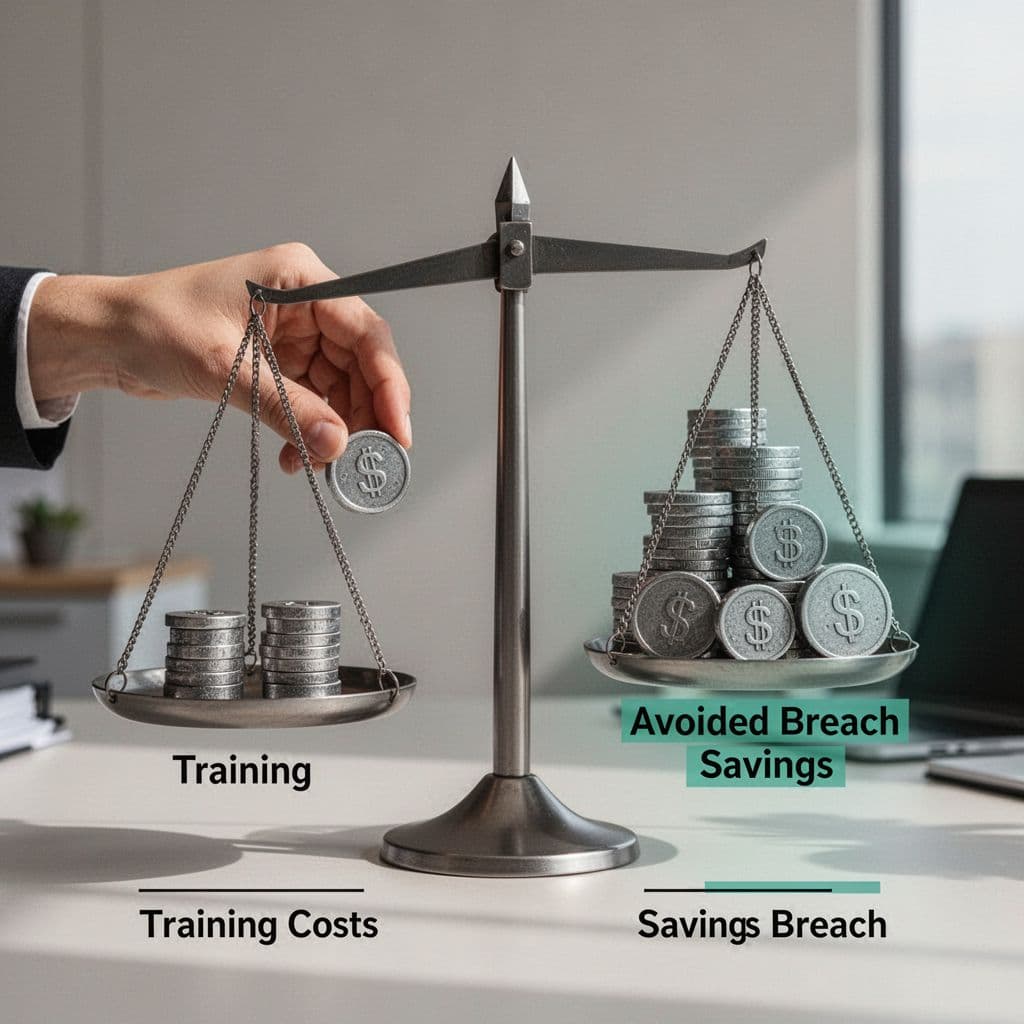
Costs include software, time, and content. Say $150,000 yearly for 1,000 users.
Estimate gains. Multiply incidents avoided by average cost. If training prevents two $2 million breaches, that’s $4 million saved.
Phishing drives numbers. Baseline click rate: 20%. Post-training: 5%. Attacks hit 10,000 users. That’s 1,500 fewer clicks. Each click costs $5,000 in cleanup. Savings: $7.5 million.
Add productivity. Faster reporting saves hours. Compliance avoids fines.
Net it out. ($7.5M gains – $150K costs) / $150K = 4,900%. Realistic? Often 300% to 800%.
Distinguish from ROE. ROE tracks surveys on confidence. ROI hits the bank.
Try a security training ROI calculator for quick tests. It uses your inputs.
Run quarterly. Baseline pre-training. Measure post. Tools automate most.
Collect Reliable Data on Training Impact
Data drives everything. Start with baselines six months before launch.
Run phishing sims monthly. Log clicks, reports. Use platforms with analytics.
Track incidents via tickets. Categorize by cause: phishing, errors.
Survey behavior changes. Ask about password habits. Spot trends.
Compliance audits give scores. Pre and post.
Costs need tracking too. License fees. Employee hours at $50 each.
Automate where possible. Dashboards pull metrics. Export to spreadsheets.
Common pitfall: vendor claims. Test yourself. Real reductions vary by industry.
SANS data shows 427% ROI over three years. Payback in under 12 months. Your results depend on execution.
Real-World Example: Calculating Security Training ROI
Consider a mid-size firm. 2,000 employees. Annual phishing incidents: 40. Each costs $100,000: cleanup, downtime.
Baseline click rate: 15%. Training costs $200,000 yearly.
Post-training, six months in: clicks drop 75% to 3.75%. Incidents fall to 10.
Avoided incidents: 30. Savings: $3 million.
Other gains: MTTR halves to two days. Saves $500,000 in lost productivity.
Compliance fines avoided: $250,000.
Total gains: $3.75 million.
ROI = ($3.75M – $200K) / $200K x 100% = 1,675%.

Scale to your org. Adjust breach costs from your logs. Use IBM averages if needed.
This matches 2026 trends. Programs hit 366% average with simulations.
Refine yearly. Add ransomware odds drops.
Conclusion
Security training ROI shows up in fewer breaches and real savings. Focus on phishing drops, incident cuts, and fast reporting. Use the formula with your data for proof.
You now have steps to calculate it. Start with baselines. Run the numbers quarterly.
Strong metrics build buy-in. Your program will grow.
Book a Discovery Call with Bud Consulting to review your setup.