table of contents
AI models power decisions in cloud services, APIs, and internal apps. One breach can expose sensitive data or manipulate outputs. You need solid AI security policies to protect deployments.
These policies set rules for your team. They guide safe operations without slowing innovation. Poor policies leave gaps that attackers exploit, like prompt injection in APIs.
This guide walks you through risks, key parts, and steps to build policies. You’ll get examples tailored to production setups.
Understand Risks in AI Deployments
AI models face unique threats in production. Attackers target training data, inference endpoints, and runtime behavior. Data poisoning alters models during training. It injects bad data to skew predictions later.
Model theft happens when hackers extract weights from APIs. They query endpoints repeatedly to reverse-engineer the model. Adversarial attacks fool inputs to produce wrong outputs. Prompt injection tricks language models into ignoring safeguards.
In cloud setups, APIs expose models to the internet. Internal apps connect to shared infrastructure. Both amplify risks if policies lack clear boundaries.

OWASP outlines these in its LLM Top 10 and Agentic Top 10 lists. Agentic risks include over-privileged tools and inter-agent trust breaks. NIST AI RMF stresses mapping these threats first.
Start by listing your deployments. Note cloud providers, API gateways, and app integrations. Rate risks by impact. High-risk models handle customer data or automate decisions. Policies must address them head-on.
Policies differ from controls. A policy states “no unaudited model changes.” Controls enforce it with CI/CD gates. Focus policies on requirements. Teams implement the how.
Key Elements of Strong AI Security Policies
Effective policies cover governance, access, data handling, and monitoring. Structure them as clear sections with ownership and enforcement rules.
Governance sets the tone. Assign a policy owner, like your AI security lead. Require risk assessments before deployment. Example: “All models undergo OWASP Top 10 checks. Approve high-risk ones via committee.”
Access control limits who touches models. Mandate role-based access. For APIs, enforce API keys and rate limits. Policy example: “Only approved engineers deploy to production. Revoke access after 90 days inactivity.”
Data governance protects inputs and outputs. Ban unvetted training data. Log all inferences for audits. In internal apps, segment data flows.

Monitoring demands continuous checks. Policy rule: “Alert on anomaly detection, like unusual query patterns.” Reference NIST AI RMF Govern function for oversight.
For EU operations, align with AI Act deadlines. High-risk systems need logs by August 2026. Use OWASP Secure AI Model Ops Cheat Sheet for details.
Tailor to environments. Cloud policies stress provider tools like AWS GuardDuty. API policies require output sanitization. Internal apps focus on network isolation.
Keep policies concise, 10-15 pages max. Review yearly or after incidents.
Steps to Draft Your Policy
Build policies in phases. Assess needs first. Then define rules. Review and iterate.
Assess your setup. Inventory models, users, and environments. Map to frameworks like enterprise AI security guides. Identify gaps in current practices.
Define core sections. Use the elements above. Write actionable statements. Example: “Teams must validate models against adversarial inputs before staging.”
Involve stakeholders. Get input from engineers, compliance, and legal. Align with NIST steps: Govern, Map, Measure, Manage.
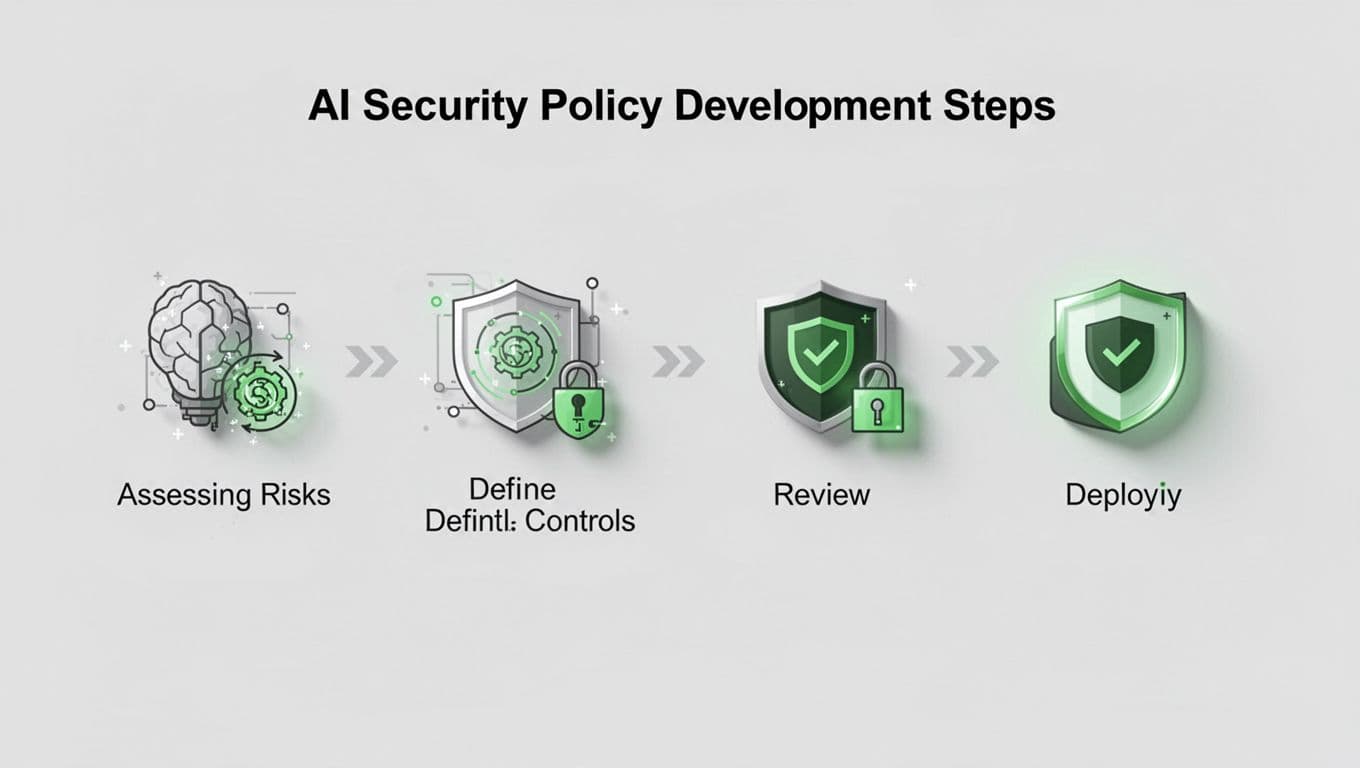
Review for completeness. Test against scenarios, like a poisoned dataset in cloud training. Cross-check with NIST-OWASP mappings.
Deploy via training and tools. Roll out to teams. Automate enforcement where possible. Track compliance with dashboards.
Update as threats evolve. Agentic AI demands fresh rules on tool access.
Apply Policies Across Production Environments
Cloud deployments need provider-specific rules. Use managed services with built-in logging. Policy: “Enable encryption at rest and in transit for all model artifacts.”
APIs demand input validation. Block prompt injections with parsers. Set query budgets to prevent DoS. Example policy: “Sanitize outputs before client delivery.”
Internal apps integrate models into workflows. Isolate via containers. Monitor for drift. Policy: “Re-train models quarterly if accuracy drops below 95%.”
Tie to compliance. EU AI Act requires transparency for limited-risk systems. NIST helps with misuse monitoring.
Test policies in pilots. Measure adoption rates. Adjust based on feedback.
Key Takeaways for AI Security Policies
Strong AI security policies start with clear risks and end with enforced rules. They protect cloud, API, and app deployments without complexity.
Focus on governance and monitoring. Use NIST and OWASP as anchors. Review often to match 2026 standards.
Your team gains confidence in production AI. Breaches drop when policies guide daily work.
Need help implementing? Book a Discovery Call with Bud Consulting to close security gaps.
(Word count: 982)