table of contents
One long training module each year feels responsible. For most companies, it’s also a weak control.
You can hit 100 percent completion, pass the audit, and still watch employees click fake invoice links, reuse passwords, or paste data into unapproved AI tools. That’s because security awareness training often gets built for compliance records, not daily decisions.
The gap becomes obvious when you look at what annual programs measure.
Completion rates don’t equal behavior change
Annual training usually tracks three things, completion, quiz scores, and policy attestation. Those are useful compliance signals. They are not proof of safer behavior.
Compliance completion asks, “Did people finish the course?” Behavior change asks, “Are fewer people taking risky actions at work?” The second standard is harder, but it matters more.
Six months later, few people remember the detail that mattered most. Meanwhile, the real trigger arrives inside email, chat, or phone calls, not in a quiz window.
People don’t make bad choices because they missed a slide. They click because they’re busy, trusting, tired, or under deadline. That pattern shows up across sectors, which is why reports like Mimecast’s state of human risk in 2026 focus on human behavior, not course attendance.
Recent data carried into 2026 shows training still helps. Trained employees click phishing emails about 32 to 38 percent less often than untrained groups. They also report suspicious emails more often, about 21 percent versus 5 percent in one cited data set. Still, those gains are strongest when learning is ongoing and tailored.
If your main KPI is completion, you’re measuring attendance, not risk.
A yearly module is like a safety briefing on January 2 for a job that changes every week. People remember parts of it. They don’t always recall the right action in the moment.
Why annual training misses today’s real attacks
Attackers don’t wait for your next refresher. By the time the yearly course returns, the playbook has shifted.
Recent security awareness training statistics show how wide the gap can be. Average phishing click rates sit around 2.7 percent overall, yet spear-phishing can reach 53.2 percent. People click in about 21 seconds on average. AI-written phishing messages have posted far higher click rates than standard campaigns. Reporting often happens much later, which gives attackers time to move.

Phishing now looks routine. A fake message may mirror a real supplier thread or HR workflow. Annual content often teaches old signs, like poor grammar, that attackers no longer need.
Social engineering has also spread beyond email. Early 2026 breach reporting tied major incidents, including attacks reported around Crunchbase and Match Group, to social engineering, credential misuse, or both. Voice phishing, text lures, and executive impersonation work because they catch people in motion.
Password reuse doesn’t stop because a video says, “Use strong passwords.” Unless training sits beside password managers, SSO, and access controls, people fall back to convenience.
Shadow IT grows for the same reason. Teams adopt file-sharing apps and AI assistants because they speed up work. An employee using a public AI chatbot to summarize contracts may not see the risk. Security, privacy, and legal teams do. If employees don’t get approved options and clear use cases, policy loses to pressure.
In 2026, the hardest cases mix all of this. An AI-written email, a cloned voice message, and a fake login page can appear in one chain. Annual training can’t keep pace with that cadence.
What a modern security awareness program looks like
Better programs treat awareness like habit-building, not event management. They use short, repeated learning moments across the year. They also match content to the risk each team faces. Short monthly modules, often five minutes or less, fit work far better than an hour-long annual block.
Finance staff need invoice fraud examples. HR teams need hiring scams and payroll change fraud. Developers need secrets handling and AI coding tool guidance. Executives and assistants need training on impersonation, travel, and payment pressure. That’s where role-based training beats generic slides.

Manager accountability matters too. Employees take security cues from their direct leaders. When managers discuss recent scams, praise quick reporting, and coach people after failures, the topic stops feeling like a once-a-year interruption.
Phishing simulations help when they teach, not punish. Good campaigns mirror current threats, land at realistic times, and give immediate feedback. A practical phishing simulation guide makes the point well. Simulations should build judgment and reporting habits, not shame people into silence.
Measure what changes risk
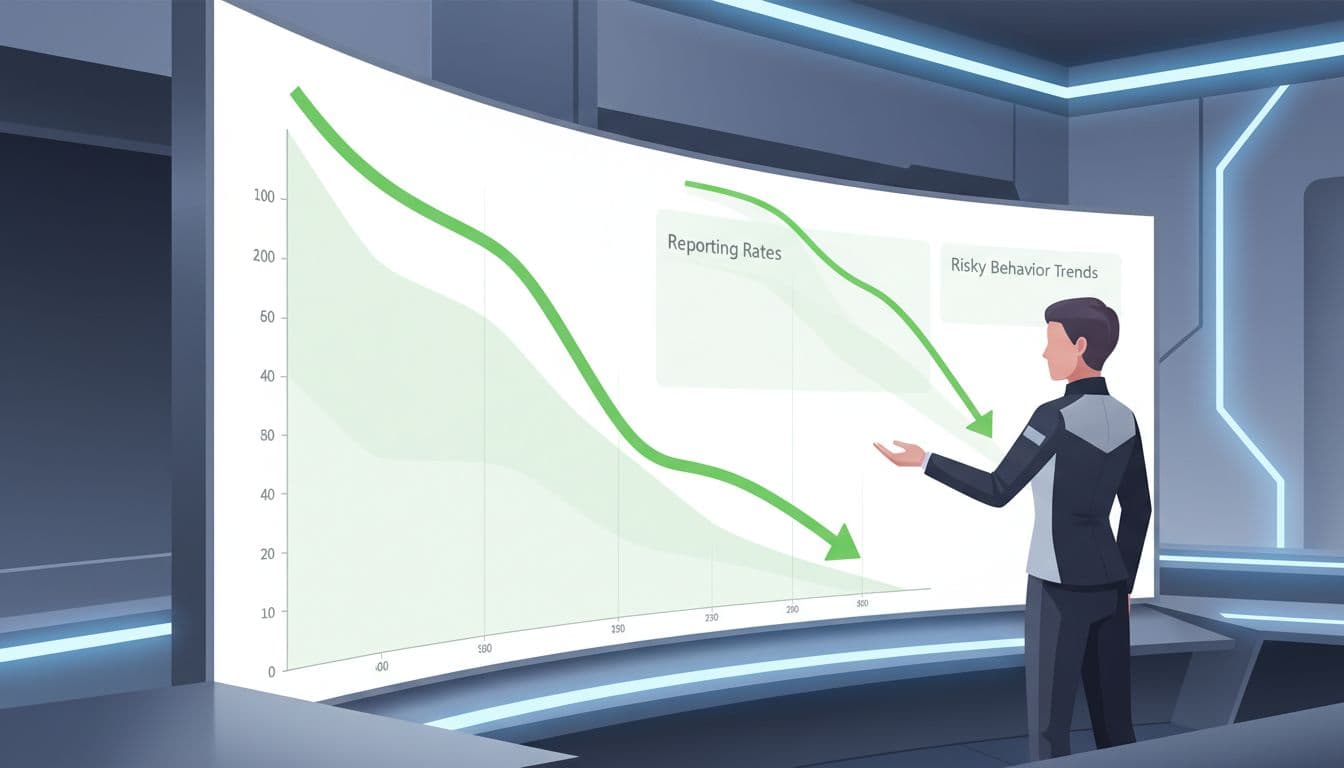
Use a few metrics that connect training to behavior.
| Compliance metric | Better behavior metric |
|---|---|
| Completion rate | Suspicious email reporting rate |
| Quiz score | Repeat failure rate |
| Policy sign-off | Risky behavior reduction by team |
| Annual pass rate | Time to report and time to contain |
These numbers tell a clearer story. Also segment them by role and business unit, because a company average can hide a weak spot. If reporting goes up, repeat failures fall, and risky actions drop, the program is working. Annual training still has a place for policy and audit needs. It just can’t carry the whole load.
A once-a-year course can satisfy a requirement. It rarely changes behavior at the speed attackers change tactics.
The stronger model is continuous, role-based, manager-backed, and measured with real behavior signals. That’s the difference between box-checking and risk reduction.
Your next audit matters. Your next phishing email matters more.