
table of contents
A strong board report template does more than collect program updates. It shows whether CTEM programs are growing, serving students well, and leading to real outcomes.
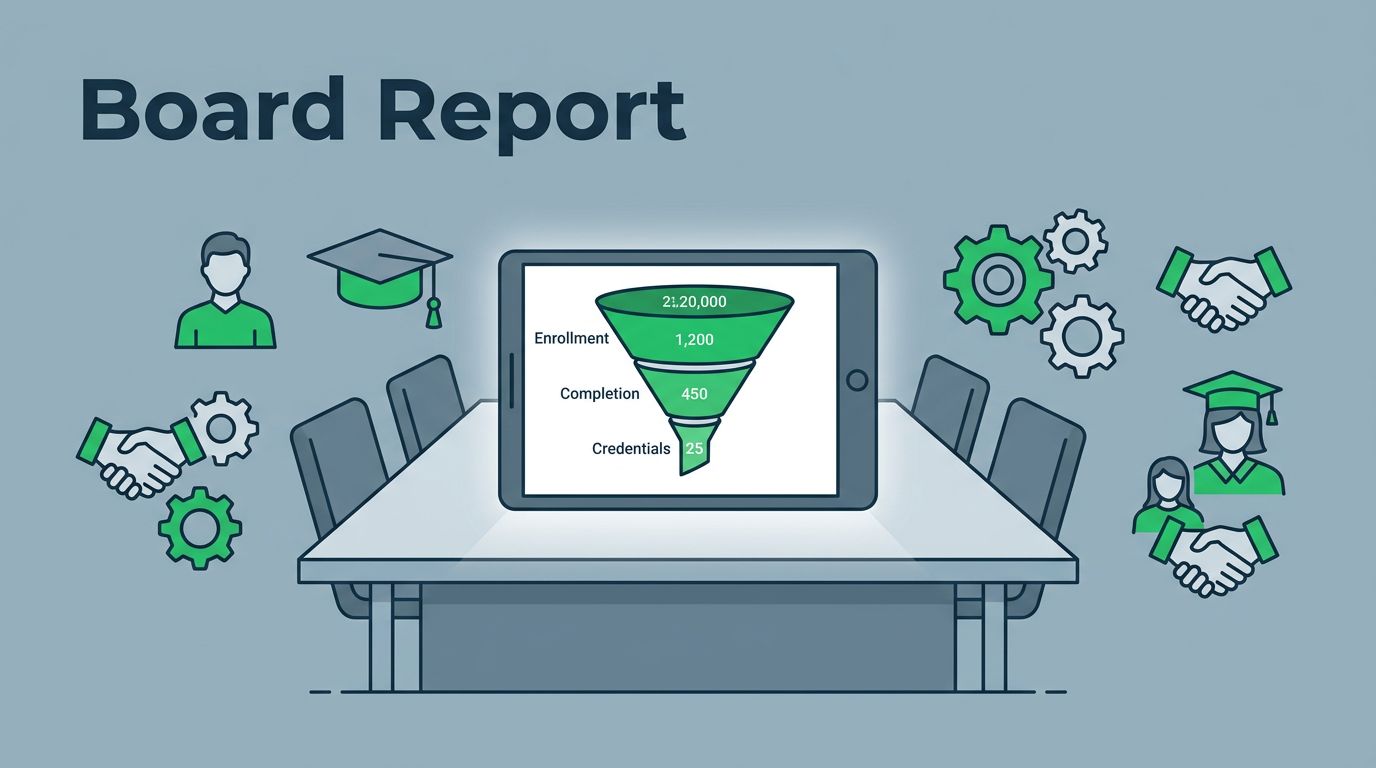
Boards do not need a stack of raw data. They need a clear path from enrollment to completion, credentials, work-based learning, and next-step readiness. That matters even more in 2026, when district leaders are expected to show results, equity, and spending in the same report.
What boards actually need to see
Most CTEM updates fail because they list activity instead of outcomes. A board does not need every field from the student information system. It needs a short story backed by numbers.
That story should answer a few simple points. Are more students entering the program? Are they staying? Are they earning credentials or completing pathways? Are employer partners opening doors? Are all student groups getting fair access?
A good reference point is Delaware’s CTE annual report, which keeps student outcomes and public accountability in the same place. For a clean way to define pathway progress, the CTE pathway concentration indicator is also useful.
The best board reports feel like a dashboard, not a scrapbook. They give the board enough detail to ask smart questions and approve the right next steps.

The best reports focus on a small set of metrics that show both scale and student results.
| Metric | What to show | Why the board cares |
|---|---|---|
| Enrollment | Total students, trend over time, and participation by pathway | Shows demand and access |
| Completion | Course completion, pathway completion, or concentrator counts | Shows whether students are staying engaged |
| Certifications | Industry-recognized credentials earned | Shows real skill gain |
| Work-based learning | Internships, clinicals, apprenticeships, job shadows | Shows career exposure and readiness |
| Industry partnerships | Active partners, new partners, donated time, equipment, or mentors | Shows employer alignment |
| Equity | Participation and success by subgroup | Shows who benefits and who is missing |
| Budget and funding | Grant use, local spending, open balances, staffing needs | Shows stewardship of funds |
| Postsecondary or career readiness | Dual credit, placements, offers, admissions, or apprenticeships | Shows next-step outcomes |
A table like this keeps the report tight. It also helps the board compare one term to the next without getting lost in spreadsheets.
A copy-and-paste board report template
Use this structure for a one-page board update, then attach a fuller appendix if needed.
If a metric does not help the board make a decision, it belongs in the appendix.
CTEM Board Report
- Reporting period: [Quarter, semester, or school year]
- Program area: [CTEM pathway, school, or district program]
- Presenter: [Name and title]
- Headline takeaway: [One sentence on what changed since the last report]
- Enrollment and access: [Total enrolled, trend, and key subgroup participation]
- Completion and persistence: [Course completion, pathway completion, and student retention]
- Credentials earned: [Number and type of certifications or industry badges]
- Work-based learning: [Internships, job shadows, apprenticeships, clinicals, or capstones]
- Industry partnerships: [Active partners, new partners, and what they contributed]
- Equity snapshot: [Participation and outcome gaps, plus any action taken]
- Budget and funding update: [Budget used, grant status, staffing, and major purchases]
- Career or postsecondary readiness: [Dual credit, placements, FAFSA support, or college/career plans]
- Risks or barriers: [Staffing gaps, supply limits, attendance issues, or schedule conflicts]
- Board action needed: [Approval, guidance, funding shift, or policy decision]
For partnership language and examples, Partnerships in Practice offers a useful frame for employer engagement.
This format keeps the report short, but it still shows the full picture. It also makes the board’s role clear, which is exactly what good governance needs.
A sample filled-in example for a district report
Here’s a simple example of what the same format can look like when filled in.
| Template field | Example text |
|---|---|
| Reporting period | Fall semester, 2025-26 |
| Program area | Health Science and Information Technology |
| Headline takeaway | Enrollment rose, completion stayed strong, and two new employers joined |
| Enrollment and access | 412 students enrolled, up 8% from last year, with growth in grades 10 and 11 |
| Completion and persistence | 89% completed their selected pathway courses |
| Credentials earned | 76 industry-recognized credentials, led by OSHA-10 and Adobe certifications |
| Work-based learning | 118 students completed internships, job shadows, or clinical rotations |
| Industry partnerships | 14 active partners, 4 new this term, 2 donated equipment or guest speakers |
| Equity snapshot | Participation among multilingual learners rose from 11% to 16% |
| Budget and funding update | 92% of grant funds spent, with $18,000 reserved for spring lab upgrades |
| Career or postsecondary readiness | 61 seniors earned dual credit or a credential tied to local hiring needs |

The sample works because it stays specific. It names the pathway, shows the trend, and points to student outcomes. It also gives the board enough detail to ask about staffing, expansion, or funding shifts without forcing them to hunt for context.
A strong CTEM report should feel calm and direct. When the data are clear, board members can focus on what matters most, student access, student success, and the return on district investment. That is the job of a good board report template.

