table of contents
Most security teams don’t lack findings, they lack focus. If your backlog keeps growing while risk still feels high, that’s the problem continuous threat exposure management tries to fix.
Continuous Threat Exposure Management (CTEM) gives you a way to keep checking what attackers could reach, what matters most to the business, and what needs action first. It’s not a one-time project, so let’s start with the plain-English version.
What continuous threat exposure management actually means
CTEM is an ongoing way to find, rank, test, and reduce the exposures an attacker could use. Think of it less like an annual health check and more like continuous monitoring with a treatment plan.
That simple idea matters because most security teams already have plenty of data. They have vulnerability scans, cloud alerts, identity reports, and penetration test results. What they often don’t have is a shared way to decide what is most dangerous right now.
CTEM is not a once-a-year test, it’s a repeatable way to cut the exposures attackers can reach now.
In current security practice, an “exposure” can be much more than a software bug. It might be a cloud misconfiguration, an over-privileged admin account, an exposed remote access service, a forgotten internet-facing app, or a path that chains several small weaknesses together. That exposure-first mindset is why CTEM feels different from older programs.
Most current definitions, including CTEM.org’s guide to the five-stage cycle, describe CTEM as a loop: scoping, discovery, prioritization, validation, and mobilization. Gartner introduced the term, but the model has gained traction because it matches how attacks work in 2026. Attackers rarely use one flaw in isolation. Instead, they link access, identity gaps, and weak controls into a usable path.
So CTEM is risk-based and exposure-focused. It asks, “Can an attacker use this, and would it hurt something important?” That’s a better question than “How many findings did the scanner produce?”
How CTEM works in real security programs
Strong CTEM programs repeat the same cycle, but they don’t start everywhere at once. They begin with a tight scope, such as a payment platform, a production cloud account, privileged identities, or remote access systems.
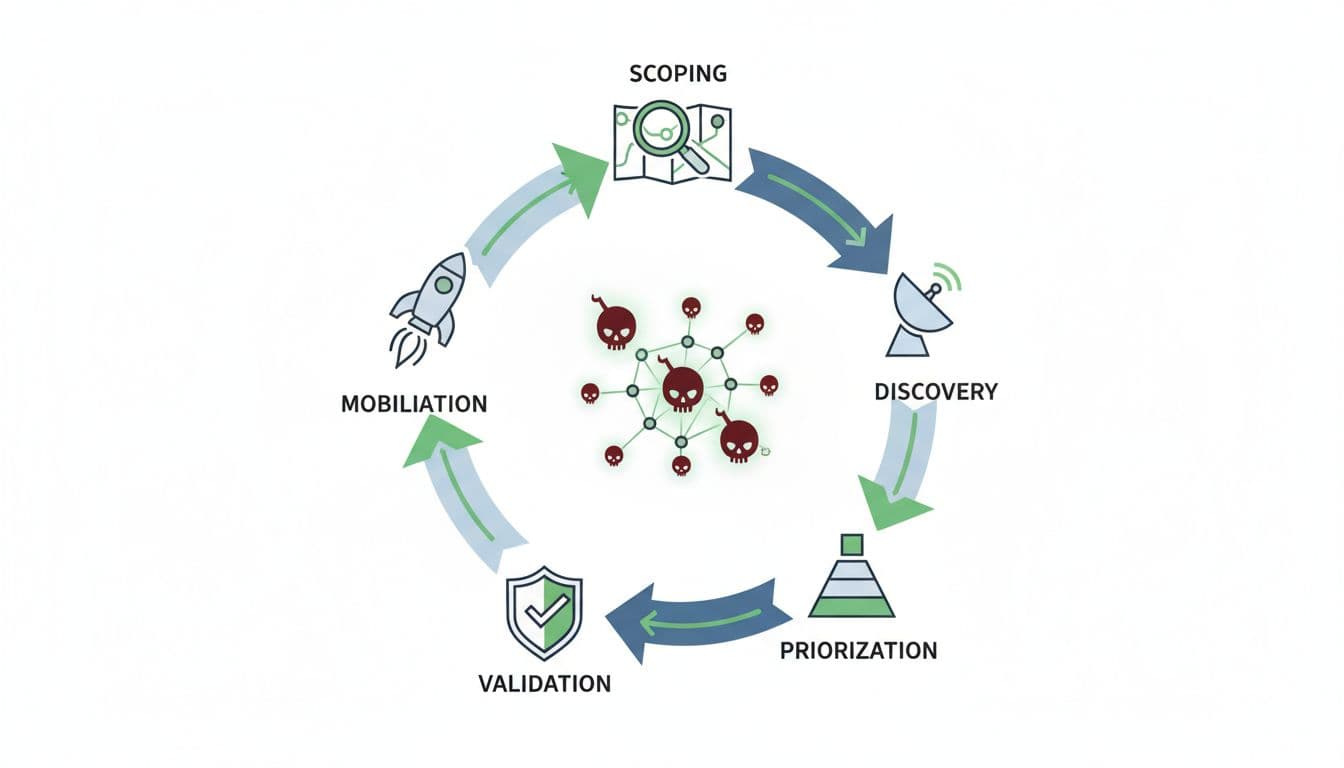
First comes scoping. Security and business owners agree on what matters most. Next comes discovery, where teams gather data on assets, identities, cloud settings, vulnerabilities, and external exposure. Then comes prioritization, which ranks issues by exploitability, business impact, and attack path context. After that, validation tests whether the exposure can truly be used. Finally, mobilization assigns fixes, tracks progress, and feeds lessons back into the next cycle.
Validation is where CTEM separates itself from a basic reporting exercise. A high-severity flaw on an isolated lab server may wait. Meanwhile, a medium-severity flaw on a public single sign-on system tied to weak admin controls may jump to the top. That’s why many 2026 programs combine attack-path analysis, cloud posture data, identity exposure, and breach simulation. For a practical cloud-focused example, Wiz’s CTEM overview shows how teams tie findings to exploitable paths.
A real scenario makes this clearer. A hospital may have hundreds of missing patches. CTEM narrows the focus to the VPN gateway, the imaging app, and an over-privileged service account because those three items create a realistic lateral movement path into sensitive systems. Security validates the chain, then IT fixes those items first.
A SaaS company might see a different pattern. It already runs cloud security tools, yet CTEM reveals a forgotten staging app, weak domain settings, and excessive developer rights. Each issue alone looks manageable. Together, they create a simple route to production access.
CTEM vs vulnerability management, attack surface management, and pen testing
These practices overlap, but they are not the same. Here’s the quick comparison.
| Practice | Main focus | Cadence | Best at | Weak alone |
|---|---|---|---|---|
| CTEM | Real exposures tied to business risk | Continuous loop | Prioritizing and validating what attackers can use now | Needs data, ownership, and follow-through |
| Vulnerability management | Known flaws and missing patches | Regular scans | Patch hygiene and broad coverage | Often lacks attack-path context |
| Attack surface management | Internet-facing assets and shadow exposure | Continuous discovery | Finding what is exposed outside | May not prove exploitability |
| Penetration testing | Human-led control testing | Periodic | Deep testing of selected paths | Snapshot in time, limited scope |
The takeaway is simple. CTEM does not replace these practices. It connects them. Vulnerability management feeds it findings, attack surface management shows what is exposed, and pen testing helps validate defenses. Platforms built for continuous exposure validation support this by testing whether a finding is truly usable, not merely present.
How to start CTEM without boiling the ocean
Start with one business service or one high-risk asset group. Pick something that matters, such as customer data, remote access, or privileged identity paths.
Then name owners across security, IT, cloud, and application teams. CTEM fails when findings sit between teams with no one accountable for the fix.
Also, agree on a few simple measures. Good early metrics include fewer exploitable internet-facing paths, faster validation of fixes, and less time spent on low-value findings. If a tool gives you more alerts but less clarity, it’s not helping enough.
CTEM works because it turns security into a steady decision loop. When you focus on exposures attackers can use, the backlog gets smaller, and the work gets smarter.
For organizations evaluating CTEM, the best next move is small and concrete. Scope one area, validate one attack path, and use the results to build support for a wider program.