table of contents
A slow cybersecurity hire often starts with a sloppy intake, not a weak market.
When the req is vague, recruiters chase the wrong people and hiring managers lose weeks. In 2026, that hurts twice as much because strong candidates move fast and good teams are already stretched.
A solid cybersecurity hiring checklist fixes that before the search starts. It sharpens the role, sets real must-haves, and gives everyone the same target.
Why most security reqs stall before sourcing
Many teams open a search with the title first and the problem later. That usually creates a job description that reads like a wish list.
Hiring managers and candidates still care about proof, not polished wording, as Dice’s 2026 hiring view makes clear. If the intake does not define the work, the shortlist gets noisy.
A cloud security engineer, detection engineer, and security operations leader all solve different problems. If you treat them like one profile, recruiters will waste time and strong candidates will walk.
The fix is simple. Start with the risk, the gap, and the outcome. Then build the search around that.
Separate technical needs, business context, and hiring signals
A good intake meeting keeps three things apart. Technical needs tell you what the person must do. Business context explains why the role exists. Hiring signals show what proof should count.
Use this split before you write the job post.
| Category | What to capture | Good intake question |
|---|---|---|
| Technical requirements | Tools, platforms, depth, and scope | “Do we need AWS controls, Kubernetes, or both?” |
| Business context | Trigger, risk, team gap, and urgency | “Did an incident, audit, product launch, or attrition create this role?” |
| Hiring signals | Past work, outcomes, and proof | “What would a strong candidate have built or fixed in the last year?” |
When those three pieces stay separate, it gets easier to compare candidates and explain the role to finance, HR, and engineering.
It also stops scope creep. A role that starts as security engineering can quietly turn into cloud ops, compliance, and incident response if no one draws a line.
Role variations change the intake fast
One title can hide very different jobs. A security engineer might own platform hardening and tooling. A cloud security engineer needs IAM, cloud posture, and IaC review. A detection engineer needs query logic, telemetry design, and alert tuning. A GRC analyst needs control mapping, audit support, and risk writing. An AppSec engineer needs SDLC fluency, code review habits, and secure CI/CD. A security operations leader needs triage flow, staffing, and escalation discipline.
For role-specific framing, HADESS’ cloud security engineer guide helps separate cloud depth from general security work, while Wiz’s GRC analyst overview shows how compliance roles tie to frameworks and risk. Those differences matter before a recruiter ever writes the posting.

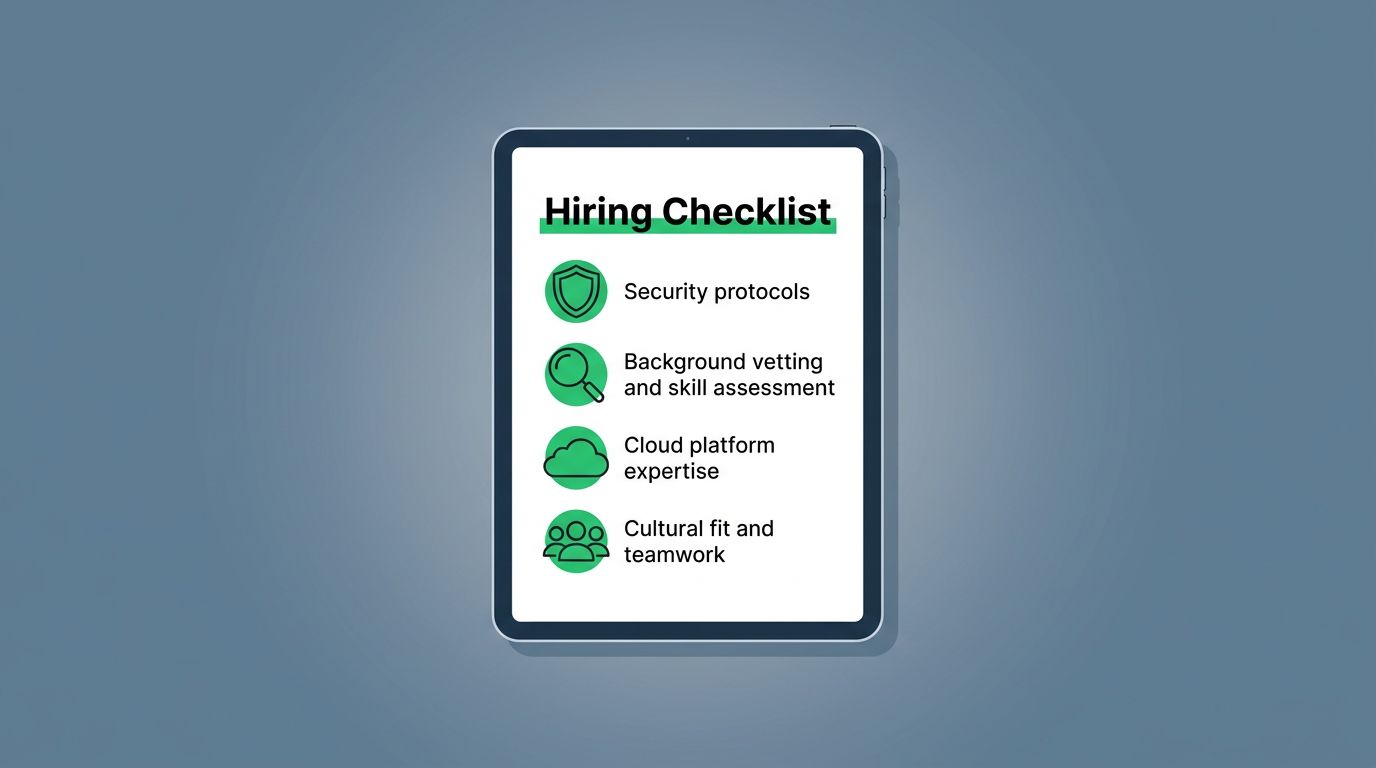
Your reusable cybersecurity hiring intake checklist
Use this every time a security role opens.
- State the business problem. Say whether the role supports cloud hardening, detection coverage, audit readiness, product security, or operations coverage.
- Name the stack. List cloud providers, SIEM, EDR, IaC tools, ticketing systems, and any coding languages that matter.
- Define the real seniority. Explain the scope of decisions, not the title alone.
- Separate must-haves from teachable gaps. Keep the must-haves tight, then name what the team can teach in the first 90 days.
- Write the proof you want. Ask for shipped detections, hardened landing zones, passed audits, reduced MTTR, or secure code changes.
- Capture the partners. Note who the hire must influence, such as cloud teams, app teams, IT, legal, or risk leaders.
- Set the process rules. Decide who interviews, what each round tests, and how fast feedback must land.
- Define the first 90 days. Good candidates want to know how success will be measured.
A strong intake also improves candidate quality. It keeps the team focused on recent evidence instead of broad claims. That matters because many employers still value certifications and training, but they need hands-on skill to show up first, as ISC2’s hiring trends study shows.
If the role is senior, niche, or stuck behind too many opinions, Book a Discovery Call with Bud Consulting before the search goes live.
Red flags that slow the search
A weak intake usually shows the same warning signs.
- The title keeps changing in every meeting.
- Leaders ask for one person to own cloud, app, and GRC work.
- No one can explain what success looks like after 90 days.
- The interview panel tests different job descriptions.
If the team can’t describe success in plain language, candidates will fill in the blanks, and usually in the wrong direction.
That is where time-to-fill grows. It also lowers trust with the people you want most.
A better intake shortens the whole search
Good security hiring starts before sourcing. When the intake covers the business problem, the stack, and the proof you need, recruiters move faster and candidates trust the process.
That one meeting can cut weeks, protect candidate quality, and keep the role aligned with the work that actually needs doing. In a market this tight, that discipline is the difference between a live search and a stalled one.