table of contents
When your enterprise needs a major security partner, the choice often comes down to two consulting giants. Evaluating EY vs Accenture cybersecurity capabilities requires looking past the polished marketing decks and into how these firms actually deliver services. Both brands carry massive global weight, but their operational strengths, delivery models, and specialist focuses differ significantly. Knowing those differences helps procurement teams and security leaders avoid costly misalignment.

Key Takeaways
- EY integrates its cybersecurity practice tightly with traditional risk, assurance, and industrial operational technology capabilities.
- Accenture centers its cybersecurity model on large-scale enterprise modernization, zero trust architecture, and governance risk compliance leadership.
- Pricing structures and team availability vary widely by region, industry sector, and whether you require advisory work or fully managed operations.
- Evaluating either firm requires rigorous request for proposal questions that test real-world staffing quality over brand reputation.
Core Philosophical Differences in Cyber Strategy
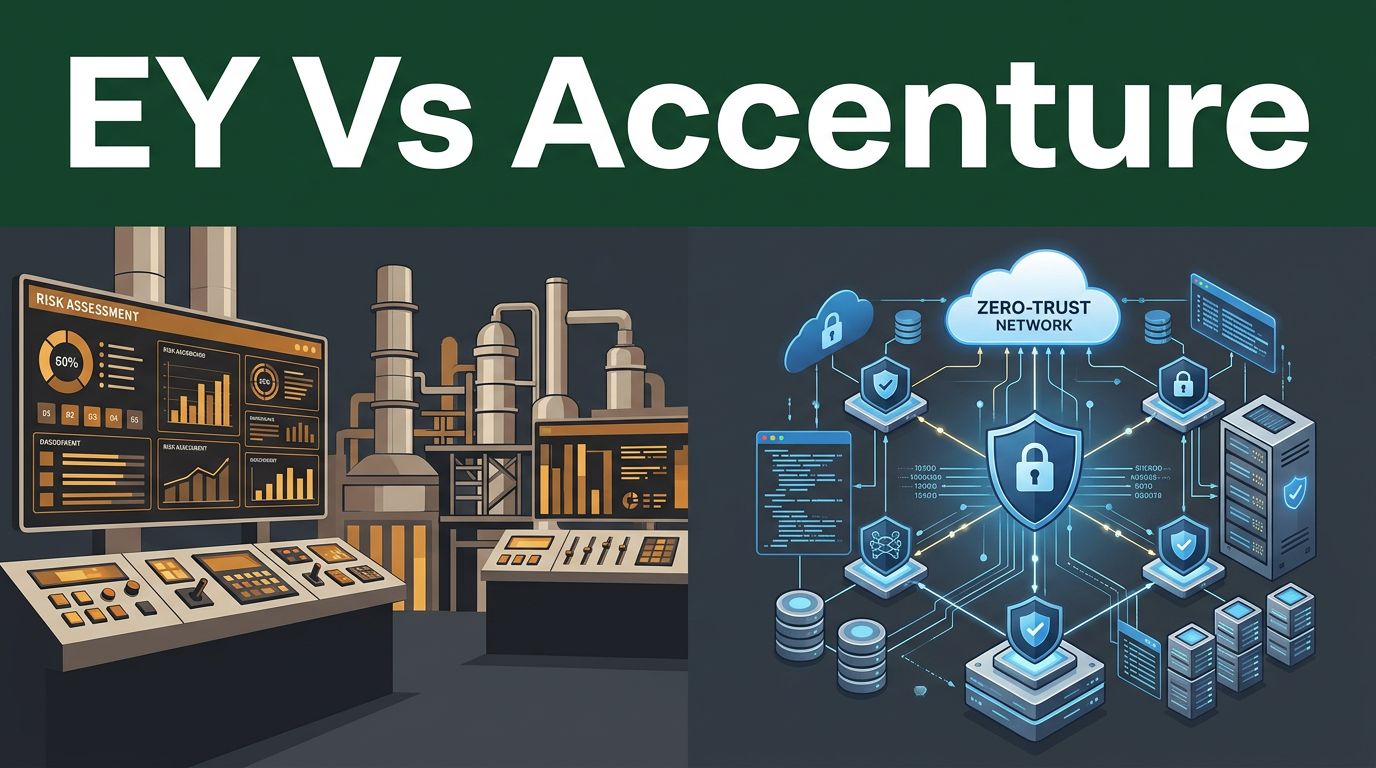
EY approaches cybersecurity through the lens of business risk, compliance, and regulatory resilience. Their portfolio spans strategy, governance, risk and compliance, identity, cloud security, threat detection, and specialized industrial operational technology protection, as outlined in EY’s global cybersecurity services overview. Because EY has deep roots in audit and financial advisory, its security teams frequently bridge the gap between technical threat data and board-level risk reporting.
Accenture approaches security through enterprise transformation and digital scale. Their practice focuses on large-scale modernization, zero trust implementations, and secure-by-design engineering. While EY leans heavily on compliance alignment and assurance frameworks, Accenture focuses on engineering complex architectures across global cloud footprints. If your organization is undergoing a massive digital migration, Accenture’s delivery DNA often feels native to that environment.
Security leaders must decide whether their primary pain point is regulatory alignment or technological transformation. Choosing the wrong partner usually leads to cultural friction between internal IT teams and external consultants. Understanding these foundational approaches prevents mismatches during high-stakes vendor selection cycles.
Managed Security Services and Operational Delivery
Managed detection and response requirements separate advisory-heavy firms from operations-heavy providers. EY runs global security operations centers backed by structured accelerators and managed services that handle daily threat monitoring. Their managed services model is designed to run full security operations using their own teams, proprietary frameworks, and global delivery networks.
Accenture operates at an industrial scale with automated tooling and deep technical integrations across major cloud providers. Their managed cyber services focus on rapid provisioning, automated response playbooks, and continuous monitoring for Fortune 500 enterprises. Organizations often find that Accenture scales faster for high-volume technical monitoring, while EY provides tighter coordination with internal audit and compliance committees.
| Operational Dimension | EY Cybersecurity | Accenture Cybersecurity |
|---|---|---|
| Primary Heritage | Risk, Audit, and Compliance | Enterprise IT and Digital Transformation |
| Managed Operations | Global SOC network with compliance focus | High-scale automated managed threat services |
| OT / Industrial Depth | Extensive industrial cybersecurity services | Standard enterprise IT and cloud security focus |
| GRC Positioning | Integrated governance and assurance | IDC MarketScape GRC consulting leadership |
This comparison highlights that your choice depends on whether your security operations need an auditor’s rigor or an engineer’s velocity. Reviewing internal staffing constraints clarifies which operational model fits your team.
Specialized Sectors and Industrial Technology Depth
Industrial environments and operational technology present challenges that standard corporate IT consultants often mishandle. EY has built specific recognition in industrial cybersecurity, ranking as a verified leader in industrial security consulting and managed services. Their teams deploy standards like IEC 62443 to secure manufacturing plants, energy grids, and supply chain infrastructure.
Accenture focuses heavily on corporate enterprise environments, financial institutions, and retail ecosystems where digital consumer touchpoints drive risk. Their strengths lie in identity and access management foundations, quantum readiness assessments, and large-scale zero trust rollouts. If your assets include physical machinery, smart factories, or critical infrastructure, EY’s industrial depth provides a distinct advantage.
| Industry Focus | EY Strengths | Accenture Strengths |
|---|---|---|
| Manufacturing and OT | IEC 62443 compliance, plant security | General IT modernization for manufacturers |
| Financial Services | Regulatory audits, M&A due diligence | High-volume fraud prevention, core banking security |
| Public Sector | Government risk frameworks, public infrastructure | Large federal IT modernization programs |
Matching your sector to the vendor’s proven delivery track record reduces deployment friction. Always ask for case studies from organizations operating in your exact regulatory and physical environment.
AI-Enabled Accelerators and Delivery Ecosystems
Artificial intelligence has changed how cybersecurity consulting firms build and deliver client work. EY utilizes named proprietary accelerators such as EYQ for private large language models, IsecMapper for automated evidence validation, and PARIS for privileged access risk scoring. These tools allow EY consultants to speed up compliance assessments and reduce manual review cycles.
Accenture deploys proprietary enterprise security platforms designed for real-time threat intelligence sharing and automated vulnerability remediation. Their tools focus on continuous posture assessment across multi-cloud infrastructure rather than audit-driven evidence collection. Both firms invest heavily in automation, but their output reflects their underlying business models.
| Innovation Area | EY Approach | Accenture Approach |
|---|---|---|
| Primary AI Focus | Audit automation and compliance validation | Cloud posture automation and threat analytics |
| Proprietary Tooling | EYQ, IsecMapper, PARIS | Enterprise security analytics platforms |
| Delivery Style | Risk-focused assessment accelerators | Engineering-focused deployment scripts |
Evaluating these tools during a vendor evaluation helps you understand how much billable time you are actually saving. Request live demonstrations of these proprietary accelerators before signing long-term statements of work.
Pricing Structures and Engagement Economics
Consulting costs vary dramatically based on scope, geography, and whether you purchase advisory hours or managed retainers. Market data indicates that EY consulting engagements often map closely to traditional professional services pricing models, with day rates varying by region and service tier. They frequently bundle cybersecurity assessments into broader financial audits or corporate restructuring projects.
Accenture typically structures major enterprise contracts through scoped, milestone-based quotes tied to complex architectural deliverables. Their pricing reflects large-scale engineering deployments and software integration overhead. Organizations must examine the total cost of ownership, including hidden licensing fees for proprietary vendor tools and ongoing managed service retainers.
Before committing to either firm, you should Book A Call With Us to discuss how boutique specialist firms compare to these global giants on cost and speed.
Practical RFP Questions for Evaluation
Evaluating global consulting firms requires specific questions that cut through marketing language and test real delivery capability. Standard requests for proposal often yield generic responses that make both providers look identical. Security leaders need targeted inquiries that expose staffing realities and tool integration challenges.
Ask prospective partners to provide exact staff turnover rates within their dedicated cybersecurity practices. Inquire about the percentage of work delivered by named senior consultants versus offshore generalists. Require vendors to detail how their proprietary tools integrate with your existing security information and event management stack without requiring custom API development.
Here are four essential questions to include in your next security RFP:
- What exact percentage of our day-to-day managed security operations will be handled by onshore versus offshore personnel?
- Can you demonstrate how your proprietary automation accelerators integrate with our current cloud security posture management tools?
- What specific certifications do your assigned operational technology engineers hold for IEC 62443 compliance?
- How do you handle intellectual property protection when utilizing private language models for our security data analysis?
Asking these questions forces providers to move past generic slide decks and address specific operational constraints. The responses reveal which firm is genuinely prepared to secure your enterprise environment.
Conclusion
Choosing between these two consulting leaders depends entirely on your specific risk profile and business objectives. EY fits organizations that require deep regulatory compliance, industrial operational technology security, and audit-grade risk governance. Accenture suits enterprises undertaking massive digital transformations, cloud modernization projects, and large-scale zero trust architectural overhauls.
No single provider wins every category across every industry sector. Evaluate your internal skills gaps, review your compliance mandates, and test both firms with rigorous operational questions before making a final commitment.