table of contents
Hiring a cloud network security engineer takes more than checking for “cloud” on a resume. The right person has to understand traffic paths, identity, firewall policy, logging, and incident response at once.
If you hire too narrowly, you get a network specialist who struggles with cloud control planes. If you hire too broadly, the job turns into a vague catch-all and good candidates walk away.
A clear scope, a practical interview loop, and a test based on your real stack will save time. They also cut the risk of a costly mismatch.
What the role owns in practice
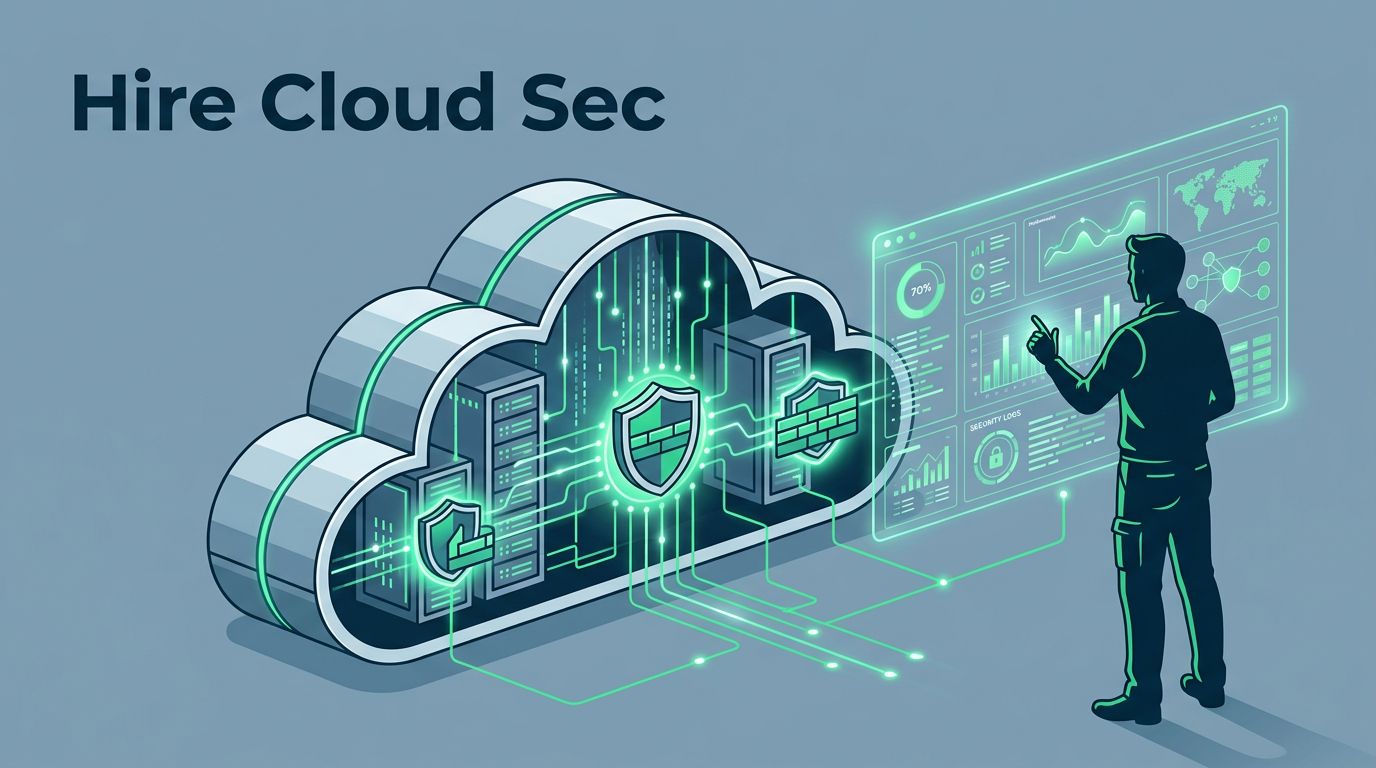
A cloud network security engineer protects the paths your data uses. That includes public ingress, private subnets, VPNs, peering links, DNS, load balancers, and the policy around them.

They are often the person who explains why an app is exposed or why traffic is blocked. They also help during incidents, because logs only help when someone can read them fast.
In 2026, the role usually sits between cloud infrastructure, network operations, and security operations. Many teams also expect some work in infrastructure-as-code and container networks, because those controls now shape the attack surface.
A useful rule is simple. If the candidate can only talk about one platform or one tool, keep probing. Good hires understand the control plane, the data plane, and the people who own each one.
A broader cloud security engineer roles and responsibilities guide is useful when you need to separate platform security from network control.
Typical ownership includes:
- Designing and tuning network controls, such as security groups, ACLs, firewalls, VPNs, and routing rules.
- Reviewing risky changes before they reach production.
- Investigating alerts, traffic spikes, and suspicious access paths.
- Working with developers, platform teams, and SOC staff during incidents.
- Keeping access tied to identity, not just IP ranges.
That mix is why the role is hard to hire. You need someone who thinks in packets, but also communicates in plain language.
The skills that matter most in the first screening
Screening gets easier when you split the job into must-haves and nice-to-haves. Otherwise every resume looks close enough.
| Area | Must-have | Nice-to-have |
|---|---|---|
| Cloud networking | Security groups, ACLs, routing, DNS, VPNs, load balancers | Advanced segmentation, SASE, hybrid routing design |
| Identity | Least privilege, MFA, role design, service account hygiene | Just-in-time access and cross-account governance |
| Monitoring | Reads flow logs, cloud audit logs, and SIEM alerts | Writes detections and tunes alert noise |
| Automation | Can read Terraform or similar config | Writes policy-as-code and guardrails |
| Scope | Strong in one cloud | Comfortable across AWS, Azure, and GCP |
| Communication | Clear incident notes and handoff docs | Leads design reviews and mentors others |
The best resume shows judgment, not just tool names. If the person has never touched logs, network policy, or change control, the fit is weak, even with strong certs.
Look for evidence that they have made tradeoffs. Did they simplify a rule set? Did they remove risky access? Did they document a fix so the next person could repeat it? That is the kind of thinking you want.
Tools and platforms worth asking about
The exact stack will vary, but the themes are stable. Ask about the tools that sit on the network path and the tools that prove what happened.
| Category | Common examples | What strong experience sounds like |
|---|---|---|
| Cloud control planes | AWS VPC and security groups, Azure VNets and NSGs, GCP VPC and firewall rules | Explains traffic flow and where policy lives |
| Detection and logs | VPC Flow Logs, CloudTrail, Azure Monitor, Sentinel, Security Command Center, SIEM tools | Knows which log answers which question |
| Edge and access | VPN, ZTNA, WAF, proxies, IAM, MFA | Ties identity to network access |
| Infrastructure as code | Terraform, CloudFormation, Bicep | Reviews configs before deployment |
| Network and security vendors | Palo Alto, Fortinet, Cisco, Zscaler, Check Point | Troubleshoots policy without guesswork |
Brand names matter less than the reasoning behind them. A team on AWS should still listen for cloud-agnostic ideas, because good network design transfers.
If your apps run on Kubernetes, ask about network policies, ingress, and service-to-service access. If the candidate has never seen those patterns, they may need a long ramp-up.
Certifications that help, and when to ignore them
Certs can support a screen, but they should not carry it.
A strong shortlist often includes CCSP, AWS Certified Security, Azure Security Engineer Associate, and Google Professional Cloud Security Engineer. CISSP is useful for senior candidates who need to work across policy, risk, and controls.
For a network-heavy role, vendor certs can help too, especially when your environment is built around one firewall or access platform. Still, a cert proves study, not judgment.
If the candidate cannot walk through a real incident or explain a live control they built, the cert should stay a small signal. A network security engineer hiring guide is a useful companion when you want to balance formal credentials with practical tests.
Use certifications as a filter, not the finish line. A strong engineer can explain why a control exists, when it should change, and what breaks if it does.
Interview questions that reveal real skill
Good interview questions make the candidate explain how traffic actually moves. They also expose whether the person can think under pressure.

Use questions that force candidates to connect cloud, network, identity, and response work.
- “Walk through how you would secure traffic between a public app and a private database in AWS, Azure, or GCP.” Strong answers mention segmentation, routing, identity, secrets, and logs.
- “Which logs do you check first after a sudden spike in east-west traffic?” Good answers name flow logs, audit logs, change history, and alert triage.
- “How do you design least privilege when network and identity teams both touch access?” Listen for roles, service accounts, approval flow, and break-glass access.
- “Tell me about a security group or firewall rule you had to fix fast. What changed?” Strong answers show prioritization, validation, and rollback thinking.
- “How would you explain a risky cloud network finding to a developer?” Good answers stay plain, concrete, and tied to impact.
- “What would you automate first in your first 90 days?” Look for repetitive reviews, guardrails, or alert tuning.
Listen for tradeoffs. A strong candidate can explain why one control is enough for now and what might break later. A weak candidate names five products and leaves it there.
Good interviews force candidates to narrate packet flow, identity checks, and failure points. They do not reward acronym dumps.
Technical assessments that are hard to fake
A useful benchmark is how to hire a network security engineer, which favors realistic scenarios over trivia. That approach works well here too.
The best assessment is short, practical, and tied to your environment. Keep it close to the real work, because that tells you more than a whiteboard puzzle ever will.
- Review a short Terraform or cloud firewall change and mark the risky parts.
- Read flow logs and audit logs, then explain the most likely path of movement.
- Review an architecture diagram and add controls for ingress, segmentation, and access.
- Write a brief incident note after a simulated event.
Score the work on reasoning, accuracy, remediation, and clarity. If the role will touch production, include a change review step. That shows whether the candidate understands how security fits into real delivery.
A good assessment also shows how the person thinks when details are missing. Do they ask the right questions? Do they notice gaps? Do they call out assumptions before they guess?
How hiring changes by company stage
The same title can mean different things, depending on company size. The role should match the environment, not the other way around.
| Company stage | Best fit | Screen for |
|---|---|---|
| Startup | Broad hands-on generalist who can secure cloud networking, handle incidents, and document changes | Practical cloud skills, speed, calm under pressure |
| Mid-market | Builder who can create guardrails, support DevOps, and clean up legacy gaps | IaC, cross-team change control, hybrid comfort |
| Enterprise | Specialist who can work across teams, policy, compliance, and segmentation at scale | Governance, automation, stakeholder management, incident depth |
The bigger the company, the more coordination matters. The smaller the company, the more range and speed matter.
Startups should avoid hiring a pure strategist with no operating muscle. Mid-market teams should avoid under-scoping the role. Enterprises should avoid assuming a title means current hands-on skill.
If the brief is still fuzzy, Book a Discovery Call with Bud Consulting and tighten the scope before the search drifts.
Remote hiring without losing signal
Remote hiring works well for this role if you make the process visible. Ask for written notes, not only live answers, because cloud network work depends on clear handoffs.
A practical process looks like this, a short written screen, a live troubleshooting session, and one design review with a shared diagram. If the candidate can explain a change on screen and summarize it in writing, you learn a lot.
Also check time-zone overlap and on-call expectations early. A cloud network security engineer may need to join incidents fast, so the schedule has to match reality.
Remote interviews should test communication as much as config skill. Someone who cannot explain a route table or firewall change in plain language will slow the team down later.
Use the remote process to confirm discipline. Ask how the candidate documents changes, hands off incidents, and keeps notes when several teams are involved. Those habits matter more when people are not in the same room.
Mistakes that slow down a good hire
A strong candidate pool can disappear fast if the process is sloppy.
- Writing a job description that mixes cloud security, network admin, SOC, and DevOps into one seat.
- Ranking certs above production experience with logs, routing, and access control.
- Using abstract questions instead of role-based scenarios.
- Ignoring how the person will work with developers and platform engineers.
- Forgetting to define on-call, response time, and salary range before interviews start.
Each of these mistakes adds weeks to the search and weakens the shortlist. If your interview loop does not include a live config or incident review, you are guessing.
The fix is simple. Define ownership, choose realistic tests, and keep the process tight enough that good candidates can move through it.
Conclusion
Hiring a cloud network security engineer goes smoother when you treat the role as a mix of network control, cloud policy, and incident response. The strongest candidate can explain how traffic moves, how access is granted, and how problems show up in logs.
That clarity matters more than a long tool list or a stack of certifications. Start with the real paths, logs, and ownership boundaries in your environment, then build the interview around them.
When the scope is tight and the assessment mirrors the job, the right hire is much easier to spot.