table of contents
Hiring a GRC manager can save a regulated company from messy audits, control gaps, and last-minute fire drills. It can also create a false sense of security if the hire looks good on paper but cannot run the work.
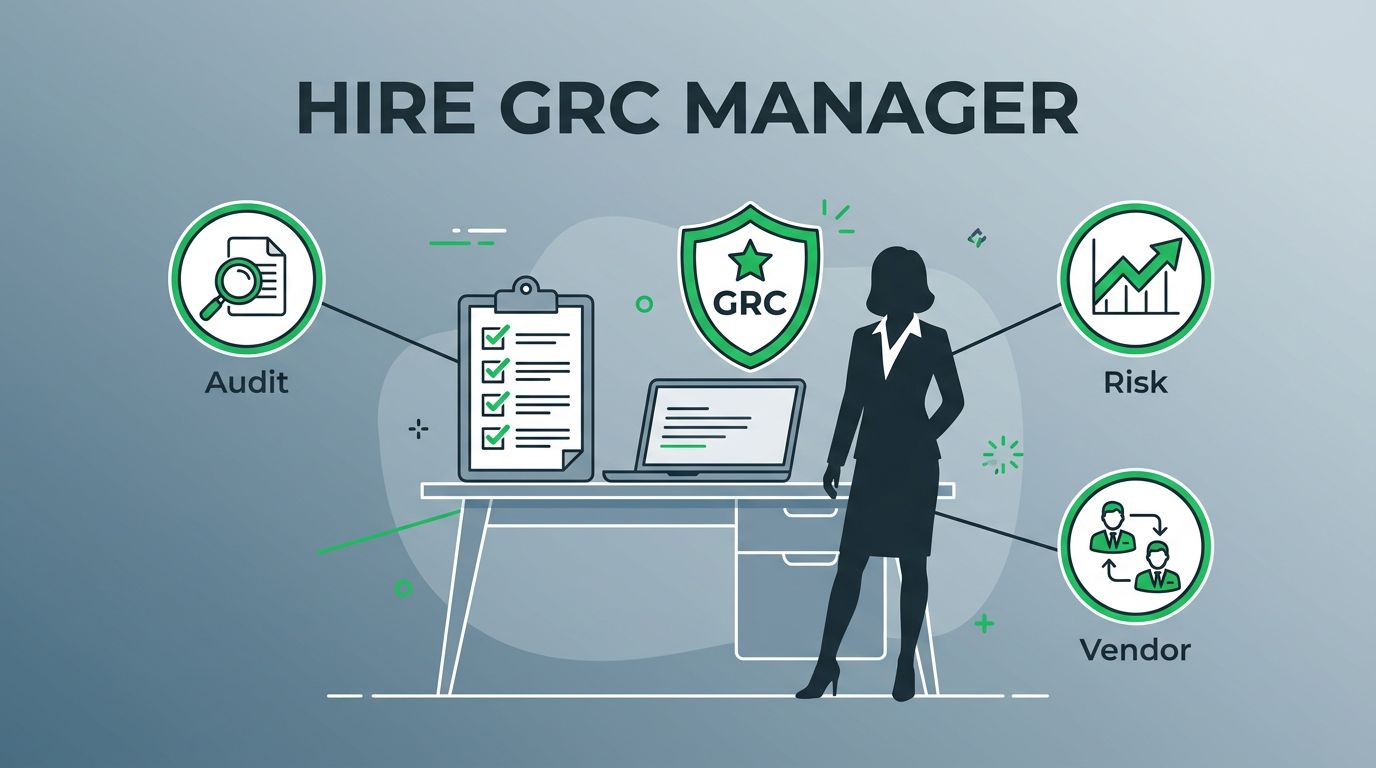
The right person does more than track policies. They connect audit readiness, risk assessments, control ownership, vendor reviews, and internal teams that do not always move at the same speed.
When you hire a GRC manager, the safest path is to tie the search to your real obligations, then test for proof in past work. That makes the role clearer for candidates and easier to judge.
Build the role around real obligations
Start with the work, then write the job description. A GRC manager at a healthcare company faces different pressure than one at a B2B SaaS firm or a payments business. The first may spend more time on HIPAA and access controls. The second may live inside SOC 2, vendor risk, and customer due diligence.
A strong scope usually includes ownership of recurring compliance work, not just support tasks. That means the manager should keep controls moving after the first audit passes.
For a useful reference on executive reporting and compliance authority, see board-level compliance leadership guidance.
Use the role definition to spell out what the person will own:
- Audit readiness across internal and external reviews
- Control testing and remediation tracking
- Policy management with review dates and approval flow
- Third-party risk reviews and follow-up
- Cross-functional coordination with security, legal, HR, finance, and engineering
- Leadership reporting on open risks, exceptions, and deadlines
If your company uses AI in products or operations, add that to the scope now. By 2026, the better candidates know how to set guardrails for approved tools, review data use, and track human oversight. If they have never touched AI governance, they may still be useful, but they will need support.
The job should read like a real operating model. If it sounds like a list of buzzwords, the search will attract the wrong people.
Look for proof they can run frameworks
The best candidates can explain how they turned a framework into daily work. Anyone can name SOC 2 or ISO 27001. Fewer people can show how they built evidence, assigned owners, and closed gaps before an auditor asked.
Use the company type to set the framework focus.
| Company type | What the manager should know |
|---|---|
| SaaS selling to enterprises | SOC 2, vendor risk, access reviews, evidence collection |
| Healthcare or life sciences | HIPAA, data handling, privacy, incident response |
| Payments or retail | PCI DSS, logging, segmentation, change control |
| Public company or SOX-bound business | SOX, IT general controls, segregation of duties, audit trails |
| AI-heavy product company | AI governance, model review, human oversight, data lineage |
The table should shape your interview. A strong candidate will not claim deep expertise in every framework. Instead, they will explain how they learned each one and how they kept the work moving.
By 2026, you should also expect comfort with modern compliance tooling. That includes GRC platforms, evidence automation, ticketing workflows, and dashboards that show control status without manual cleanup. A candidate who still depends on spreadsheet chaos may struggle as the program grows.
If you want more interview prompts, these GRC hiring questions are a useful supplement.
Look for these signals in their answers:
- They can explain how a control owner gets assigned and held accountable.
- They know the difference between a real fix and a temporary exception.
- They can describe how they tracked evidence over time, not just for one audit.
- They understand when to escalate a risk and when to document an accepted exception.
Test whether they can work across teams
A GRC manager succeeds through relationships as much as knowledge. Security will own some controls. Legal will care about contracts and privacy terms. HR will handle onboarding, offboarding, and training records. Engineering will control change management, access, and release evidence.
If a candidate speaks in blame, they will struggle. If they speak in process and ownership, they have a better chance.
A good GRC manager makes it easy for other teams to do the right thing.
Listen for plain language. Strong candidates explain controls without hiding behind policy jargon. They can tell a CTO why a missing approval matters, and they can tell a finance leader how a control gap affects audit scope.
They should also know how to push back without creating friction. In regulated companies, that skill matters. A useful GRC hire keeps pressure on the business while staying credible with people who own the work.
A strong candidate usually brings three habits:
- They ask who owns each control before they talk about deadlines.
- They translate risk into business impact.
- They keep a calm tone when a deadline slips or an audit request changes.
That mix is hard to fake. It shows up fast in interviews.
Run interviews that expose real judgment
A polished resume does not tell you how someone handles a live issue. A scenario-based interview does.
Use a simple sequence:
- Ask them to walk through a control failure they found and fixed.
- Give them a scenario with a tight audit deadline and a new product launch.
- Ask how they would handle a vendor that fails a security review.
- Ask what their first 90 days would look like in your company.
The best answers include ownership, timing, and escalation. They should mention evidence, remediation, and who needs updates. They should also show they know how to keep work moving when one team is late.
You can learn a lot from how they discuss tradeoffs. Do they protect the control, or do they rush to finish the audit response? Do they know when to ask legal for help? Do they know when a risk needs executive attention?
A good scorecard helps here. Rate candidates on framework knowledge, audit handling, stakeholder management, and judgment. That keeps the process focused and reduces the chance that one strong personality overshadows weak evidence.
What strong 2026 candidates bring
The market in 2026 rewards people who can keep compliance current, not ceremonial. Strong candidates know how to work with continuous monitoring, automated evidence, and living control libraries. They do not wait for the next audit to clean things up.
They also understand AI risk at a practical level. That means they can talk about approved use cases, data sources, model oversight, bias checks, and human review. They do not need to be AI researchers. They do need enough fluency to build guardrails that teams will follow.
Certifications still matter, especially in regulated environments. CISSP, CISM, CRISC, CIPP/E, and ISO 27001 auditor or implementer credentials can help. Still, the real test is whether the person has used that knowledge inside a working program.
If you need a specialist search partner for this kind of role, Book a Discovery Call with Bud Consulting. It helps when the role sits at the intersection of compliance, security, and operations.
Conclusion
A strong GRC manager hire gives a regulated company more than tidy documentation. They make audits easier, controls clearer, and risk conversations more honest.
The best searches focus on proof. Look for people who have owned controls, handled evidence, managed vendors, and worked across teams without slowing the business down. If they can do that, they can help your company stay ready when the next audit, review, or new rule arrives.