table of contents
Hiring the wrong IAM engineer is expensive. Access breaks, audits get messy, and every app team feels the pain. If your stack spans SaaS, on-prem systems, directories, and privileged access, you need someone who can connect moving parts, not just click through one admin console.
This guide is for leaders who need to hire IAM engineer talent fast, but still hire well. It covers when to open the role, what experience matters, how to test real depth, and where teams often miss.
Table of contents
- When to hire an IAM engineer
- What experience matters in complex identity environments
- Junior, mid-level, and senior IAM engineers compared
- Interview questions and a simple scorecard
- Common hiring mistakes that slow teams down
- FAQs
When to hire an IAM engineer
You should hire before identity work becomes a fire drill. In practice, that means you already have signs.
Manual onboarding is one sign. So is slow offboarding. If access reviews live in spreadsheets, risk is already piling up. The same goes for failed SSO rollouts, broken MFA policies, merger activity, or a growing stack of contractors and third-party apps.
A good rule is simple. If one identity change touches HR, cloud apps, Active Directory, and PAM, the work has outgrown a generalist admin.
Hire for integration depth when identity spans cloud, on-prem, and privileged access.
Many teams also wait too long after adding Okta or Microsoft Entra ID. A platform license doesn’t solve architecture. Someone still has to map groups, clean roles, wire SCIM, handle federation, and close deprovisioning gaps. As Okta’s IAM best practices make clear, policy, governance, and lifecycle work have to line up.
What experience matters in complex identity environments
Years alone won’t tell you much. Look for scope, integrations, and failure stories. Strong candidates can explain what they built, what broke, and how they fixed it.
In complex environments, the best hires usually have hands-on work across hybrid identity, not one narrow tool. Current enterprise roles often pair Okta and Microsoft Entra because the real job is cross-platform policy and lifecycle control.
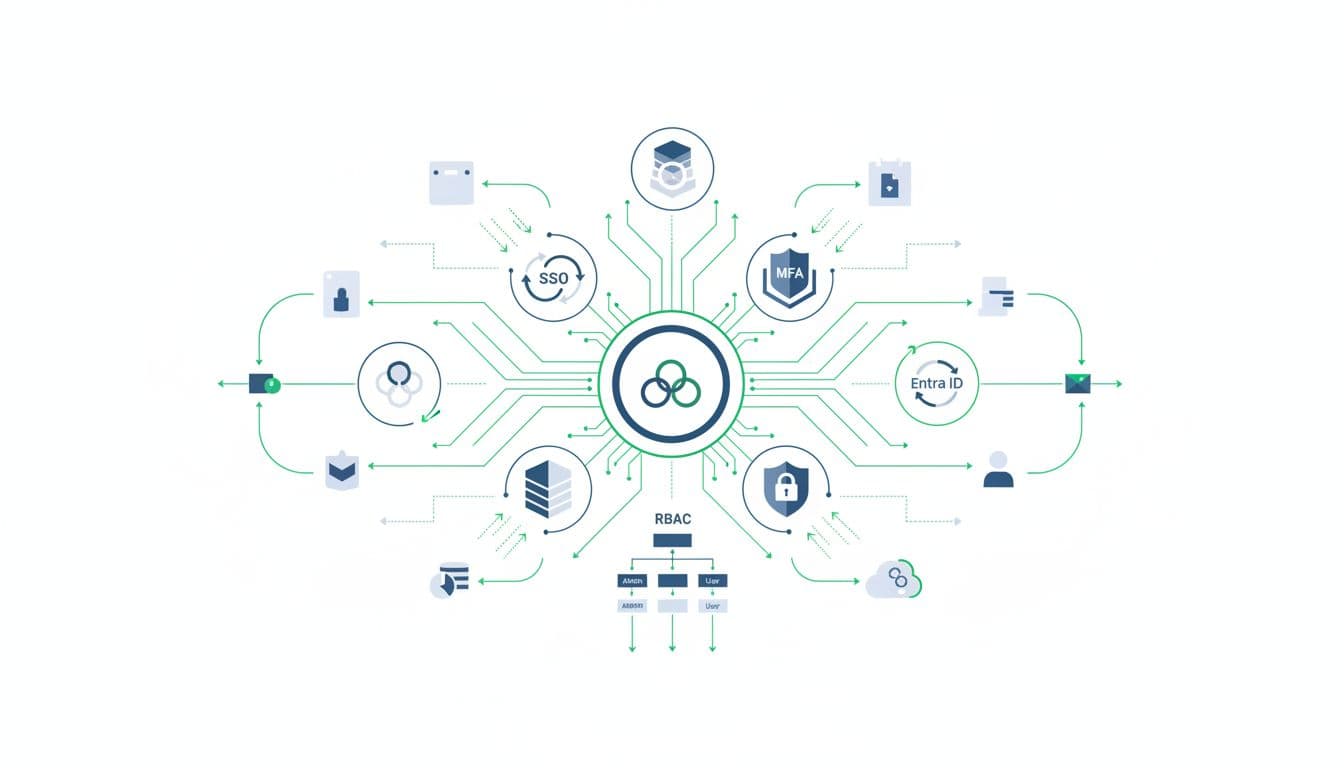
Focus on these competency areas:
- Access and federation: SSO, MFA, conditional access, SAML, OIDC, and trust setup between cloud and legacy apps. Ask for examples, not definitions.
- Authorization design: RBAC, ABAC, entitlement modeling, role mining, and separation of duties. Good engineers reduce role sprawl instead of hiding it.
- Lifecycle and governance: Provisioning, deprovisioning, SCIM, joiner-mover-leaver flows, access reviews, and IGA tooling such as SailPoint. Roles like Rubrik’s SailPoint engineer show how much onboarding, reconciliation, and custom rules matter.
- Privileged and hybrid identity: CyberArk or another PAM tool, service accounts, Active Directory, LDAP, Entra ID sync, and cloud-to-on-prem patterns. The Okta, CyberArk, and SailPoint integration guide is a useful picture of how these layers connect.
Also test whether they know Ping tools, especially in large enterprises with older federation patterns. A strong engineer can compare Okta, Entra ID, and Ping without turning it into a product pitch.
Junior, mid-level, and senior IAM engineers compared
Seniority in IAM is about risk, system reach, and decision-making. Title inflation is common, so define the level before you source.
Use this table to separate levels quickly:
| Level | Typical scope | What they handle well | Where they need help |
|---|---|---|---|
| Junior | One platform or workflow | User lifecycle tickets, basic MFA, group mapping, simple app onboarding | Architecture, protocol debugging, role design |
| Mid-level | Several core systems | SSO integrations, SCIM provisioning, AD and LDAP sync, policy tuning, incident support | Large redesigns, PAM strategy, cross-team standards |
| Senior | Enterprise-wide identity | Hybrid architecture, complex federation, IGA and PAM integration, role model design, audit-facing decisions | Usually needs only business alignment, not technical direction |
A senior IAM engineer should think in systems. They don’t just add apps. They reduce friction, close access gaps, and set patterns other teams can reuse.
Interview questions and a simple scorecard
Good IAM interviews sound like architecture reviews, not trivia contests. Push candidates toward real scenarios.

Use questions like these:
- Walk through an SSO rollout for a legacy app that doesn’t support modern auth natively.
- How would you design RBAC or ABAC for a fast-changing business unit?
- Tell us about a SCIM or provisioning failure you fixed. What caused it?
- How have you connected Entra ID, Okta, Ping, AD, or LDAP in a hybrid setup?
- Where should PAM and IGA meet, and where should they stay separate?
This quick scorecard keeps panels aligned:
| Area | Strong signal | Red flag |
|---|---|---|
| Protocol depth | Explains SAML, OIDC, SCIM, and failure modes in plain language | Recites terms but can’t troubleshoot |
| Platform breadth | Has real work in Entra ID, Okta, or Ping, plus AD or LDAP | Knows one console only |
| Governance and access model | Can discuss RBAC, ABAC, reviews, and entitlement cleanup | Treats roles as static groups |
| Ownership | Gives clear examples with outcomes, trade-offs, and lessons | Speaks only in team-level vagueness |
After the interview, ask one simple question: would this person improve identity design, or just keep the lights on?
Common hiring mistakes that slow teams down
The biggest mistake is hiring for brand names instead of outcomes. “Needs Okta” is too shallow. You need someone who can build federation, role models, provisioning logic, and audit-ready controls.
Another common miss is overvaluing certifications and undervaluing migration work. Identity gets hard during mergers, tenant cleanups, app onboarding, and privilege redesign. That’s where the real signal lives.
Teams also blur IAM, PAM, and IGA into one impossible role. Sometimes you do need one broad engineer. Still, if CyberArk vault work, SailPoint governance, and Entra conditional access are all urgent, split the role or accept a slower search.
Finally, don’t skip the environment map. Candidates need to know your sources of truth, number of apps, hybrid dependencies, and compliance pressure. Without that, you’ll attract the wrong level.
FAQs
How many years should an IAM engineer have?
For complex environments, look past years first. A mid-level engineer may have four strong years. A weaker candidate may have eight scattered ones.
Should the role sit in security or infrastructure?
Either can work. What matters is clear ownership for identity policy, lifecycle, directories, and privileged access.
Is one engineer enough for Okta, Entra ID, SailPoint, and CyberArk?
Sometimes, but only in smaller programs. In large enterprises, that mix often needs a lead engineer plus platform specialists.
Conclusion
If identity touches every system, this isn’t a back-office hire. It’s a risk, uptime, and scale decision. The best teams hire for real integration experience, clear judgment, and the ability to clean up messy access models. Get that right, and your IAM engineer won’t just support the stack, they’ll make it safer and easier to run.