table of contents
Hiring the wrong IAM help can slow projects and leave gaps in access control. The right identity access management consultant brings order to messy permissions, shaky onboarding, and audit pressure.
They also improve the user experience. When access is clean, people log in faster, managers approve requests faster, and offboarding stops turning into a manual scramble.
The best fit starts with a clear scope.
Why this hire matters now
Identity work carries more weight in 2026. Cloud apps keep spreading, contractors move in and out, and non-human identities like service accounts and AI agents need control too. That mix makes manual access handling harder to trust.
A consultant helps you turn that pressure into a plan. They can spot where access is too broad, where approvals are slow, and where old rules no longer match the business. For a current checklist of controls, see IAM best practices in 2026.
The business upside is clear. Better IAM reduces risk, speeds up joiner-mover-leaver workflows, and gives audit teams cleaner evidence. It also supports stronger compliance, tighter privileged access, and a better experience for employees who need access without delay.

What a strong consultant should deliver
A real consultant should leave behind work your team can use. Ask for outputs, not promises.
- An IAM maturity assessment that shows gaps and priority fixes.
- A target-state roadmap tied to risk, budget, and timelines.
- A role model built around RBAC, or role-based access control.
- A joiner-mover-leaver process that shortens onboarding and offboarding.
- Control guidance for MFA, SSO, and PAM.
- Audit-ready documents, owners, and success metrics.
If you need a clean starting point, a vendor-neutral IAM assessment and vendor evaluation helps separate real gaps from product noise. That matters because many IAM failures start with tool buying before ownership is clear.
The best deliverables make daily work easier. They should connect to access reviews, passwordless rollout, and admin-account control. If they don’t, the project will drift.
A good consultant leaves your team with a working model, not a slide deck.
How to judge candidates before you sign
Hiring well means checking for both technical depth and business sense. Start with experience in your environment, not general cyber talk.
Look for people who have worked across security, HR, compliance, and app teams. IAM changes touch all of them. A consultant who can’t speak to each group will slow the project down.
You should also ask for proof in a few areas:
- real implementation work, not only strategy decks
- familiarity with your stack, such as Entra ID, Okta, SailPoint, or PAM tools
- clear examples of reduced risk, faster provisioning, or cleaner audits
- sample workshop notes, roadmaps, or policy updates
Strong candidates can explain terms in plain language. They should define least privilege, SSO, MFA, and privileged access management without losing the room. If they can’t, the rollout will likely suffer later.
A good strategy paper should read like an operating plan. IAM and PAM strategy roadmaps work best when they connect control choices to owners, milestones, and support effort.
Consultant vs in-house team vs managed service provider
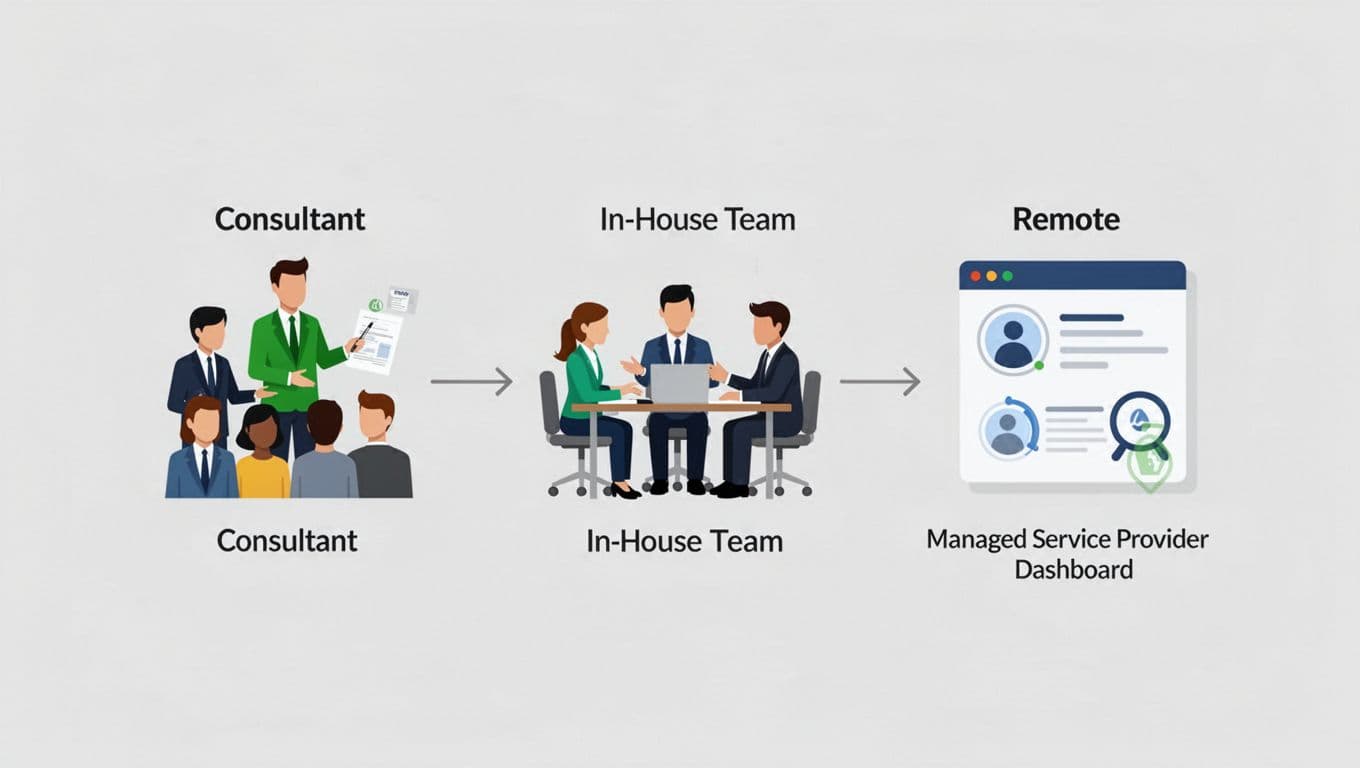
The right model depends on what you need most, change, control, or steady operations. Here is a simple view.
| Option | Best fit | Main trade-off |
|---|---|---|
| Consultant | Assessments, strategy, complex change, remediation | Less suited to day-to-day operations |
| In-house team | Daily administration and long-term ownership | May lack niche depth or bandwidth |
| Managed service provider | Repeatable support and ongoing monitoring | Can be weaker on business-specific design |
For a wider look at operating models, managed services vs in-house IT costs and ROI gives a useful frame. In many IAM programs, the best answer is a mix. A consultant shapes the plan, the internal team owns the process, and an MSP may handle select tasks.
That split works when roles are clear. It fails when everyone assumes someone else owns access governance.
When outside help is the right move
Bring in outside help when audits keep finding the same issues, when offboarding takes too long, or when your IAM platform is underused. It’s also smart when you need a senior specialist for a short window and can’t hire fast enough.
That is often the point where outside advisory and talent support pay off together. If you need help defining the scope, vetting senior IAM talent, or planning a modernization project, Book a Discovery Call with Bud Consulting.
The best time to hire is before access sprawl becomes an emergency. Once the model is clear, the rest of the work gets easier.
The decision should match the work
The right hire gives you more than advice. It gives you a cleaner access model, faster onboarding, safer offboarding, and better evidence for audits.
That is the real test of value. If your IAM program feels too slow, too manual, or too hard to explain, the next step is probably a sharper strategy, not another tool.