table of contents
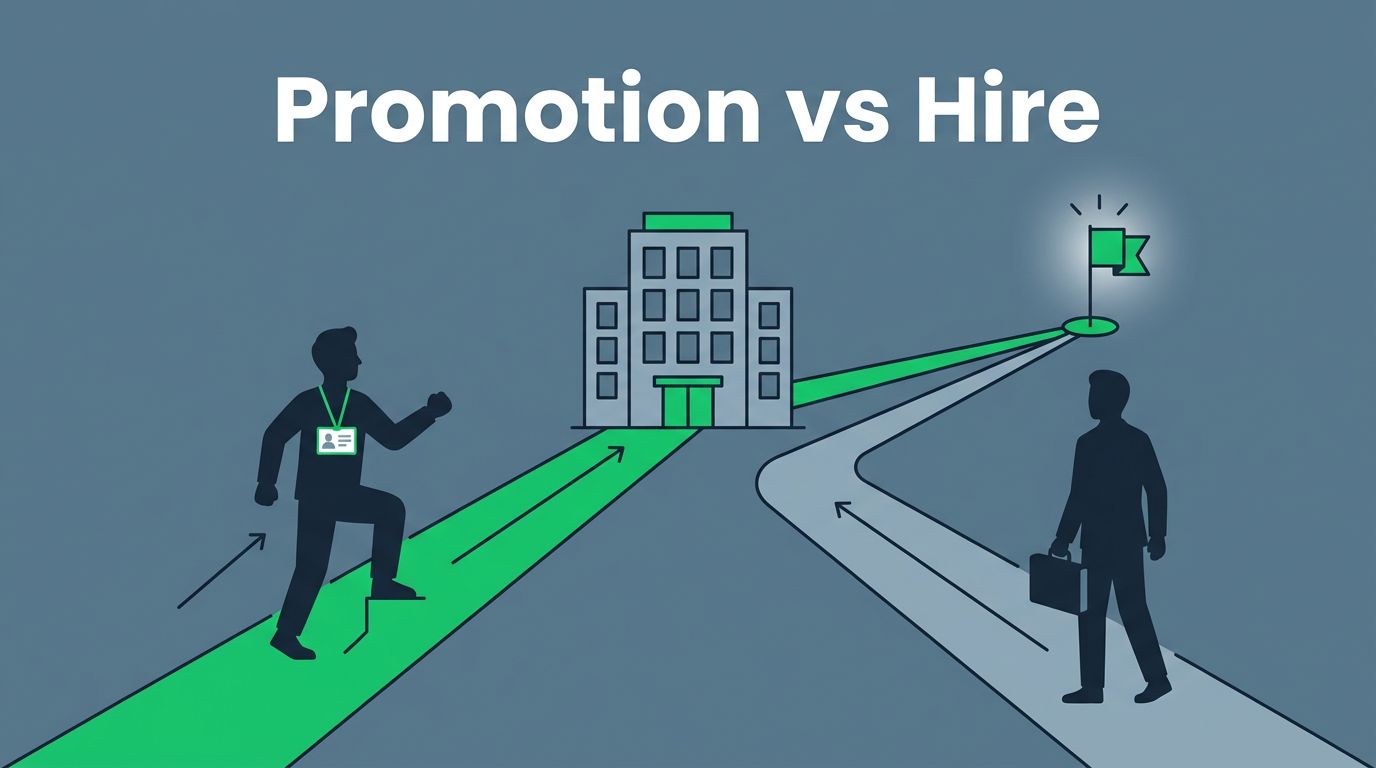
Choosing between internal promotion and external hire sounds simple until the role is real. One option rewards people who already know the business. The other can close a skill gap faster.
The right answer depends on more than loyalty or novelty. It depends on what the role needs on day one, what the team lacks, and how much risk you can carry. A good decision starts with the job, then moves to the people.
Start With the Role, Not the Vacancy
Before you look at names, write the success profile for the role. What must this person deliver in 90 days? Which skills can be taught, and which ones must already exist? That one step keeps the discussion grounded.
A broad comparison of internal vs external recruiting makes the same point. The best choice depends on the work, not a habit from the last hiring cycle. That matters more in 2026, when skills-first hiring is changing how teams screen talent.
If the role depends on company history, internal knowledge, or cross-team trust, promotion may be the cleaner path. If it needs a capability you do not already have, external hiring becomes the smarter bet.
The role should drive the decision. The org chart should not.
When Internal Promotion Makes the Most Sense
Internal promotion works best when performance is already visible. If someone has handled stretch work, led peers well, and learned the business fast, the ramp-up is shorter. That helps speed, and it also reduces the chance of a bad fit.
It also supports succession planning. You are building the next layer before you need it. That matters in any team with key-person risk, because a strong internal bench lowers disruption when people move, leave, or retire.
A promotion can also lift morale. Employees notice when growth is possible, and that shapes retention. When people see a path forward, they are less likely to look elsewhere for it.

Still, promotion should match the next level, not reward tenure alone. A top analyst may not be ready to manage conflict, coach peers, or own a budget. If the person needs a major leap in skills, calling it a promotion can create more risk than value.
When an External Hire Adds More Value
External hiring makes more sense when the organization needs something it does not have. Maybe the role demands a new system, a different market view, or experience with scale. In those cases, a fresh hire can shorten the path to results.
It also helps when the internal bench is thin. Senior security, cloud, and identity roles often fall into this bucket. For those searches, the market may hold only a few people who have done the work at the right level. That is where a specialist search partner can widen the field and save time. For hard-to-fill technical roles, Book a Discovery Call with Bud Consulting can be a practical next step.
External hiring can also reset habits. A team stuck in old routines may need someone who has already solved a similar problem elsewhere. That does not make outside talent better. It means the business needs experience it cannot build fast enough in-house.
The trade-off is onboarding. A strong outsider still needs context, allies, and clear goals. Without that, even the best hire can move slowly in the first months.
How Culture and Employer Brand Shape the Choice
The decision sends a signal. Internal promotion tells employees that growth is real, but only if the process feels fair. If managers fill roles through back channels, trust drops fast. Clear criteria, open timelines, and honest feedback matter more in 2026 than many leaders expect.
That is where internal mobility becomes part of the retention plan. Research on internal mobility and retention keeps pointing to the same pattern, people stay longer when they can move. Internal hiring does not need to win every time, but it does need a real place in the talent strategy.

External hiring affects employer brand too. A thoughtful search shows candidates that the company values skill, not just tenure. The best brands make both paths visible. They promote from within when it fits, and they hire outside when the role needs it.
Visibility beats rumor. When people understand the criteria, they accept the outcome more easily.
A Simple Decision Matrix for Managers
Use this quick matrix before you post the role or tell anyone there is a vacancy.

| Factor | Lean internal promotion | Lean external hire |
|---|---|---|
| Deep company knowledge matters | Existing context helps day one | New hire needs time to learn |
| A strong successor is ready now | Proven performance lowers risk | Candidate pool is already solid |
| The team needs a fresh skill set | Training may take too long | Market experience fills the gap |
| Morale and retention are at risk | Growth path can improve trust | New perspective may reset energy |
| The role needs speed | Less onboarding, faster ramp-up | Search may take longer |
| The business needs change | Familiarity can slow change | Outside experience can challenge habits |
If most rows point the same way, the answer is usually clear. If the table is split, compare the cost of delay with the cost of a learning curve.
The Best Choice Solves the Real Problem
The internal promotion vs external hire decision gets easier when you remove habit from the process. Start with the work, then weigh the skills, the timeline, and the impact on the team.
When the role depends on trust, history, or a ready successor, promote from within. When it needs missing expertise, a new point of view, or a faster reset, hire outside. Strong companies use both paths on purpose, not by default.