table of contents
Hiring top cybersecurity talent goes beyond technical chops. You need pros who can rally executives during a breach or sell risk fixes to devs. Poor stakeholder skills doom even the best tech experts.
Many security leaders fail here. They spot vulnerabilities fast but struggle to get buy-in. That’s why security candidate assessment must probe communication and influence.
This guide shares practical steps. You’ll learn behaviors to spot, questions to ask, and a rubric to score them.
Why Stakeholder Skills Define Security Success
Security work touches every team. You brief boards on threats, partner with IT on patches, and train staff against phishing. Without strong stakeholder ties, plans stall.
Consider incident response. A tech whiz contains malware alone. But real wins come from coordinating with legal, PR, and ops. Candidates who shine explain impacts simply and build trust fast.
Business alignment matters too. Security budgets fight sales priorities. Top candidates tie risks to revenue loss. They influence without jargon.
In vulnerability remediation, they prioritize fixes that matter. They don’t just list CVEs; they map them to app downtime costs. This shows balance.
Hiring managers see this gap often. Resumes boast certs, but interviews reveal siloed thinkers. Focus your security candidate assessment on cross-team proof.
Key Behaviors That Show Strong Stakeholder Skills
Look for proof in past roles. Strong candidates adapt messages by audience. They listen first, then tailor tech talk.
During risk communication, they use analogies. “This flaw is like an unlocked back door during a storm.” Execs grasp it without details.
In security awareness, they engage users. One candidate ran phishing sims as team contests. Participation jumped 40%. That’s influence.
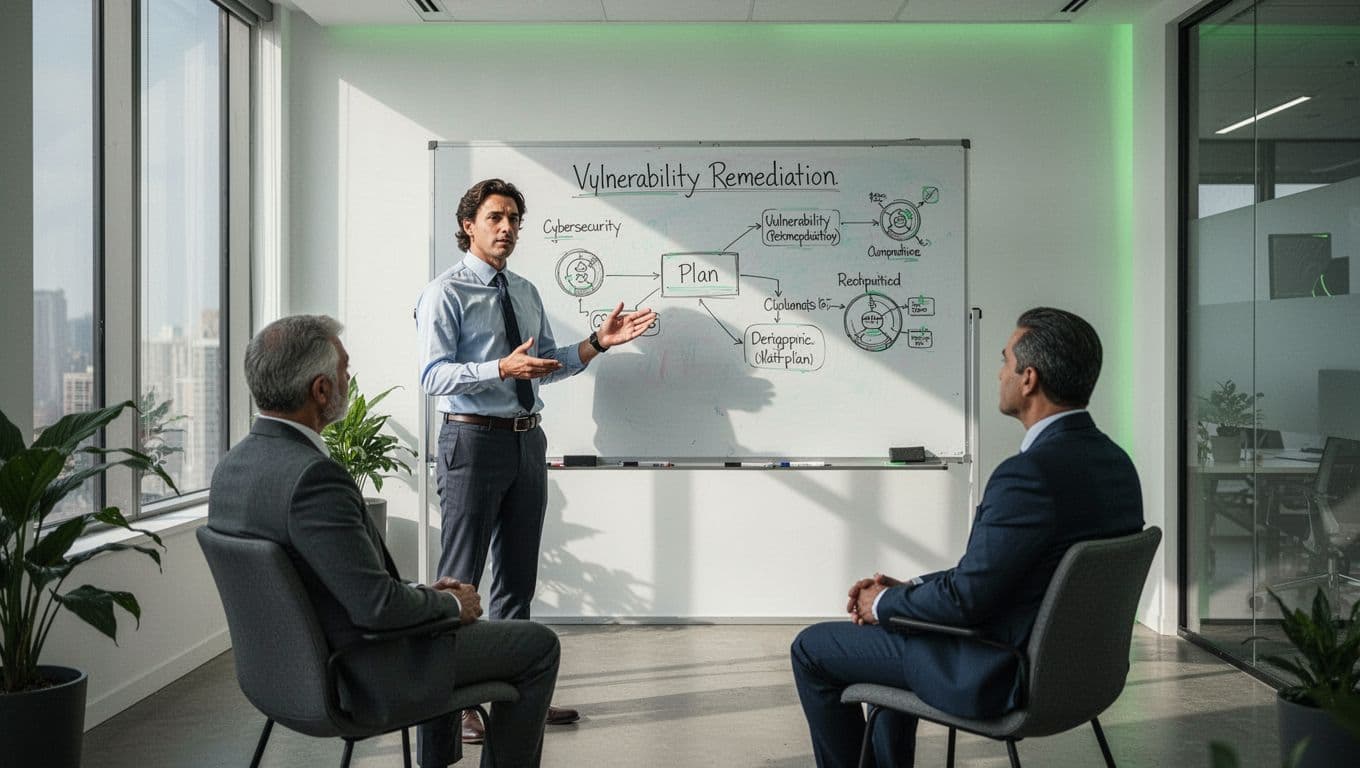
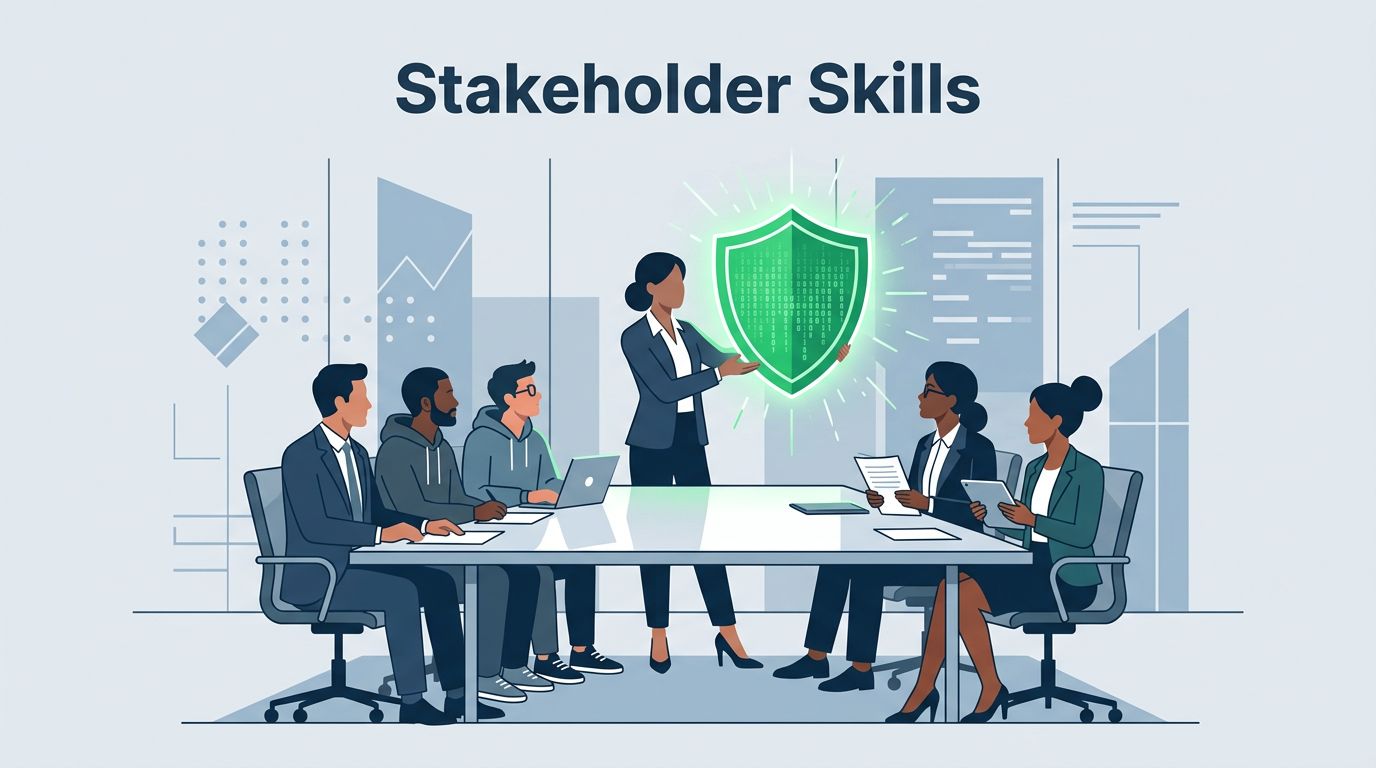
Picture this in vulnerability talks, as shown above. The leader gestures calmly, eyes on stakeholders. No overwhelming charts; focus on priorities.
Compliance pushes test grit. Candidates navigate audits with finance leads. They frame rules as profit shields, not burdens.
Cross-functional projects reveal most. In DevSecOps, they embed scans without slowing releases. They negotiate trade-offs, like delaying low-risk fixes.
Spot these in resumes or refs. Ask for metrics: “How did you boost patch rates?” Numbers prove impact.
Interview Questions to Test Stakeholder Management
Questions uncover real skills. Probe specifics over generics. Start behavioral: “Tell me about a time…”
Try these five:
- Describe pitching a big security spend to non-tech execs.
- Walk us through handling pushback on a compliance mandate.
- How did you rally devs for faster vulnerability fixes?
- Share an incident where you coordinated across teams.
- Explain aligning security goals with business OKRs.
Listen for structure: situation, action, result. Strong replies show empathy and outcomes.

In panels like the one above, note body language too. Candidates who lean in and nod build rapport.
Follow up: “What if they resisted?” This tests adaptability.
Strong vs. Weak Answers in Action
Compare responses to spot winners. Take question 3: rallying devs for fixes.
Weak: “I emailed the list of vulns. Some fixed them.” Vague, no influence shown. Blames others implicitly.
Strong: “Devs ignored my tickets because scans slowed CI/CD. I met their leads weekly, demoed a quick-scan tool, and tied fixes to user login crashes. Patch compliance rose from 60% to 95% in three months.” Specifics, empathy, results.
For incident response (question 4): Weak skips coordination: “I isolated the server.” Strong: “Alert hit at 2am. I looped ops, legal by 2:15, briefed C-suite by 6am with a one-page impact summary. Contained in 4 hours, no data loss.”
Weak answers ramble or boast tech feats alone. Strong ones highlight people skills and business wins.
Use these contrasts in your security candidate assessment. They separate doers from talkers.
Build a Rubric for Fair Security Candidate Assessment
Standardize scoring. Rate on a 1-5 scale across four areas. Tally for quick decisions.
| Criterion | 1 (Poor) | 3 (Solid) | 5 (Excellent) |
|---|---|---|---|
| Communication | Jargon-heavy; ignores audience. | Clear basics; some adaptation. | Tailors perfectly; analogies shine. |
| Influence | Pushes without buy-in. | Negotiates basics. | Builds consensus; metrics back wins. |
| Prioritization | All risks equal. | Some business tie-in. | Aligns to revenue/ops impact. |
| Empathy | Assumes compliance. | Listens somewhat. | Anticipates objections; collaborative. |
Score post-interview. Total over 16? Advance. Add notes for panels.
This rubric fits IAM leads or CISOs. It balances tech cred with soft skills. Customize thresholds per role.
Avoid These Traps in Stakeholder Evaluations
Tech bias sneaks in. Don’t overvalue certs; probe stories.
Overlook culture fit. Ask: “How do you handle skeptical stakeholders?” Clues to style emerge.
Ignore refs. Call them: “Did this person drive cross-team changes?”
Remote hires need video checks. Watch for engagement cues.
Finally, train panels. Share rubric upfront for consistency.
Strong stakeholder skills turn security into a partner, not roadblock. Use these tools in your next security candidate assessment. You’ll build teams that protect and persuade.
Spot the balance of tech and talk? That’s your hire. Book a Discovery Call with Bud Consulting to vet senior talent right.