table of contents
Hiring the wrong security profile can slow a team down for months. A security generalist vs specialist decision sounds simple, but it usually comes down to how much coverage you need, how narrow the risk is, and how much budget you have.
Some companies need one person who can handle a wide mix of work and keep the program moving. Others need deep expertise in one area, because one weak control can create outsized risk. The best hire depends on where your team is today, not on a job title alone.
What each role really brings to the team
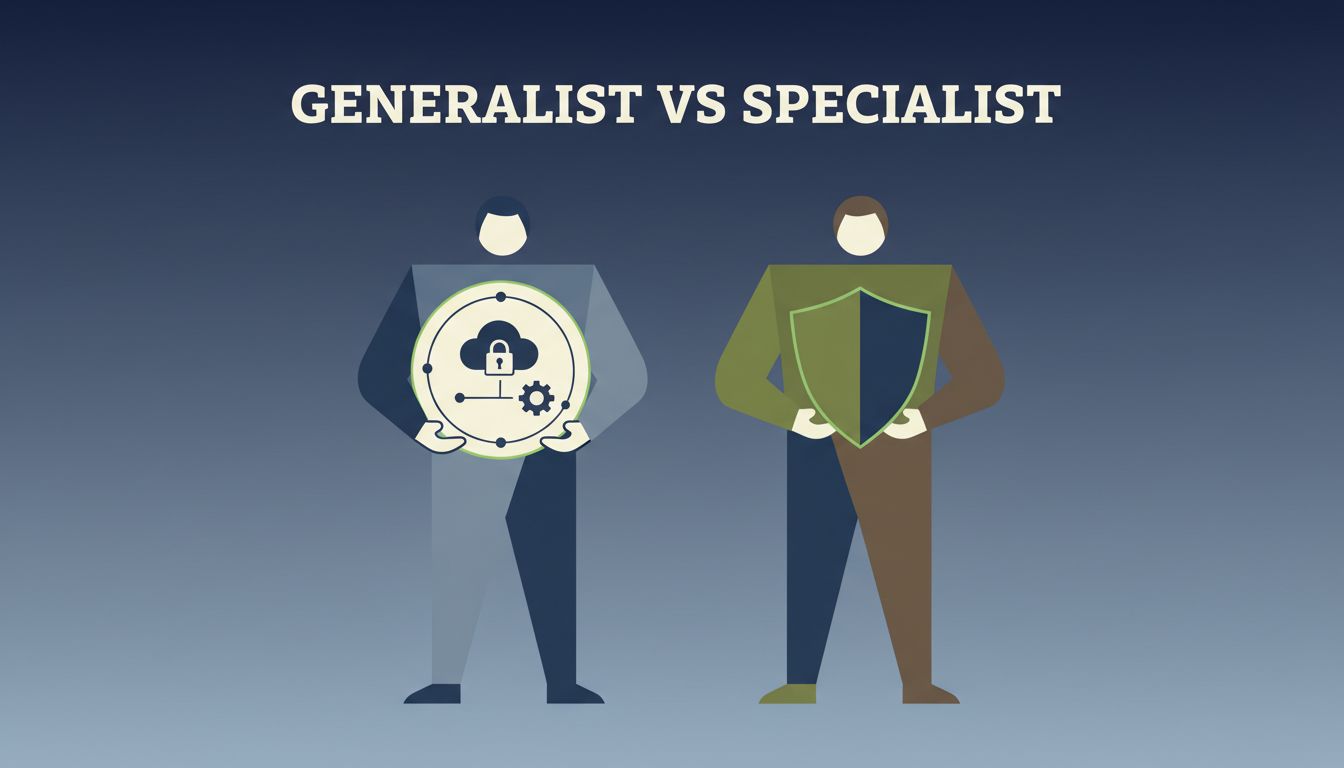
A security generalist handles a broad range of tasks across the program. That can include cloud hygiene, policy review, vendor checks, incident triage, awareness work, and basic control design. A specialist goes deep in one domain, such as cloud security, IAM, application security, offensive testing, or incident response.
The difference shows up in how they make decisions. Generalists connect dots across teams. Specialists go after hard problems in one area and often spot issues others miss.
A quick side-by-side view helps:
| Role | Main strength | Best fit | Risk if misused |
|---|---|---|---|
| Security generalist | Breadth and coordination | Early-stage teams, lean security functions, mixed task loads | Gaps in deep technical areas |
| Security specialist | Depth and precision | Regulated firms, complex platforms, high-risk controls | Narrow scope that leaves other work uncovered |
For a broader hiring lens, see hiring cybersecurity generalists vs. specialists.

The main takeaway is simple. If your team needs coverage across many small risks, breadth wins. If one area keeps creating exposure, depth wins.
When a generalist is the smarter first hire
A generalist is often the right move when your security work is still scattered. That happens often in startups and smaller SaaS companies, where one person may need to handle access reviews, basic cloud controls, vendor questions, and incident coordination.
Broad coverage matters when the company changes quickly. New tools appear. Teams ship faster. Security needs to keep pace without waiting for half a dozen niche hires.
Generalists also help when budget is tight. One capable hire can reduce risk across multiple areas and buy time for the next step. That makes sense when the alternative is leaving several basics undone.
They are also useful when security work is mostly about sorting priorities. Many businesses do not need deep tooling knowledge on day one. They need someone who can see what matters, build a plan, and keep the program from drifting.
Iceberg’s guide on how to know if you need a cybersecurity generalist or a specialist makes a similar point, especially for smaller teams with limited headcount.
When a specialist earns the budget
A specialist is worth it when the risk lives in one hard domain. Regulated organizations often fit this model. So do companies with strict audit demands, complex identity systems, or customer contracts that call for deep technical proof.
Specialists also make sense in incident-response-heavy environments. If your team faces frequent alerts, repeated breaches, or constant investigation work, a focused responder or detection engineer can change the quality of the program fast.
The same is true for deep technical gaps. A SaaS company may already have basic coverage, but still fail app sec reviews. In that case, a generalist may keep the wheels turning, while a specialist removes the biggest source of friction.
A niche expert can also be the right call when one control area affects revenue. For example, weak IAM can slow enterprise deals. Cloud misconfigurations can expose customer data. Poor AppSec can keep products from passing review. In those cases, niche specialization in cybersecurity hiring usually pays off faster than a broad hire.
A practical checklist for the hiring call
This image works well as a quick mental model before you post the role.

If one person must cover many weak spots, start with a generalist. If one weak domain keeps hurting the business, hire the specialist.
Use this checklist to pressure-test the role:
- Coverage: Does one person need to touch many areas every week?
- Depth: Is there one domain where mistakes create outsized risk?
- Compliance: Are audits, contracts, or regulations driving the hire?
- Budget: Can you fund a narrow expert, or do you need broad value first?
- Team shape: Do you already have strong technical leaders who need support in one area?
- Risk pattern: Are your problems mostly coordination issues, or are they technical failures in a single control?
If most answers point to breadth, hire a generalist. If the hard answers cluster around one control area, hire a specialist.
A good team often starts with one, then adds the other
Many companies do best with a staged model. First, hire the person who can cover the widest risk surface and build process. Then add specialists where the program starts to strain.
That approach works well for mid-sized SaaS firms, because it balances cost with real protection. It also fits regulated businesses that need one broad owner plus focused experts in identity, cloud, app sec, or offensive testing.
If you’re weighing that next hire now, Book a Discovery Call with Bud Consulting to map the gap before you write the job description.
The right choice is rarely about status or seniority. It comes down to whether your biggest problem is breadth or depth.