table of contents
A Series A round changes security fast. Headcount grows, enterprise buyers ask harder questions, and product risk gets real long before the team feels ready for it. If you hire too early in the wrong place, you burn cash. If you wait too long, deals stall and gaps pile up.
The strongest security hiring plan after Series A is built around four inputs, product risk, infrastructure complexity, regulatory exposure, and customer requirements. That answer looks different for an AI startup, a fintech platform, and a B2B SaaS company with no sensitive data.
In 2026, the market is also shifting. Cloud security, GRC, detection, and AI security are drawing more demand than classic pentest-only profiles. That matters because your first hire should match the risk you actually have, not the role title you think investors expect.
Start with risk, not job titles
A post-Series A startup usually has more to protect and more to prove. You may have more cloud accounts, more contractors, more customer data, and a sales team sending security questionnaires every week. That mix creates pressure in two directions, real control gaps and more visible buyer scrutiny.
Start by mapping where the risk sits. If your product handles sensitive customer data, a product security engineer may matter more than a generalist. If your cloud setup is messy and access is loose, a security engineer is often the better first seat. If you are one quarter away from SOC 2 or ISO 27001, GRC work can become the bottleneck.
That is also where budget discipline matters. Carta’s guide to building a hiring plan for your next fundraise is useful because it forces the same question every startup should ask, what can this company afford now, and what must wait?

The best first security hire is the one who removes a deal blocker and lowers real risk at the same time.
Choose the first hire based on the gap you have
The cleanest way to pick a first hire is to ask which gap is hurting the company right now. A small team does not need every specialty at once. It needs the right one first.
| First hire | When it makes sense | What they own first |
|---|---|---|
| Security engineer | Cloud sprawl, identity issues, weak logging, production exposure | IAM, baselines, alerting, incident readiness |
| Product security engineer | Fast shipping, APIs, customer data, AI features | Threat modeling, secure SDLC, vuln triage |
| GRC or compliance lead | SOC 2, ISO 27001, HIPAA, customer audits, questionnaires | Controls, evidence, policies, trust work |
| Security operations lead | Too many alerts, weak detection, poor response flow | Monitoring, triage, playbooks, response |
| Fractional vCISO support | No senior security lead, but strategy is missing | Priorities, board updates, interim guidance |
If you only have room for one person, choose the role that fixes the most painful problem in the next two quarters. For some teams, that is an engineer who can harden cloud and identity. For others, it is a compliance lead who can keep enterprise deals moving.
Recent market coverage backs that up. A good example is depthfirst’s Series A raise, which shows how quickly security-oriented companies are hiring across engineering and product once the round lands. The pattern is clear, growth brings pressure, and pressure needs a specific owner.
Keep the hard parts in house, outsource the rest
Series A companies often try to buy a full security program at once. That gets expensive fast. A better model is to keep decision-making and recurring risk work in house, then outsource specialist tasks that do not need a full-time seat.
| Workstream | Keep in house early | Outsource first |
|---|---|---|
| Risk decisions | Yes | No |
| Security questionnaires and deal support | Yes | No |
| Cloud guardrails and access control | Yes | No |
| Pen tests and red team work | No | Yes |
| Audit prep support | Sometimes | Often |
| Incident response retainer | No | Yes |
The rule is simple. Anything that needs deep product context should stay internal. Anything that is periodic, specialized, or hard to staff at Series A can be bought from a trusted partner.
That includes pen testing, audit prep, and sometimes vCISO support. It also includes short-term help when the company needs a plan before it can justify a full-time hire. If you need help deciding what belongs where, Book a Discovery Call with Bud Consulting.
Hire against triggers, not opinions
A security hire should follow clear triggers. Otherwise, the discussion turns into politics, or into vague fear about being unprepared.
Good triggers look like this:
- Two or more enterprise deals are blocked by security review.
- SOC 2, ISO 27001, HIPAA, or GDPR work is now on the critical path.
- Production data, customer PII, or AI agents need tighter access controls.
- Alert volume or cloud complexity is growing faster than the team can handle.
- Sales, support, or product keeps asking the same security questions with no owner.
If three or more of those are true, you probably need a full-time hire or a strong fractional lead. If only one is true, a vendor or interim advisor may be enough for now.
If you want a rough planning benchmark, Startup Security: Ratios and a 24-Month Hiring Plan is worth reading as a starting point. Just do not let a ratio replace your actual risk picture.
A phased 12-month plan for Series A teams
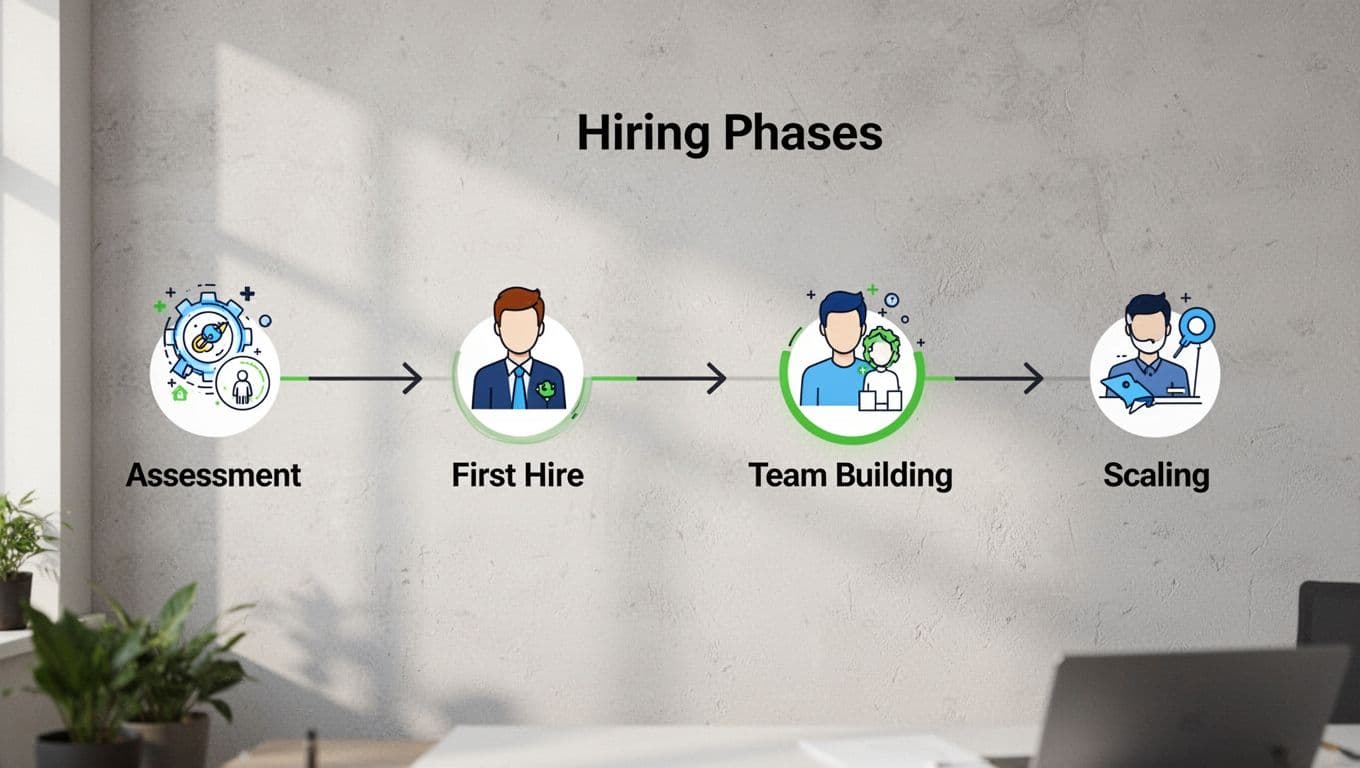
A phased plan keeps the budget sane and the work focused. It also helps founders avoid hiring a team before the company has a clear need for one.
- Days 0 to 90: assign one owner, even if it is fractional. Close the biggest control gaps, run a pen test, document your top risks, and set a simple escalation path for security issues.
- Months 3 to 6: hire the first internal role that matches your highest pain point. For many SaaS teams, that is a security engineer or GRC lead. For AI-heavy products, product security may come first.
- Months 6 to 12: add the second role only if the same problems keep coming back. If the first hire is drowning in audit work, add help. If engineering keeps introducing risk, add product security or operations support.

This phased approach works because it matches cash to need. It also gives the company room to learn what kind of security work repeats every month.
Conclusion
After Series A, the right security team is usually small, focused, and built around real pressure points. The goal is not to copy an enterprise org chart. The goal is to remove deal friction, reduce exposure, and keep the company moving.
Start with the risk map, pick the first hire that closes the biggest gap, and use outsourced support for specialist work. When that plan is tied to customer demands and product reality, your security hiring becomes a growth decision, not a guess.