table of contents
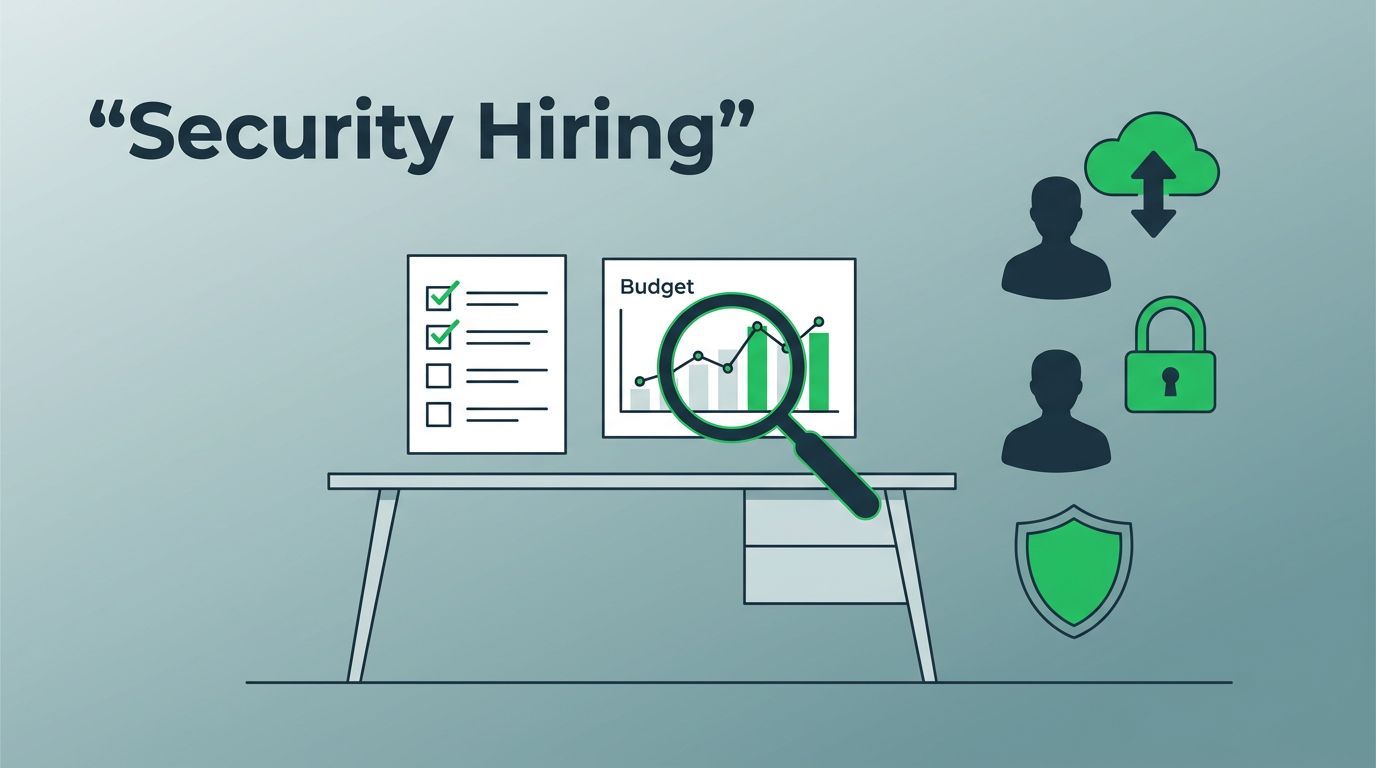
A small security budget can still buy real risk reduction if you spend it in the right order. The wrong first hire often becomes an expensive comfort blanket, while the real gaps stay open. That is why security hiring priorities should start with risk, then compliance, then coverage.
If you need a simple rule, choose the role that closes the biggest gap your team cannot absorb for another six months. After that, fill the next gap with a hire, a contractor, or an MSSP.
Start with the risks that can hurt you this quarter
Before you post a job, name the top three risks that could hurt the business right now. For many teams, those risks are cloud misconfigurations, weak access control, slow incident response, and audit failure.
McKinsey’s talent-to-value framework makes the right point for lean teams, hire around the risk you remove. If a role does not lower risk in a visible way, it should move down the list.
This is also why early-stage teams need restraint. A startup budget guide can help you focus on basics that stop the most likely failures first. Hardening access, tightening cloud setup, and defining incident response often beat a shiny tool stack.
The best first hire is the one that removes the biggest business risk, not the one with the fanciest title.
Match each role to the problem it solves
Not every security job solves the same problem. A security engineer fixes broad control gaps. A cloud security engineer protects cloud infrastructure and services. GRC keeps audits, policies, and proof from turning into a fire drill. AppSec reduces code risk before release. A security analyst watches alerts. A vCISO sets direction. MSSPs and fractional specialists fill gaps when headcount is tight.
If cloud is your biggest attack surface, a cloud security engineer role breakdown shows how broad that job can be. That matters, because many teams assume cloud security is only about IAM. It usually touches network design, logging, guardrails, and release flow too.
A quick comparison helps when budget is limited.
| Role | Best when | Budget fit |
|---|---|---|
| Security engineer | You need one owner for tools, hardening, and response basics | Strong first full-time hire for general gaps |
| Cloud security engineer | Most workloads live in AWS, Azure, or GCP | Best for cloud-native SaaS teams |
| GRC or compliance lead | SOC 2, ISO 27001, GDPR, or CCPA work blocks sales | Often the first hire when audits drive revenue |
| Security analyst | You need alert triage and monitoring more than strategy | Good when detection coverage is the main gap |
| AppSec engineer | Product releases move fast and code risk keeps rising | Best when engineering ships often |
| vCISO | You need leadership and a roadmap, not another operator | Good bridge before a full-time leader |
| MSSP or fractional specialist | You need coverage fast, or only one control area needs help | Best when budget cannot support a full hire |
The table gives a simple test. If the biggest pain is prevention, hire engineering. If the biggest pain is proof, hire GRC. If the biggest pain is visibility, use an analyst or MSSP first.
What this looks like for startups, SaaS teams, and mid-market firms

Startups
Seed-stage teams usually need a wide operator, plus outside help. If you have no compliance deadline, start with a fractional vCISO or consultant, then use an MSSP for monitoring and a contractor for AppSec reviews.
For early teams, Bessemer Venture Partners’ guide to building a cybersecurity team makes the same case, hire around exposure and speed, not org charts. Once the cloud stack grows, the first full-time hire is often a security engineer with cloud skills.
SaaS companies
SaaS firms usually hit a point where sales wants SOC 2, engineering ships every week, and cloud risk climbs. In that case, a cloud security engineer or a security engineer with AppSec depth is often the best first hire.
If the audit clock is louder than the code risk, start with GRC and buy monitoring through an MSSP. That mix keeps the business moving while you build the core program.
Mid-market organizations
Mid-market teams often have enough noise for a small security program, but not enough headcount for a full department. The smartest move is a hybrid model, one lead role, one hands-on builder, and targeted specialists.
A GRC lead plus a security engineer works well when audits and operations both matter. Add fractional help for IAM, pen testing, or program design when needed. That keeps senior talent focused on the work that cannot be outsourced for long.
Decide what to hire now, what to delay, and what to outsource
A budget decision gets easier when you sort needs into three buckets.
- Hire now when the risk is daily and internal, such as cloud exposure, weak access control, or broken response basics.
- Hire next when the risk is real but not urgent, such as GRC after the first audit or an analyst after basic logging exists.
- Outsource when you need expertise, not full-time depth, such as vCISO work, penetration tests, tabletop exercises, or short-term AppSec reviews.
That split protects cash and reduces hiring regret. It also keeps you from overbuying a role that your team is not ready to use well.
If you need help choosing between a hire, a fractional specialist, or an outsourced model, Book a Discovery Call with Bud Consulting.
The right security budget does not chase headcount. It removes the next biggest source of risk, then builds from there.
Make the first hire earn its keep
A tight budget forces discipline, and that can be an advantage. The best security hiring priorities are the ones tied to the business problem in front of you, not the role list you wish you could afford.
Start with the risk that hurts most, then match the hire to the gap. Use fractional help where you need speed or depth, and keep full-time roles for work that must stay inside the company. That is how small teams build stronger security without wasting scarce budget.