table of contents
Market downturns force difficult choices on every leadership team. When funds tighten, payroll often becomes the primary target for rapid cost reduction. While cutting headcount might save cash today, it frequently creates a dangerous form of security hiring technical debt that costs far more to resolve later. You are trading immediate balance sheet relief for long-term operational instability.
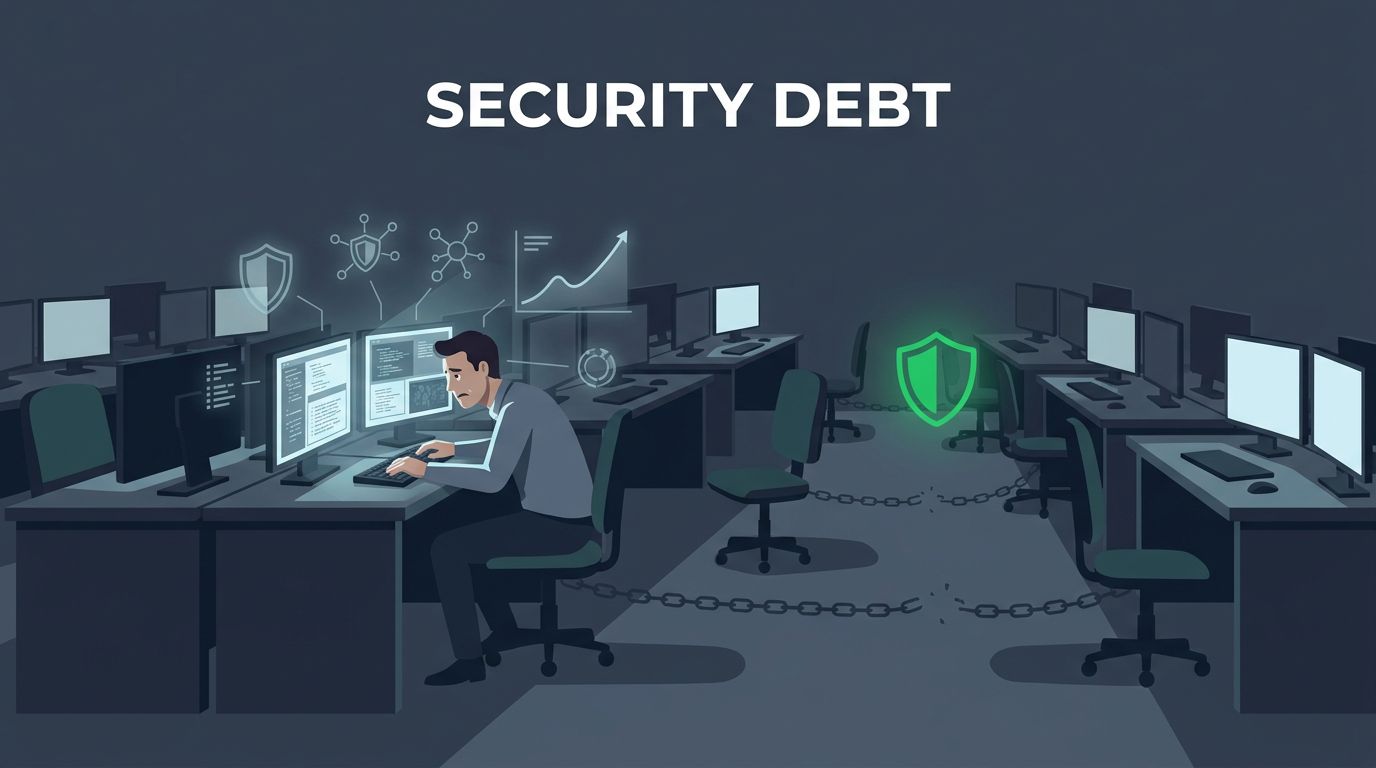
This debt manifests as unmanaged risk. Every role left vacant or every team stretched too thin introduces a gap in your defenses. Security professionals understand that visibility and response capabilities are not optional luxuries. When you lose the people who maintain these systems, you don’t just stop moving forward; you start moving backward.
Understanding Security Debt as a Business Risk
Security debt acts much like financial debt. When you choose not to hire or you let specialized roles sit vacant, you stop making payments on your protection. That interest compounds daily in the form of undetected vulnerabilities and unpatched infrastructure. If your organization relies on automated scanners or external threat intelligence but lacks the human experts to interpret and act on the findings, you are essentially paying for alerts you cannot resolve.

The primary issue is that security is a continuous process, not a static product you can turn off. When key positions in areas like Identity and Access Management or cloud security architecture remain unfilled, your attack surface expands without oversight. As Dice.com explores in their career advice, budget constraints are now the dominant factor restricting teams from maintaining adequate coverage. If your internal resources cannot keep pace with your infrastructure, you are not saving money; you are storing up future crisis points.
Framework for Assessing Hiring Tradeoffs
When you must operate within a restricted budget, you need a clear, objective way to evaluate which roles are essential and which can be managed differently. Avoid making cuts based purely on which departments seem easiest to trim. Instead, use a risk-based framework to decide where your limited headcount provides the most protection.

Start by categorizing your security functions. Some roles, like basic alert monitoring or periodic compliance reporting, might be candidates for partial automation or third-party outsourcing. Other roles, such as incident response, cloud security, and core identity engineering, usually require deep institutional knowledge and immediate accountability. If you lose the people who know your specific environment, your ability to handle a breach drops drastically. You can Book a Discovery Call with Bud Consulting to discuss how your current team structure stacks up against industry benchmarks and where you might safely consolidate functions without sacrificing essential defense.
Consider the following criteria when evaluating a potential headcount reduction:
- Institutional Knowledge: Does this person manage the only known path to remediation for critical infrastructure?
- Response Velocity: Will this reduction increase the time it takes to stop an ongoing attack?
- Compliance Thresholds: Does this role handle mandatory security controls required by law or client contracts?
- Direct Threat Reduction: Is this role actively finding and fixing vulnerabilities, or is it primarily administrative?
If a role performs work that directly stops or limits an attack, cutting it should be considered an absolute last resort. High-risk, high-impact areas like application security and incident response should remain protected. It is often cheaper to keep one specialist on staff than it is to recover from a single preventable incident that takes down your primary systems.
Hidden Costs of Understaffed Security Teams
The true cost of security hiring technical debt extends beyond potential breach expenses. When teams become too small, the remaining employees often face extreme burnout. This leads to turnover, which further drains your organizational knowledge. As noted in recent industry research from ISC2, a significant majority of security professionals agree that reducing personnel increases the risk of a breach, creating a cycle where remaining staff become even more overwhelmed.
You also lose the ability to innovate. A team operating in constant firefighting mode cannot dedicate time to improving your security posture. They spend all their energy just keeping the lights on. This prevents you from retiring legacy systems that are difficult to secure, which only creates more debt. The longer you wait to fix these fundamental issues, the harder and more expensive they become to address.
Strategic Alternatives to Full-Time Hiring
If you absolutely cannot add to your full-time headcount, you have options beyond simply leaving gaps. You can shift your focus to more flexible talent models. Many leaders now balance their core team with specialized contractors or fractional support for non-critical, project-based work.
As outlined in ISC2 guidance on recession-proofing teams, you should look at the mix between payroll employees and contractors. Contractors can provide immediate, specific expertise for defined projects without the long-term overhead of a full-time hire. This allows you to focus your limited payroll budget on versatile generalists who can cover multiple areas.
Consider these tactical shifts to maintain your defenses:
- Prioritize core functions: Move administrative or compliance-heavy tasks to automated tools where possible.
- Use fractional experts: Hire outside consultants for specialized, short-term projects that don’t require daily attention.
- Empower existing staff: Invest in cross-training your generalist IT staff to take over routine security monitoring tasks.
- Refocus your roadmap: Delay non-essential upgrades and redirect those resources to maintaining existing, secure systems.
By separating essential defenses from long-term improvement projects, you maintain security while remaining mindful of your current cash constraints. This keeps your organization protected without committing to costs you cannot sustain.
Long-Term Impact of Debt Accumulation
Eventually, every organization must pay its security debt. You can either pay it slowly and intentionally by maintaining a capable team, or you can pay it all at once when a major incident occurs. The latter option is always significantly more expensive. Beyond the direct costs of data loss or system downtime, you must account for legal fees, regulatory fines, and long-term damage to your brand and customer trust.
Successful leaders recognize that security is not a variable cost to be minimized. It is a fundamental requirement for business continuity. When the market recovers, teams that maintained their core expertise will be better positioned to scale. Teams that gutted their security department will spend months just trying to rebuild the basic visibility and trust they lost during the downturn.
Final Thoughts
Managing security hiring technical debt requires a clear-eyed view of your risks and your resources. You are making a choice between immediate savings and future stability. By using a risk-based assessment for all staffing decisions, you ensure that you don’t compromise your core security capabilities during the most challenging periods.
Focus on protecting the roles that offer the highest return in terms of risk reduction and response capability. If you must cut, cut strategically and plan for the eventual replacement of those functions. Protecting your organization is an ongoing commitment, and staying consistent, even when the budget is tight, is the most effective way to manage long-term risk.