table of contents
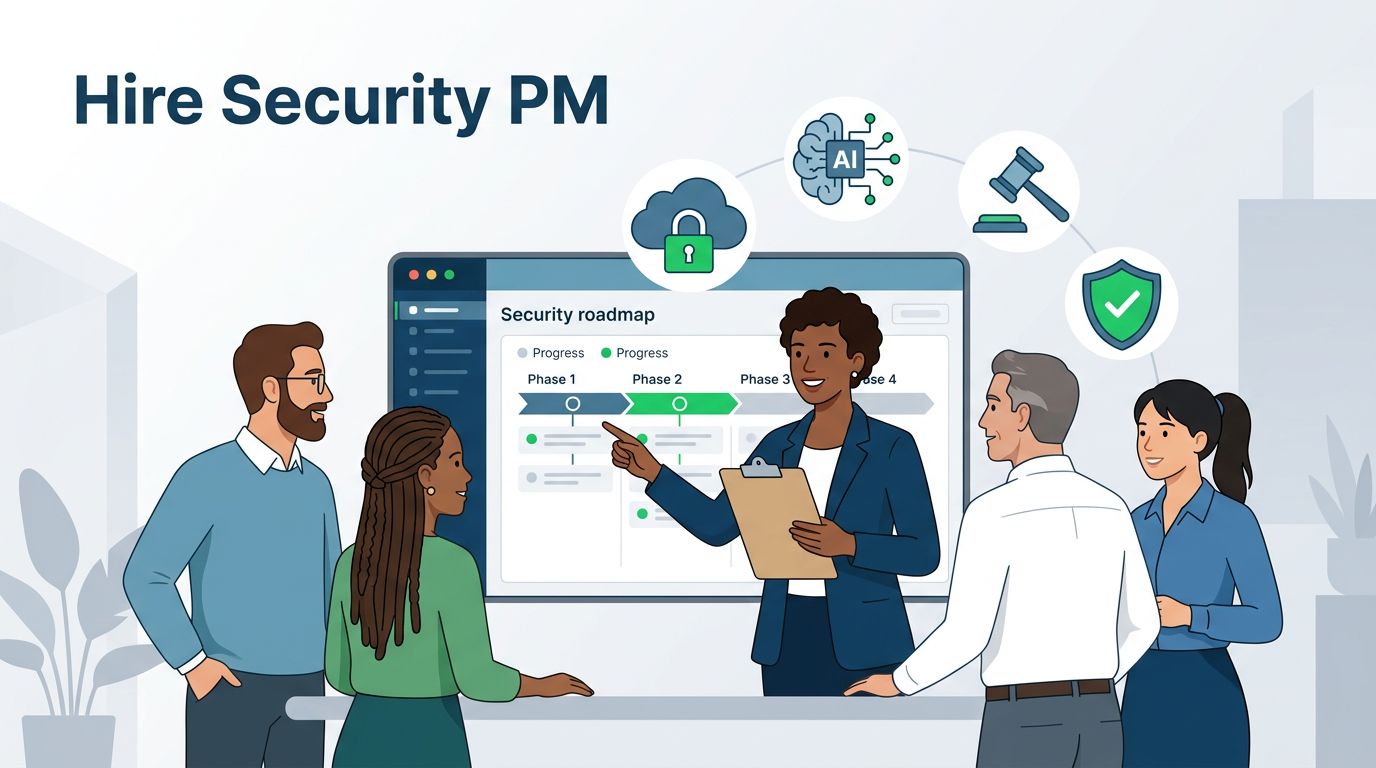
Hiring a security program manager gets tricky when the role sounds obvious on paper but feels fuzzy in practice. In a cross-functional team, the right person has to turn scattered priorities into one clear security plan that engineering, IT, legal, compliance, and business leaders will support.
That matters even more in 2026. Security teams are dealing with cloud risk, vendor pressure, AI policy, audit evidence, and tight delivery timelines at the same time. The best hire keeps the work moving without becoming the bottleneck. Start with the role itself, because the search gets easier once you know what success looks like.
Start with the real job, not the title
A security program manager is not just a well-organized project lead. The role owns the rhythm of the security program, keeps risks visible, and makes sure the right teams act on them.
In practice, that means building plans, tracking owners, clearing blockers, and reporting progress in a way leaders can use. The person also has to know when to push, when to escalate, and when to slow down so legal or compliance can weigh in.
The role usually sits between strategy and execution. A security engineer solves a technical problem. A project manager tracks tasks. A security program manager connects the work to a risk-reduction plan and keeps every stakeholder aligned.
That distinction matters when you write the job description. If you only list security concepts, you may attract technical specialists who don’t enjoy coordination work. If you only list program management, you may miss people who can speak security well enough to earn trust.
A strong charter for the role usually includes these outcomes:
- Security priorities are translated into a delivery plan.
- Risk owners know what they need to do and by when.
- Status updates are clear enough for executives and detailed enough for operators.
- Cross-team issues get resolved before they stall the program.
- Security work is measured, reported, and tied to business goals.
In 2026, the role often reaches into AI usage policy, third-party risk, cloud control rollouts, awareness programs, and audit prep. That mix is exactly why the hire needs structure, judgment, and strong communication.
The best security program managers create movement without needing formal authority over every team they touch.
What strong candidates look like in 2026
The strongest candidates don’t just say they are collaborative. They show it with examples.
Look for people who can move between technical detail and business context without losing either one. They should be able to explain a control gap to an engineer, then summarize the same issue for a VP in one clean paragraph.
Cross-functional influence is the first test. A good candidate can describe how they got buy-in from teams that did not report to them. Maybe they had to get engineering to adopt a new control, or legal to approve a policy change, or operations to adopt a new review step. The key is not charm. The key is follow-through.
Risk prioritization is the second test. Many candidates can find security issues. Fewer can rank them. You want someone who can explain why one gap matters more than another, using likelihood, impact, exposure, cost, and business timing. They should know when a problem needs a fast fix and when it needs a phased plan.
Execution is the third test. This role lives or dies on cadence. Look for habits such as weekly status checks, decision logs, clear owners, and written next steps after meetings. That sounds simple, but it keeps programs from drifting.
Communication is the fourth test. The candidate should write well, speak clearly, and avoid hiding behind jargon. If they can’t explain a risk in plain language, they will struggle with stakeholders outside security.
A useful shortcut is to ask whether they can handle conflict without creating drama. Security programs often stall because teams disagree on scope, timing, or ownership. A strong hire can hold that tension, push for a decision, and keep relationships intact.
If you want a broader set of screening ideas, the cyber security program manager interview questions page is a useful reference point for building your own list.
Write a job description that filters for fit
A lot of hiring problems start with the job description. If the posting is vague, overloaded, or copied from a general program manager role, the wrong candidates will apply.
For a better result, write the job around outcomes. Say what the person will own, who they will work with, and what success looks like in the first six to twelve months. Keep the language specific.
A strong posting usually includes these sections:
Sample job description outline
- Role purpose: explain that the person will run and coordinate security programs across teams.
- Primary partners: name engineering, IT, legal, compliance, privacy, business ops, and leadership.
- Core responsibilities: include roadmap ownership, risk tracking, reporting, policy rollout, and stakeholder management.
- Success measures: list metrics such as closed actions, fewer overdue risks, better audit readiness, or faster approval cycles.
- Decision scope: note whether the role can set priorities, escalate risks, or approve changes.
- Tools and process: mention the systems used for tracking and reporting, such as Jira, ServiceNow, spreadsheets, or a GRC platform.
- Working style: state whether the role needs to run meetings, write executive updates, and manage multiple work streams at once.
For a practical reference while you draft the posting, the security program manager job description examples page shows the kind of responsibilities companies often spell out. Use it as a guide, then tailor the language to your own environment.
A good posting should also avoid turning the role into three jobs. If you ask for deep cloud architecture, audit leadership, security engineering, and vendor management all in one hire, the search will get muddy fast. Decide what the role truly owns and cut the rest.
Here’s a simple way to separate must-haves from nice-to-haves:
| Area | Must-have | Nice-to-have |
|---|---|---|
| Program delivery | Has led cross-functional security or risk programs with clear owners and deadlines | Has done the same in a fast-growing or highly regulated company |
| Stakeholder management | Can influence engineering, IT, legal, compliance, and business partners | Has worked through conflict in a matrixed environment |
| Security knowledge | Understands common controls, risk, and compliance basics | Has deeper exposure to cloud security, IAM, app sec, or privacy |
| Communication | Writes concise updates and runs meetings well | Has experience presenting to executives or boards |
| Data and reporting | Tracks program health with metrics and follow-up actions | Has built dashboards or formal reporting packs |
The takeaway is simple. Hire for the ability to move work across teams first, then add domain depth where your organization needs it most.
Use interview questions that reveal how they work
The interview should test judgment, not memorized language. A polished candidate can talk about security in broad terms. A good hire can explain how they got something finished.
Use questions that force the candidate to describe real situations, not theory. Listen for names of stakeholders, clear tradeoffs, and the final outcome.
- Ask them to walk through a security program they ran across engineering and compliance. You want to hear how they set scope, handled friction, and tracked progress.
- Ask how they decide which risk gets addressed first when several teams believe their issue is urgent. Strong answers should mention impact, likelihood, timing, and business cost.
- Ask for an example of a time they had no formal authority over the teams doing the work. Good candidates explain how they built accountability anyway.
- Ask how they report status to leaders without creating noise. The best answers are short, factual, and focused on decisions needed.
- Ask about a time a stakeholder rejected a control or policy change. Look for curiosity, patience, and a path to resolution.
- Ask what metrics they use to measure program health. They should go beyond “tasks completed” and talk about risk reduction, closure rates, and aging issues.
- Ask how they handle a program that is moving too slowly. You want to hear about blockers, escalation, and re-prioritization.
Strong answers usually include three things: the problem, the people involved, and the result. Weak answers stay abstract or turn into a list of buzzwords.
You can also add a short working session. Give the candidate a scenario, such as a cloud control rollout with legal review and engineering pushback. Then ask them to map the next two weeks of actions. That shows how they think in real time.
Build a hiring scorecard the panel can use
A simple scorecard keeps the panel focused. It also reduces the chance that one strong interview impression outweighs real evidence.
Use five categories and score each one from 1 to 5. Then multiply by the weight. That gives everyone a shared frame for the final decision.
| Category | Weight | What good looks like |
|---|---|---|
| Cross-functional influence | 30% | Can align engineering, IT, legal, compliance, and business partners |
| Risk prioritization | 25% | Uses a clear method to rank work and explain tradeoffs |
| Execution and follow-through | 20% | Keeps a program moving with owners, dates, and clean follow-up |
| Communication | 15% | Writes and speaks in a way leaders and operators both understand |
| Security judgment | 10% | Knows enough security to make smart decisions and ask the right questions |
Use the same scorecard for every finalist. That makes comparison fair and keeps the discussion grounded in evidence.
If the panel can’t explain why a candidate scored high, the scorecard is too vague.
One useful rule helps here. If a candidate is excellent in security knowledge but weak in cross-functional delivery, they probably aren’t right for this role. The reverse can also be true, depending on your team. A strong operator with solid security judgment can add more value than a deep specialist who can’t move people.
Before you close the process, make sure the interview panel includes at least one engineering leader, one compliance or legal partner, and one business stakeholder. The role is cross-functional, so the hiring process should be too.
If you need help shaping the search or calibrating the role before you open it, Book a Discovery Call with Bud Consulting.
Common hiring mistakes that slow the program down
The most common mistake is hiring for title polish instead of operating strength. A candidate can sound senior and still struggle to get decisions made across teams.
Another mistake is writing the role around one framework or one tool. The work is bigger than that. The person needs to run the program, not just manage a system.
A third mistake is skipping the stakeholder test. If the candidate never meets engineering, legal, or compliance during the interview process, you’re guessing about their fit.
It also hurts to ignore writing skill. This role lives in status updates, risk notes, follow-ups, and executive summaries. If the candidate can’t write clearly, the program will pay for it later.
Finally, don’t leave authority unclear. If the person owns the program but can’t escalate blockers or set priorities, they will spend months pushing uphill. Define the decision rights before the offer goes out.
Conclusion
Hiring a security program manager for cross-functional teams works best when you stop treating the role like a generic program job. The right hire brings influence, judgment, and follow-through, then uses those skills to keep security work moving across teams that don’t report to them.
If you define the charter clearly, test for real stakeholder skill, and use a scorecard that reflects the job, the search gets easier and the result gets better. In 2026, that kind of hire does more than fill a seat. They keep the security program moving in the same direction as the business.