table of contents
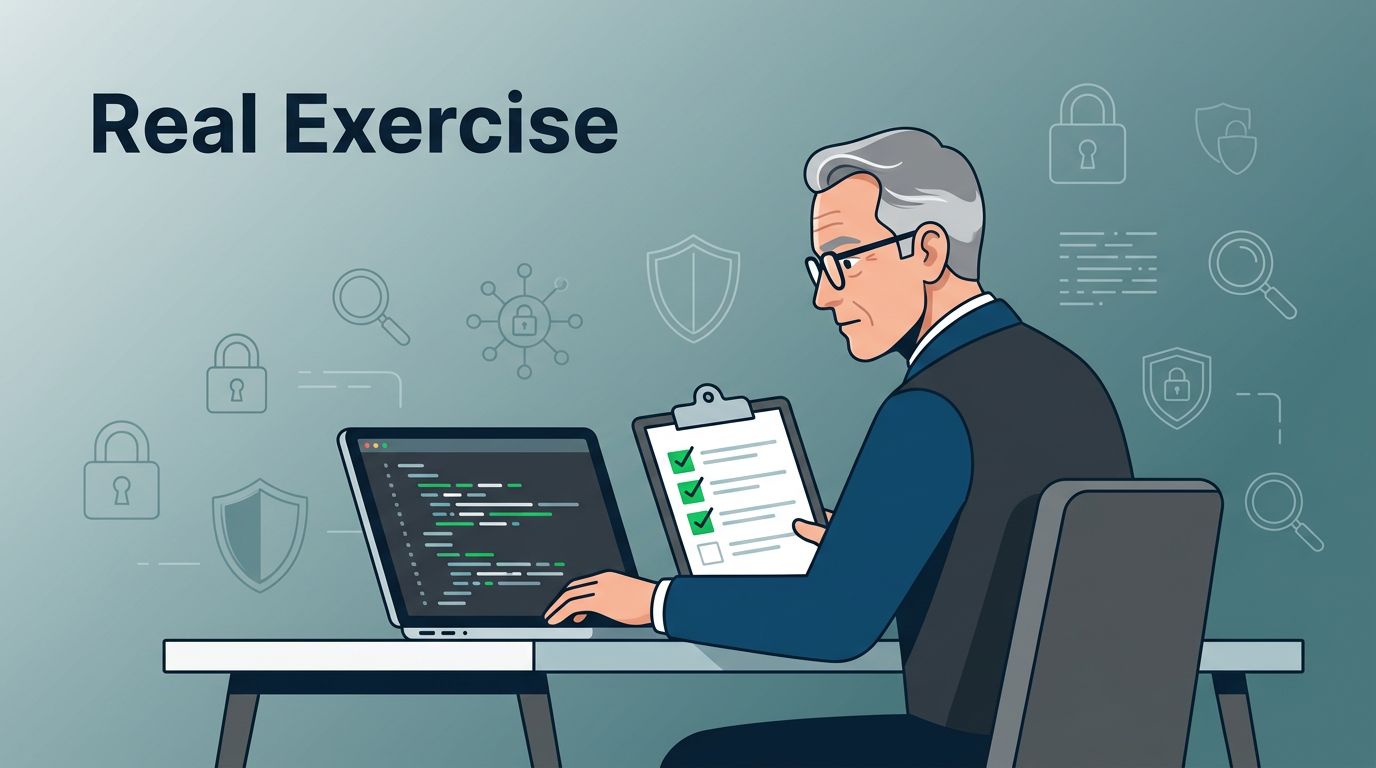
Senior security candidates finish take-home exercises when the task feels real, bounded, and worth their time. They walk away when the prompt looks like unpaid project work.
That line matters because strong candidates spot weak candidate experience fast. They also care about the signal-to-noise ratio.
For AppSec, cloud security, detection engineering, product security, and security engineering roles, the exercise should reveal judgment, not free labor. The best version fits inside 60 to 120 minutes and leads to a sharp discussion.
What senior candidates will actually accept
Senior people do not mind effort. They mind waste. If the assignment mirrors a bug review, a threat model, or a policy decision they would handle on the job, they usually engage. If it asks for a weekend write-up, they decline.
A good rule is simple, the prompt should create one artifact and one conversation. A short review of a vulnerable API works better than a broad “design a secure platform” brief. For product security, a focused workflow threat model maps well to real work, and GitLab’s AppSec threat modeling process is a useful reference for keeping scope tight.
A good take-home looks like a work sample, not free consulting.
If you want examples of compact review tasks, secure code review challenges show how little surface area you need to get strong signal.
The right shape changes by role. Here’s the quick version.
| Role | Best take-home shape | Time box | What it reveals |
|---|---|---|---|
| AppSec or product security | Review one small service or one auth flow | 60 to 90 minutes | Risk ranking, secure design judgment |
| Cloud security | Inspect IAM, Terraform, or a control gap | 60 to 90 minutes | Least privilege, blast radius, cloud fluency |
| Detection engineering | Write or tune one detection rule | 60 to 120 minutes | Precision, maintenance, false-positive thinking |
| Security engineering | Patch one flaw or propose one guardrail | 60 to 90 minutes | Practical engineering, ownership |
The pattern is clear. Ask for one decision, one short explanation, and one tradeoff.
Role-specific exercises that senior candidates actually finish
AppSec and product security
Give the candidate a small API diff or code sample plus a one-page architecture sketch. Ask for the top three risks, the first fix, and one follow-up question they would send to engineering. That takes 60 to 90 minutes and shows whether they can rank issues, not just list them.
For product security, a single workflow threat model works well. The candidate should map trust boundaries, name abuse cases, and choose one control to add. That is enough to see how they think without turning the assignment into a research paper.

If you want a concrete reference point, secure code review challenges show how little code is needed to create meaningful discussion. Pair that with GitLab’s AppSec threat modeling process, and the scope stays grounded.
Cloud security
Hand them an IAM policy, a Terraform snippet, or a cross-account access plan. Ask for risks, least-privilege fixes, and rollout concerns. Senior cloud security candidates dislike broad architecture homework, as seen in accounts of cloud security take-home tests.
The best prompt makes them reason about blast radius and operational fit. Can the control break deployments? Will it block a service account? What is the smallest safe change? Those are real cloud security questions, and they fit a short exercise.

A strong cloud take-home does not ask for a full audit. It asks for a focused judgment call with a practical fix.
Detection and content engineering
Give one telemetry set and one detection gap. Ask for a rule, a tune-up plan, and the false-positive tradeoff. The output can be a Sigma-like rule, a query, or content notes. A work sample for threat detection engineers is useful because it keeps the task close to production work.
Senior candidates want to show judgment about precision, coverage, and maintenance. They also know that a perfect rule with no tuning plan is weak. A good exercise asks them to balance those concerns without building an entire detection stack.

For content engineering, the same logic applies. Ask what they would ship first, what they would tune later, and what false alarms they expect.
Security engineering
Security engineering needs a bounded fix, not a platform build. Ask for a small change that touches code and process. Examples include adding a config check, tightening an auth path, or proposing a guardrail in CI.
Ask for the change, the risk it reduces, and the edge cases. Resist the urge to ask for a whole platform or a polished deck. That crosses into unpaid project work fast. The sweet spot is a change they could code or design before lunch.
A simple rubric that scores judgment, not polish
Use a short rubric before you send the prompt. It keeps reviewers aligned and cuts debate later.
| Criterion | 2 points | 1 point | 0 points |
|---|---|---|---|
| Risk identification | Finds the highest-risk issue and explains why | Finds a relevant issue but misses priority | Lists issues without ranking |
| Fix quality | Suggests a practical fix with tradeoffs | Fix works but lacks detail | Suggestion is vague or unrealistic |
| Scope control | Stays inside the brief and asks smart questions | Drifts a little, but stays useful | Expands into unrelated work |
| Communication | Clear, concise, accurate | Understandable, but dense | Hard to follow |
If someone writes a thoughtful but imperfect answer, they should still score well. That is the point.
Red flags that make senior candidates opt out
No time box is the first warning sign. If the candidate has to guess whether the task takes 30 minutes or four hours, they will assume the worst.
Other red flags show up fast:
- A prompt that asks for a doc, code, and presentation. That is too much for one take-home.
- A task that can become internal consulting. Senior candidates will spot the free work risk.
- No debrief or feedback path. People want a conversation, not a submission portal.
- Vague success criteria. If nobody can tell what good looks like, the exercise feels arbitrary.
One more warning matters in security hiring. If the assignment is harder than the actual job, your process is the problem. Candidates compare the task to the role, then they decide whether to continue.
Senior candidates finish take-home exercises when the work feels honest. The best security take-home exercises show judgment in a narrow slice of the job, then leave room for discussion.
If your process still asks for free consulting, the strongest applicants will move on. If you want help tightening senior security hiring around real signal, Book a Discovery Call with Bud Consulting.