table of contents
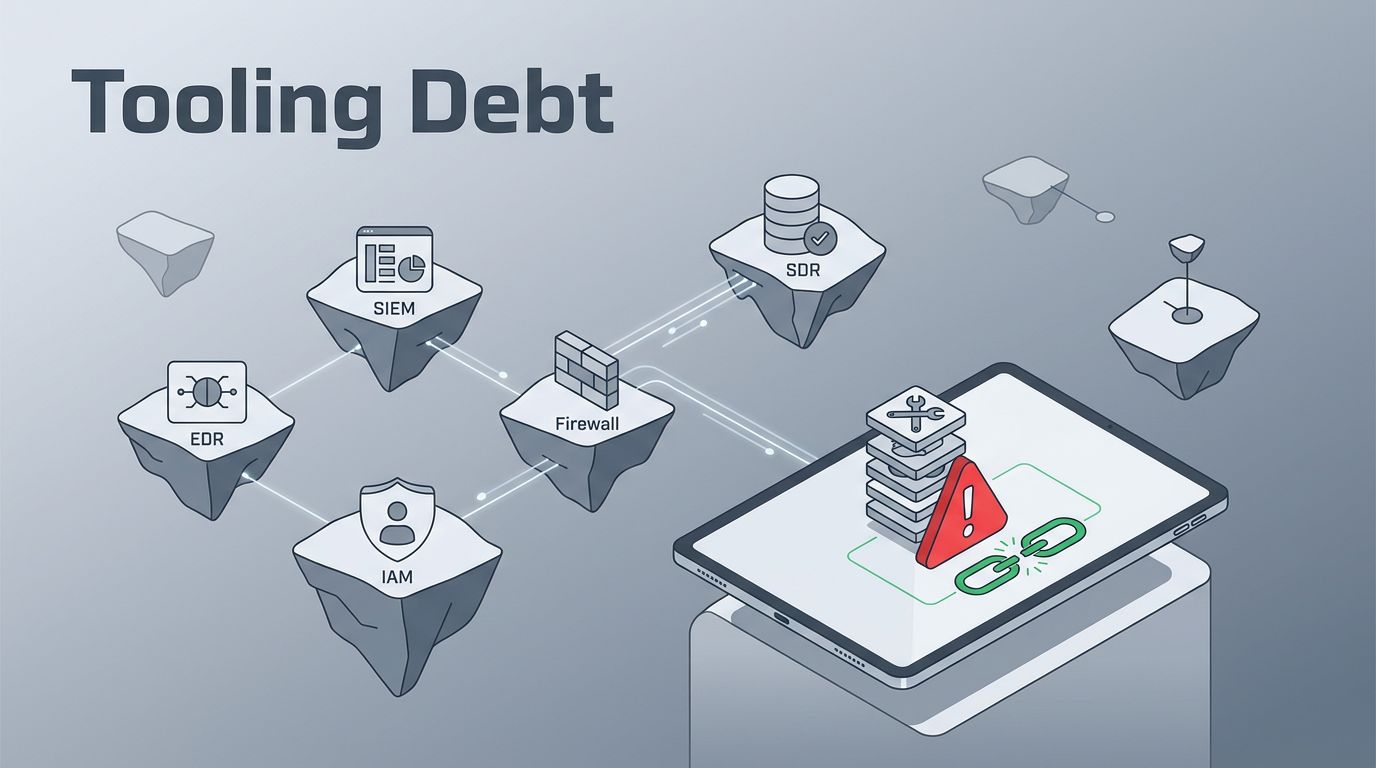
Security leaders often find themselves managing a paradox. You acquire new tools to defend against emerging threats, yet each addition adds weight to your operational load. When tools remain partially deployed, lack integration, or rely on outdated configurations, they create security tooling technical debt. This hidden burden slows down your team, obscures visibility, and eventually creates the very vulnerabilities you bought the software to prevent.
If you don’t address this friction, your security operations center becomes a collection of disconnected islands rather than a unified defense. Analysts waste time toggling between platforms, and alerts lose their context in the noise of overlapping capabilities. Identifying this debt requires a clear look at how your current stack actually performs compared to what you originally purchased.

Identifying Your Security Tooling Debt
Technical debt in your security stack often starts with good intentions. A team might purchase an endpoint detection tool for a specific cloud workload but never finish the full migration of policies. Another common issue is license sprawl, where different departments purchase redundant software because they lack visibility into what the security team already owns. These small gaps might seem manageable at first, but they compound quickly.
When evaluating your environment, look for indicators of stalled progress. Ask your team which tools they find frustrating to use daily. If an analyst ignores alerts from a specific system because the data is unreliable, that tool is a primary source of debt. You can read more about when technical debt strikes the security stack to understand how these issues affect strategic planning.
Redundancy is the silent killer of efficiency. Many organizations pay for features they don’t use or licenses that sit idle. To find these bottlenecks, start with a simple inventory. Compare your current tool list against the actual active user count and the specific security outcomes those tools support. If you cannot point to a direct risk reduction for a particular platform, you should investigate why it remains in your stack.
The Impact on Operational Velocity
Security tooling technical debt directly drains your team’s energy. When tools don’t talk to each other, engineers spend hours building manual workarounds just to move data between a ticketing system and an incident response platform. This manual labor is not just slow; it is error-prone. Every hour spent fixing an integration is an hour lost on threat hunting or vulnerability remediation.
Analyst fatigue is often a direct result of this fragmented environment. When teams juggle too many consoles, the cognitive load prevents them from spotting subtle signs of a breach. You end up with a stack that alerts on everything but provides actionable intelligence on almost nothing. Over time, this leads to high turnover in specialized roles, as your best people grow tired of fighting the infrastructure instead of the adversaries.
Furthermore, patching becomes a logistical nightmare when your vulnerability management tools are not synchronized with your asset inventory. If your scanners miss newer cloud instances or containers, you have blind spots that attackers will find eventually. Maintaining your roadmap requires tackling technical debt before it owns your roadmap to keep the organization agile. If you are struggling to align your security investments with actual business risks, you can Book a Discovery Call with Bud Consulting to discuss how to consolidate your stack for better efficiency.
An Evaluation Framework for Your Stack
To manage this debt effectively, you need a repeatable process for reviewing your tooling. Start by auditing your current capabilities against your primary security goals. Create a grid that lists every tool, its annual cost, the primary use case it covers, and the level of internal support it requires. Be honest about whether the tool is truly delivering value or if it is just consuming budget and time.
| Tool Category | Primary Use Case | Integration Status | Maintenance Burden |
|---|---|---|---|
| SIEM | Threat detection | Partial | High |
| EDR | Endpoint security | Full | Low |
| Vulnerability Scanner | Asset visibility | Low | High |
| IAM | Access control | Full | Medium |
Once you have this view, rank your tools by their impact on your security posture. High-impact tools that are fully integrated should stay. Low-impact tools that require high maintenance are your first candidates for retirement or consolidation. When you evaluate your security stack, look for opportunities to replace multiple legacy tools with a single platform that offers broader functionality and native integrations.
Focus on long-term sustainability rather than short-term fixes. If a new tool adds too much configuration overhead, consider whether you have the internal skills to manage it effectively. Sometimes, it is better to optimize existing tools than to add another layer of complexity to your environment. Security-as-code practices can help here, as they allow you to automate configurations and reduce the risk of drift in your security policies.
Preventing Future Debt Accumulation
Addressing your existing backlog is only half the battle. You must change your acquisition process to prevent new debt from forming. Before you purchase any new technology, require a clear integration plan. Who will own the maintenance of this tool? How does it fit into your existing automation pipeline? If you cannot answer these questions, the tool will likely become a liability within six months.
Build security requirements into your procurement process. Every vendor should provide clear documentation on how their product integrates with your current SIEM, SOAR, or ticketing systems. Do not settle for vague promises of compatibility. Test the integration in a sandbox environment before signing a long-term contract. You want to ensure the product solves a specific, measurable problem instead of adding to your administrative workload.
Finally, set up a recurring review cycle for your entire security stack. Technology changes, and what worked three years ago might be the main contributor to your technical debt today. Dedicate one month every year to pruning your stack. Remove unused licenses, deactivate ghost rules in your firewalls, and consolidate duplicate functionalities. This disciplined approach keeps your security posture strong without letting the tools you buy become the primary threat to your own efficiency.
Moving Toward a Cleaner Defense
Technical debt in your security tools is a structural issue, not just a nuisance. By treating your security stack as a product that needs consistent maintenance, you can reduce waste and improve your team’s ability to respond to real threats. Efficiency comes from clarity and integration, not from the number of logos on your dashboard.
Start by auditing your most resource-intensive tools to see if they truly provide the value you expected. If a platform is consuming more time than it is saving, it is time to move on. Focus your efforts on building a lean, integrated, and well-maintained stack that supports your team’s expertise. A simpler, more focused security architecture allows your professionals to do what they do best: protect the organization.