table of contents
VC-backed startups face tough choices on security spend. Boards push for SOC 2 reports. Customers demand detailed questionnaires. VCs check breach risks before wiring funds. You need a startup security budget that matches your stage without burning cash.
Yet most teams guess at numbers. They overspend on shiny tools or skip basics. This leaves gaps that kill deals. A smart framework ties spend to ARR, headcount, and risks like AI models or cloud stacks.
Let’s break down practical ways to build yours. You’ll see stage-based examples and prioritization tips that fit 2026 realities.
Why Your Startup Needs a Tailored Security Budget Now
Startups ignore security budgets at their peril. A single failed customer review can cost $500K in lost ARR. Boards now expect metrics on cyber risk tied to revenue.
In 2026, pressures mount. VCs fund AI-heavy firms but demand zero-trust setups first. Customers in fintech or health send 50-page questionnaires. Compliance like SOC 2 Type II blocks Series A closes without it.
Data shows the cost. Average breach hits small firms at $4.88M per IBM’s latest report. Yet smart budgets cut that risk. They focus on high-impact areas like IAM and cloud monitoring.
You balance growth and defense. Tie security to business goals. For example, if enterprise sales drive GTM, prioritize audit-ready controls. This approach wins trust and funding.
Budgets scale with maturity. Seed teams spend on basics. Series B hires operators. Always link spend to outcomes like faster RFPs or lower insurance premiums.
Key Factors That Drive Security Budget Size
No universal number fits all. Your budget hinges on stage, ARR, headcount, data sensitivity, and GTM.
Stage matters most. Seed focuses on hygiene. Later rounds add teams and automation. ARR guides scale: under $1M means lean tools; $10M+ needs MDR services.
Headcount affects costs. Tools price by seats. A 25-person team pays less for EDR than 100. Data sensitivity pushes spend. AI firms guard models. Healthcare handles PII.
GTM shapes priorities. B2B SaaS chases SOC 2 for questionnaires. Consumer apps stress app sec. Cloud-native stacks demand config scanning.
Real-time trends confirm this. Global cyber budgets hit $240B in 2026 per Gartner. Startups aim for 8-12% of IT spend. VCs like it lean to avoid tool sprawl.
Assess your risks first. Map threats to revenue impact. Then allocate. This keeps CFOs happy and boards aligned.
Stage-Based Security Budget Frameworks
Budgets grow with funding rounds. Seed builds foundations. Series C operationalizes full programs.
At seed ($0-3M raised), spend $20K-$40K yearly. Focus IAM, MFA, cloud configs. No full-time hires yet.
Series A ($3-15M) jumps to $50K-$150K. Add fractional CISO, policies, basic monitoring. Aim for SOC 2 Type I.
Series B ($15-75M) hits $300K-$700K. Hire first security engineer. Build IR plans, annual pentests. Target SOC 2 Type II.
Series C and beyond? $500K-$1M+. Full teams, MDR, automation. Prep for ISO 27001.

This scaling matches risks. Early stages prevent basics. Growth handles enterprise scrutiny. For details on stage breakdowns, check ShipSafer’s startup security budget guide.
Adjust for your path. Consumer GTM skips heavy compliance. Enterprise needs it all.
Sample Budget Allocations by ARR and Stage
Tie budgets to ARR for clarity. Under $1M ARR? Keep it under 5% of ops budget. $10M+? 10-15%.
Here’s a sample table for a 50-headcount SaaS firm in 2026. Percentages split tools (40%), people (30%), services (20%), compliance (10%).
| ARR Tier | Total Annual Security Budget | Tools (e.g., EDR, IAM) | People (Fractional/Full) | Services (Pentest, MDR) | Compliance (SOC 2 Audit) |
|---|---|---|---|---|---|
| <$1M (Seed) | $30K-$50K | $15K (20%) | $10K (25%) | $15K (40%) | $5K (15%) |
| $1-5M (A) | $100K-$150K | $50K (40%) | $30K (25%) | $40K (30%) | $20K (15%) |
| $5-20M (B) | $300K-$500K | $150K (40%) | $120K (30%) | $80K (20%) | $40K (10%) |
| $20M+ (C) | $600K-$1M | $300K (40%) | $250K (30%) | $150K (20%) | $60K (10%) |
These draw from benchmarks like TechCompass’s SaaS security roadmap. SOC 2 Type II costs $25K-$50K for Series A per SOC2Scout.

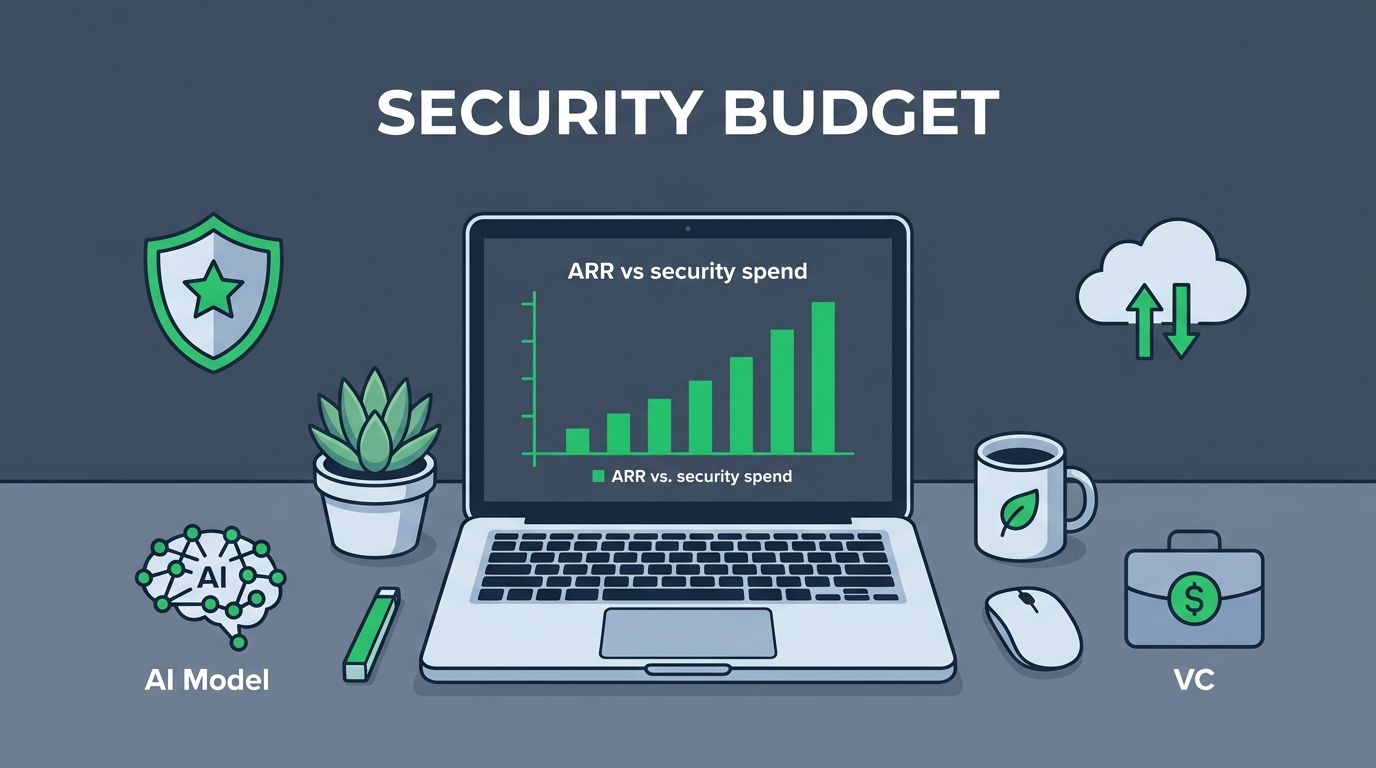
The table shows progression. Early ARR stresses services for quick wins. Later shifts to people for scale. Tweak for AI risks: add 10% for model protection.
Prioritizing Security Spend with Limited Resources
Limited cash demands tough calls. Rank by impact: protect revenue first.
Start with IAM and MFA. They block 80% of breaches cheap. Next, cloud monitoring for misconfigs. AI usage? Secure prompts and data pipelines.
Use a risk scorecard. Score threats by likelihood and business impact. Fund top 20%.
For seed teams, pick consolidated platforms. One tool for EDR and vuln scanning saves 30%. Avoid sprawl.

Enterprise questionnaires guide you. Common asks: encryption, pentest reports, IR plans. Build those.
Fractional CISOs cost $10K-$20K quarterly. They spot gaps without full hires. Boards love the expertise.
Measure ROI. Track questionnaire pass rates or insurance savings. Adjust quarterly.
Breaking Down Spend: Tools, People, Services
Allocate across categories. Tools get 40%: EDR, SIEM, cloud scanners. Pick AI-native ones for 2026 threats.
People take 30%. Start fractional. Hire at Series B: one engineer at $150K base.
Services 20%: pentests ($10K-$25K), MDR ($50K+ yearly). Outsource response early.
Compliance 10%: SOC 2 audits scale with headcount. Type I at Series A: $12K-$22K.
Praetorian’s cybersecurity budget framework suggests similar splits: 20-30% detection, rest prevention.
Cloud stacks dominate. Budget for CSPM tools. AI? Add red teaming.
Insure it. Premiums drop with controls: $50K savings offsets spend.
Handling Compliance Pressures Like SOC 2 and ISO
Customers and VCs demand proofs. SOC 2 tops lists. Startups pay $30K-$80K first year for Type I/II.
Prep costs more than audits. Tools and fixes add 60%. Use platforms like SecureFrame.
ISO 27001 follows for global GTM. Start at Series B: $100K+ yearly.
Questionnaires hit weekly. Automate responses with TPRM tools.
VCs tie funding to this. No SOC 2? Deals stall. Boards want dashboards.
For costs, see SOC2Scout’s 2026 startup guide. Plan 15-20% of budget here.
Common Pitfalls and How to Avoid Them
Many startups botch budgets. They buy too many tools. Or skip people for “automation.”
Underfund basics. Weak IAM leads to breaches. Fix: enforce MFA everywhere first.
Ignore GTM fit. Consumer apps waste on SOC 2. Match spend to customers.
No metrics. Boards cut vague lines. Track risk scores and deal velocity.
Overspend on audits sans controls. Prep first.

Filaments’ budgeting guide warns against growth backseat. Tie to sales wins.
Review quarterly. Adjust for AI threats or headcount jumps.
Conclusion
Smart security budgets scale with your startup’s risks and goals. Base them on stage and ARR. Prioritize IAM, cloud, and compliance to meet VC and customer demands.
Key wins come from focus. Allocate 40% tools, 30% people. Measure everything. This setup cuts breach odds and speeds deals.
In 2026, pressures rise but so do tools. Build now to protect growth. Need help tailoring yours? Book a Discovery Call with Bud Consulting.
(Word count: 2487)