table of contents
Public companies face intense scrutiny on security. Investors and regulators demand proof of strong controls before the bell rings. If you’re a late-stage private firm eyeing an IPO in 2026, underestimating your security team size can derail the process.
You deal with SOX 404 audits, board questions on vendor risks, and rising threats to cloud assets. A mismatched security headcount forecast leaves gaps in compliance and response. This guide walks you through practical steps to size your team right, by function and risk profile.
Start by mapping demands to your growth stage. Then build a model that finance teams respect.
Grasp IPO-Driven Security Requirements
IPOs trigger new rules. SOX 404 requires solid internal controls over financial reporting. Security flaws here can flag material weaknesses and spook underwriters.
Audits ramp up too. Expect external firms to probe your cloud setups, app vulnerabilities, and third-party vendors. Boards want quarterly updates on risks like identity breaches or supply chain attacks. In 2026, with AI threats evolving, public status amplifies these pressures.
Consider a Series D SaaS company with 500 employees and $100M ARR. They need GRC staff for policy docs and audit prep. Security ops must handle 24/7 monitoring. Without enough heads, remediation drags, delaying S-1 filings.
Finance teams often benchmark against peers. For ratios, check this startup security hiring plan that ties headcount to overall growth. It shows 1:100 engineer-to-security ratios scaling to IPO.
Your forecast starts here. Match staffing to these demands, or risk restatements post-IPO.
Evaluate Risks and Current Gaps
Know your baseline first. Audit current controls against frameworks like NIST or ISO 27001. Identify high-risk areas: multi-cloud environments demand cloud security experts; custom apps need app sec testers.
Risk profiles vary. A fintech with payment data requires heavy identity and sec ops focus. An enterprise SaaS might prioritize third-party risk due to 200+ vendors.
Run a gap analysis. Count incidents over the last year. If breaches hit double digits, double sec ops. For SOX, test IT general controls now. Weaknesses in access reviews or change management signal hiring needs.
Board expectations shape this. They ask for metrics like mean time to respond. If your team misses SLAs, forecast additions.
Tools help. Use threat modeling to quantify needs. A high-risk profile might need 20% more staff than low-risk peers.
This step grounds your numbers in reality. Skip it, and your forecast looks like guesswork.
Build Your Headcount Model by Function
Break it down by role. Base totals on employee count, revenue, and risks. Aim for 1-2% of total headcount in security for IPO-ready firms.
GRC leads with 20-30% of the team for policies, audits, and reporting. Security engineering follows at 15-20% for tools and automation. Cloud security gets 15% in hybrid setups. App sec, sec ops, identity, and third-party risk split the rest.
Here’s a sample for a 1,000-employee company at $250M ARR, medium risk:
| Function | Low Growth (Current) | IPO Ramp (Next 12 Mo) | Notes |
|---|---|---|---|
| GRC | 3 | 6 | SOX docs, audit liaison |
| Security Engineering | 4 | 7 | Automation, tooling |
| Cloud Security | 3 | 5 | Multi-cloud controls |
| App Security | 2 | 4 | Code scans, pentests |
| Sec Ops | 5 | 9 | 24/7 SOC, incidents |
| Identity | 2 | 4 | IAM, PAM rollout |
| Third-Party Risk | 1 | 3 | Vendor assessments |
| Total | 20 | 38 | +90% for IPO |
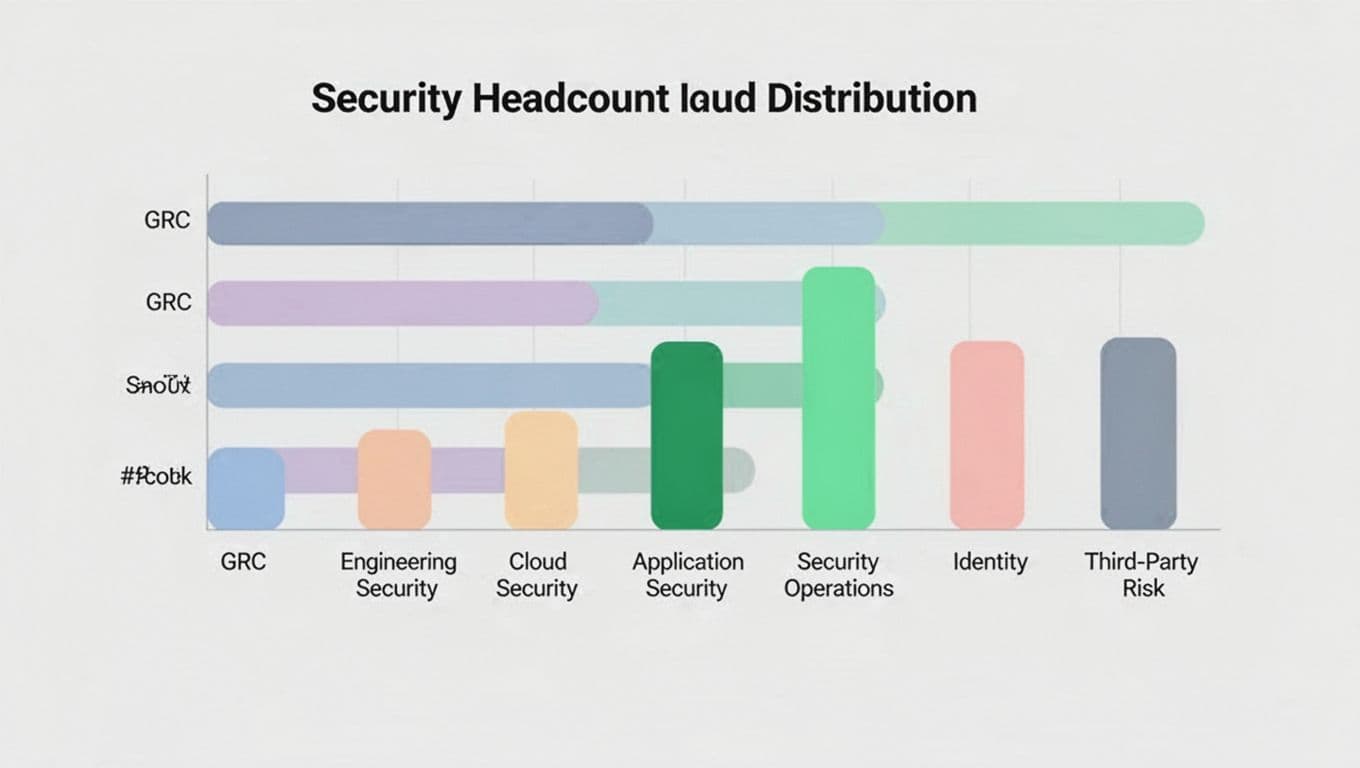
This model scales. For higher risks, add 10-15% overall. Gartner outlines ideal cybersecurity team sizes factoring disruption levels.
Adjust quarterly with finance projections. Tie to revenue milestones. This makes your ask credible.
Factor in External Help Options
Don’t hire everyone internally. MSSPs cover sec ops for scale without full SOC builds. vCISOs guide GRC during audits. Consultants fill app sec spikes.
A 500-employee firm might outsource 40% of sec ops initially. As IPO nears, insource for control. Automation tools cut engineering needs by 20-30%.

Blend works best. Use MSSPs for monitoring; hire identity experts in-house. For SOX, consultants speed 404 testing. This keeps costs down while meeting board demands.
Vetting matters. Pick partners with public company experience. Track their SLAs in contracts.
External help bridges gaps fast. It lets you hit IPO timelines without overstaffing.
Match Plans to Finance and Board Realities
Present forecasts in exec terms. Show ROI: proper staffing avoids $10M+ in breach costs or delays.
Align with FP&A cycles. Use 24-month projections. Highlight vendor oversight needs, as boards grill on third-party risks.
For SOX readiness, reference strategies like those from Moss Adams. They note insourcing for complex firms.
If hiring lags, book a discovery call with Bud Consulting. They source specialists for these ramps.
This alignment turns security into a board asset, not a line item fight.
Key Takeaways
Strong security headcount forecasts secure your IPO path. Build models by function, weigh risks, and mix internal with external talent. Tie everything to audits and growth.
Your team will handle SOX, vendors, and threats without gaps. Investors notice control maturity.
Forecast now. Public markets wait for no one.