table of contents
Remote engineering teams face more attack vectors than ever. Developers log in from home offices, coffee shops, or international spots, each with their own devices and networks. One overlooked vulnerability can cascade across your cloud stack.
You manage async code reviews, contractors with temporary access, and identity sprawl from too many SaaS tools. Security metrics help you spot risks before they hit production. They turn vague worries into clear actions.
This post covers challenges, key metrics, tools, and a scorecard approach. You’ll leave with specifics to track right now.
Security Challenges in Distributed Engineering Teams
Remote setups amplify risks. Distributed devices mean endpoints pop up everywhere, often unmanaged. Cloud-based tools like GitHub or AWS invite shadow IT, where devs spin up resources without oversight.
Async collaboration hides issues too. Pull requests sit for days across time zones, delaying vulnerability scans. Contractors add temporary access that lingers if you don’t prune it fast. Identity sprawl grows as teams stack auth providers, creating forgotten accounts ripe for compromise.
Cross-time-zone incident response drags on. Alerts hit at 3 a.m. your time, but the affected dev is asleep halfway around the world. Valydex’s remote work guide lists metrics like remote-access MFA coverage and endpoint compliance rates that address these gaps directly.

Zero trust practices help here. In 2026, 38% of enterprises use ZTNA over VPNs because it cuts attack surfaces by 67%, per recent IT stats. Still, tool sprawl blocks full adoption for 26% of teams.
Focus metrics on these pain points. Otherwise, you chase shadows instead of fixing root causes.
Core Metrics to Track for Remote Security
Pick 10-12 metrics that balance coverage and actionability. Track them weekly or monthly to catch drifts early. Good benchmarks come from industry data; aim higher for remote teams.
Start with identity and access. MFA coverage rate = (accounts with MFA enabled / total accounts) x 100. Target 99%; below 95% signals sprawl risks. Pitfall: Count only logins, not service accounts.
Endpoint health matters most remotely. Device compliance rate = (compliant devices / total active devices) x 100. Compliant means EDR installed, patched, and encrypted. Shoot for 98%; drops often tie to BYOD policies.
Patch compliance follows. Formula: (patched high-severity vulns within SLA / total high-severity vulns) x 100. SLA is 7 days; 95% is solid. Ignore it, and exploits target your fleet.

Incident response: MTTR (mean time to response) averages hours from alert to containment. Target under 4 hours for high-severity; time zones make this tough, so automate paging. Track false positive rate too: (false alerts / total alerts) x 100. Over 20% wastes dev time.
Developer-focused ones preserve velocity. Security debt ratio = (lines of code with open vulns / total lines). Keep under 2%. Shift-left adoption measures SAST scans in CI; 100% pipeline coverage is the goal.
From distributed dev metrics, remote teams hit 100% code review compliance often, beating onsite groups. Use these as baselines.
Vendor risks round it out. Third-party risk score aggregates their patch cadence and attestations. Review quarterly; flag scores over 7/10.
Automation Tools to Measure and Report Metrics
Manual checks fail at scale. Automate with tools that integrate into your stack. They pull data from Okta, CrowdStrike, or GitHub Actions for real-time views.
Dashboards like Datadog or Grafana visualize trends. Set them for zero-trust signals, like ZTNA session denies. Developer experience stays high because gates block bad PRs early, without slowing merges.
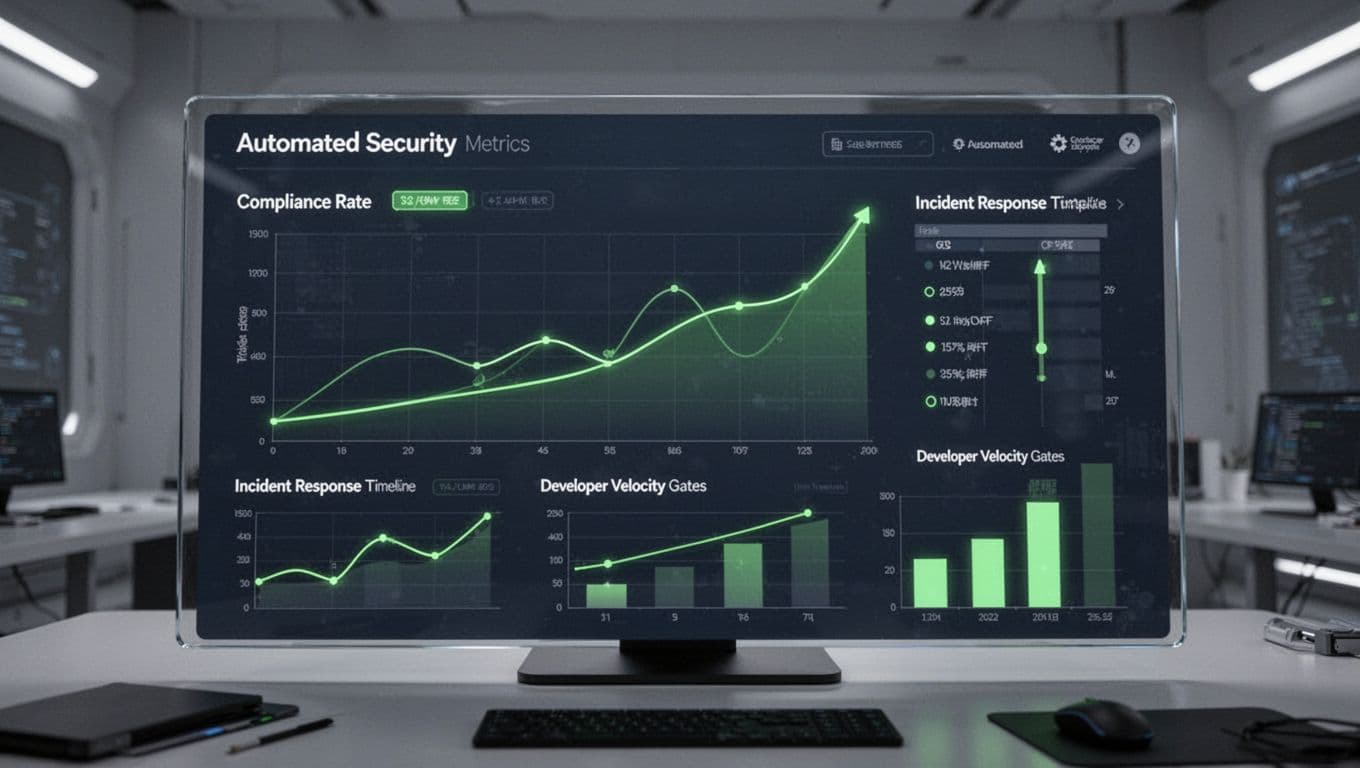
Tools shine in async setups. PagerDuty handles cross-time-zone escalations with on-call rotations. For training, KnowBe4 tracks completion at 90%+ rates automatically.
Neontri’s playbook recommends GitGuardian for secret scanning in CI. Pitfall: Over-rely on dashboards without context; a spiking MTTR might mean better detection, not worse response.
In 2026, platforms like SentinelOne push EDR coverage to near 100%. Combine with DORA metrics twisted for security, like deployment frequency without failed sec gates.
Build a Balanced Security Scorecard
Group metrics into categories for clarity. Use this table as a starter; tweak for your stack.
| Category | Metric | Target | Cadence | Escalate If |
|---|---|---|---|---|
| Identity | MFA Coverage | 99% | Weekly | <95% |
| Endpoints | Compliance Rate | 98% | Daily | <90% for 3 days |
| Response | MTTR | <4 hrs | Monthly | Trending up |
| Code | Security Debt Ratio | <2% | Weekly | >5% |
| Vendors | Risk Score | <7/10 | Quarterly | New vendor >8 |
| Training | Completion Rate | 95% | Monthly | <80% |
| Shift-Left | SAST Coverage | 100% | Weekly | Gaps in main branch |
| Zero Trust | ZTNA Sessions | 80% of access | Monthly | VPN reliance >20% |
This scorecard fits one page. Review in standups; automate reports via Slack bots. Common pitfall: Gaming numbers, like closing tickets without fixes. Tie to outcomes, like zero breaches from unpatched endpoints.
Zero trust cuts breach costs by $1.76M on average, per ORDR’s 2026 report. Start small; add as your team matures.
If gaps persist in your setup, Book a Discovery Call with Bud Consulting to audit and staff up.
Key Takeaways
Remote teams thrive with focused security metrics like MFA coverage and MTTR. They address distributed risks head-on without overwhelming dashboards.
Build your scorecard around 10 core ones. Automate tracking to keep devs moving fast. Benchmarks show 95-99% targets work; watch for context in trends.
Strong metrics build secure habits across time zones. Your posture improves as numbers do.