table of contents
What if a single overlooked flaw lets attackers steal customer data from your SaaS app? Many startups face this risk daily. You know basic patching and logging matter, but crowdsourcing fixes from ethical hackers speeds things up.
A bug bounty program turns that idea into action. It pays researchers to spot issues before bad actors do. Yet success demands preparation. In 2026, with AI tools flooding reports and cloud environments expanding attack surfaces, you need solid basics first. This guide walks you through each step so your program delivers real risk reduction.
Ensure Your Security Foundations Are Solid
Start here or risk chaos. Bug bounties amplify findings, but they don’t fix weak hygiene. Map your assets with tools like automated scanners. Confirm you log events, patch promptly, and triage internally.
Teams often skip this. Without it, reports pile up unresolved. Demand at least one full-time security engineer for review. Smaller outfits use managed triage from platforms. AI workflows help duplicate issues fast, but humans judge impact.
In cloud SaaS setups, inventory APIs and auth flows. CISA pushes coordinated vulnerability disclosure (CVD), so build fix timelines into your process. Check HackerOne’s program maturity framework for benchmarks. It outlines tiers from basic handling to scaled operations.
Challenges include noise from AI scanners, up 80% in reports. Still, programs like curl’s doubled valid finds after restarting on a platform. Prep cuts friction and proves ROI to leaders.
Define Your Program Scope
Narrow scope attracts quality researchers. List exact assets: main web app at example.com, *.example.com subdomains, mobile apps, and APIs with docs links.
Exclude third-party services unless they chain to your core. Skip marketing sites or physical offices. GitHub’s policy offers a model: github.com and subdomains in bounds, with clear outs like staging.
For SaaS, include multi-tenant checks and IDOR risks, common in 2026 findings.

Your team reviews a map like this to set boundaries. Highlight critical paths in green. This prevents out-of-scope noise and focuses efforts.
Use examples from BugBop’s scope guide. It stresses primary assets only. Announce scope publicly to build trust.
Pick a Platform and Design Rewards
Platforms handle submissions and payouts. Bugcrowd suits beginners with fair triage. HackerOne leads for volume, paying $300M total. Compare via TrustRadius 2026 rankings.
Start public for broad reach, go invite-only later. Fees run 20-30%, but they manage legal bits.
Tie rewards to severity. Low: $100-500 for UI glitches. Medium: $500-2,500 for limited data leaks. High: $2,500-10,000 for PII access. Critical: $10,000+ for takeovers.

Visualize tiers this way. Stack values show escalation. GitHub pays $20K-30K for criticals; adjust for your risk.
Budget $50K yearly for startups. Higher draws top talent amid AI competition.
Set Up Report Handling and Triage
Streamline or drown in submissions. Aim for 24-hour first response.
Steps: Researcher submits. Team checks duplicates. Assess severity with CVSS. Assign to engineering. Fix, retest, pay.
AI duplicates 80% junk fast in 2026. Platforms add triagers.
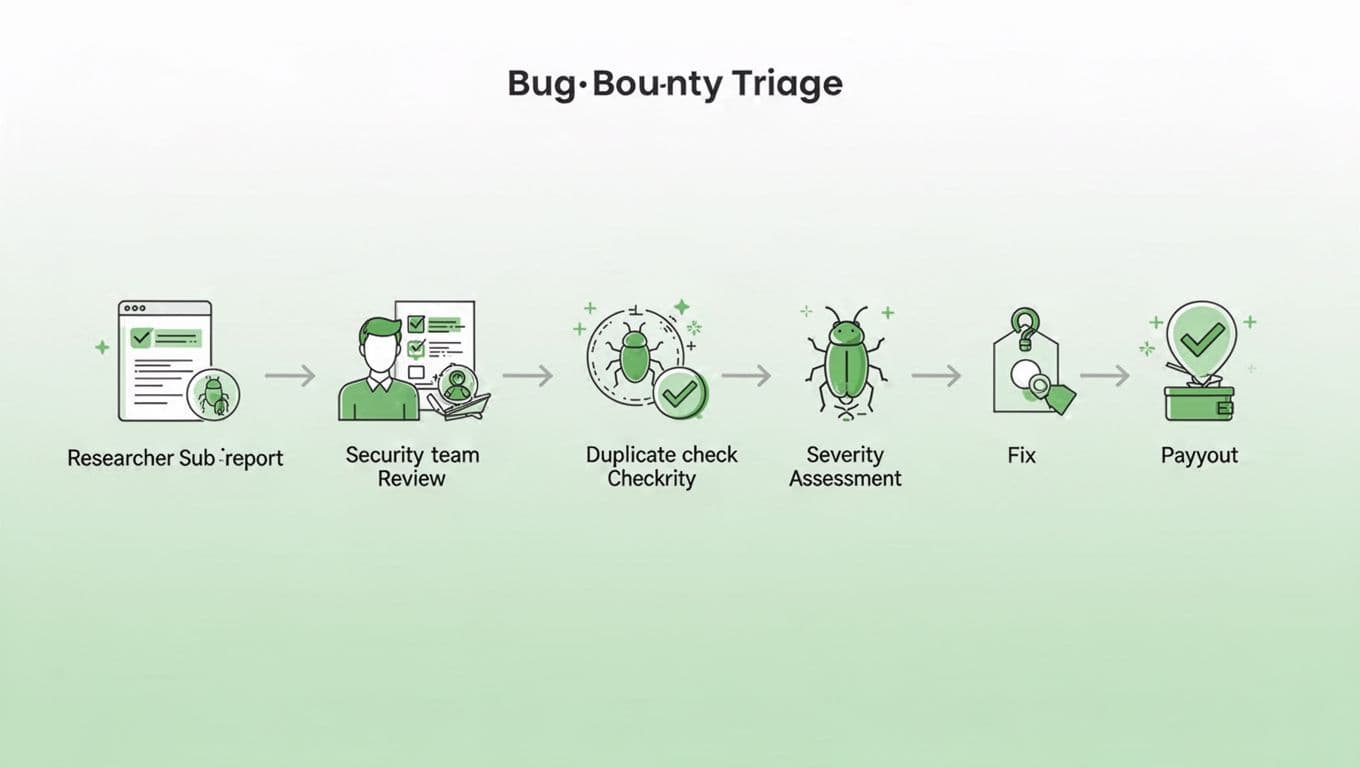
Follow a flow like this. Green steps mark progress.
Track metrics: valid rate over 15%. Internal fixes prove value.
Add Safe Harbor and Clear Policies
Legal protection matters. Safe harbor shields good-faith testers from CFAA suits. State: “We authorize in-scope testing. No liability if you follow rules.”
Include no-public-disclosure timelines. Bugcrowd’s disclose.io terms set a standard.
Post policy on a security.txt page. Define acceptable behavior. This builds researcher trust.
Launch Checklist
Use this to go live:
- Confirm asset inventory and internal triage.
- Publish scope, policy, and rewards.
- Integrate platform.
- Test with a private beta.
- Monitor first 30 reports; adjust.
- Share wins publicly.
Scale by inviting stars after 3 months.
Key Takeaways
Strong foundations make bug bounty programs work. Define tight scope, pick a solid platform, and triage fast. Safe harbor and CVD handle 2026 realities like AI noise.
You now have the blueprint. Programs cut risks without replacing core security. Need talent to run it? Book a Discovery Call with Bud Consulting for vetted experts.
Expect challenges, but rewards outweigh them for prepared teams. Start small, measure fixes, and iterate.