table of contents
Cyber incidents cost businesses an average of $3.86 million in 2025. For CISOs, that number hits harder when insurance falls short. You face rising AI-driven threats and stricter underwriters who demand proof of controls like MFA and EDR.
A solid cyber insurance review process aligns your security posture with coverage needs. It cuts premiums and avoids claim denials. Let’s walk through how to set one up.
Assemble Your Review Team
Start with the right people. You need cross-functional input to match policies with real risks. Include legal for exclusions, finance for limits, and your incident response lead for claims readiness.
Pull in your broker early. They know 2026 market shifts, like falling rates but tighter terms on AI risks. Ask them: “What controls do top carriers require for our industry?”
CISOs often lead this group. Finance checks budget impacts. Legal spots gaps in liability coverage. Your broker bridges to underwriters.

This team meets quarterly. They review applications before submission. In one mid-market firm, this caught a supply chain exclusion that saved 20% on premiums.
Document roles clearly. Assign owners for evidence collection. This prevents silos and speeds renewals.
Assess Risks and Current Coverage
Know your gaps first. List threats like ransomware, AI phishing, and supply chain attacks. Map them to policy sections.
Review your existing policy line by line. Check sub-limits on systemic events or nation-state hacks. Underwriters added these in 2026 due to cloud outages.
Compare against controls. Do you have EDR on all endpoints? Tested backups? Recent tabletop exercises? Carriers want evidence from the last 90 days, as noted in Voss Intelligence’s guide on carrier expectations.
Rate maturity on a 1-5 scale:
- MFA enforcement: 100% on critical accounts?
- Patch management: Weekly for high-risk vulnerabilities?
- IR plan: Tested in last 12 months?
Fix low scores before renewal. This process turns risk assessment into actionable insurance terms.
Follow a Sample Review Workflow
Structure saves time. Use a 90-day cycle tied to renewal dates. It builds governance without overwhelming your team.
Break it into phases. First, gap analysis. Then, evidence gathering. Finally, broker submission and negotiation.
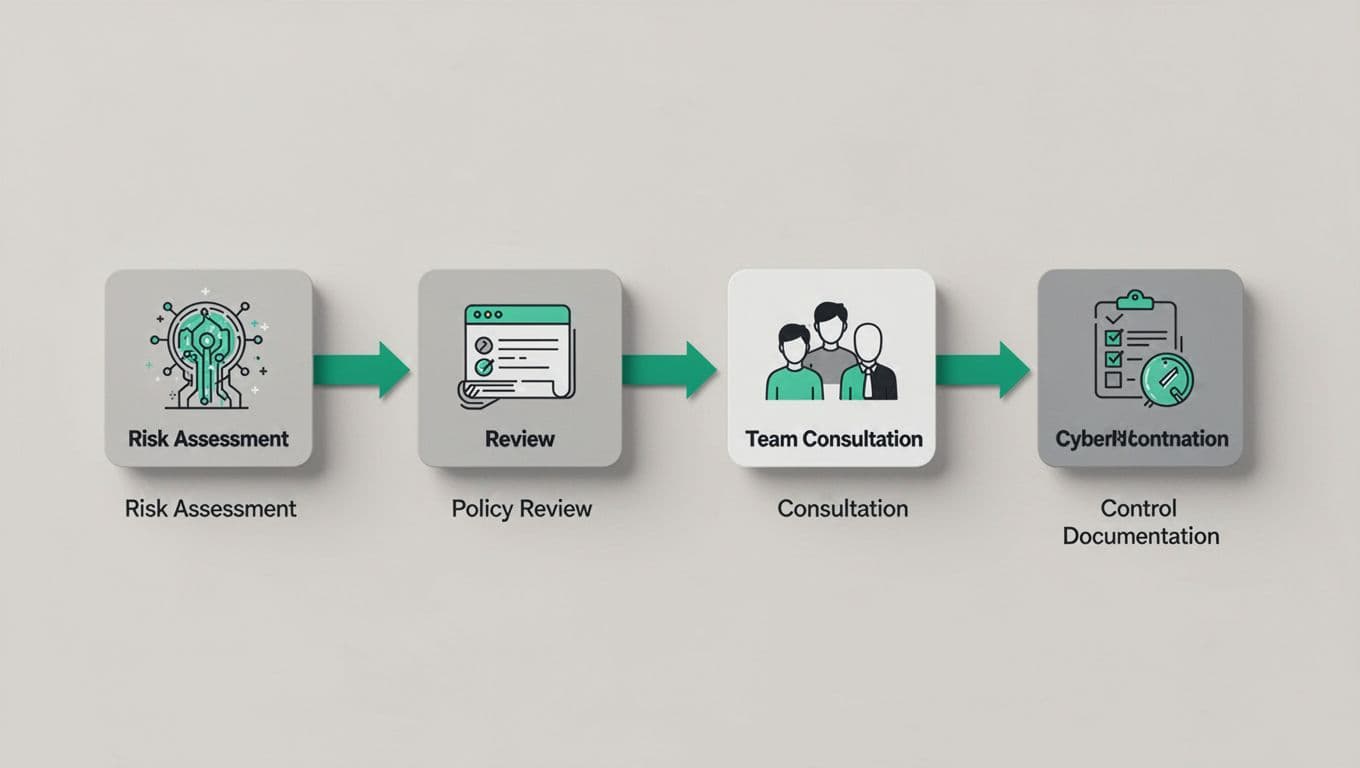
Here’s a checklist for each:
Days 1-30: Inventory
- Audit controls (MFA, EDR, backups).
- Identify vendors and SLAs.
- Run vulnerability scans.
Days 31-60: Validate
- Test backups for recoverability.
- Hold IR tabletop.
- Collect logs and reports.
Days 61-90: Package and Pitch
- Build proof pack.
- Meet broker for quotes.
- Negotiate based on your data.
This workflow matches EY’s beginner’s guide for CISOs. It reduced back-and-forth for one enterprise by half.
Ask Targeted Questions Across Teams
Stakeholders provide clarity. Tailor questions to their expertise.
To your broker:
- Which carriers offer best rates for our risk profile?
- What changed in 2026 exclusions for AI or privacy claims?
- Can we bundle with D&O for CISO liability?
To legal:
- Does this cover regulatory fines under CCPA audits?
- How do war exclusions apply to gray-zone attacks?
- Are notification timelines realistic (24-72 hours)?
To finance:
- What limits match our breach exposure?
- How do deductibles impact cash flow?
- Any tax benefits from premiums?
To incident response team:
- Does the policy fund forensics and PR?
- Have we simulated a claim filing?
- What’s our breach notification sequence?
These questions uncover mismatches. One CISO found their policy excluded BYOD endpoints, prompting EDR expansion.
Dodge Common Pitfalls in Reviews
Mistakes cost coverage. Many assume policies auto-apply. They don’t.
Overlook exclusions first. New 2026 ones hit AI losses and invoice fraud. Read footnotes.
Don’t fake security docs. Underwriters verify MFA screenshots and backup tests. Fresh evidence rules.
Skip claims drills. Test procedures pre-incident. Know your carrier’s portal.
Failing to quantify risks leaves you average-rated. Use tools to show low exposure, as in C-Risk’s approach for CISOs.

Track these in your process. It builds trust with carriers.
Final Thoughts
A strong cyber insurance review process ties security to business protection. It demands proof, teamwork, and regular checks against 2026 realities like AI threats and tight underwriting.
You now have steps to assemble a team, map risks, and avoid traps. Start your next cycle early. For tailored advice on aligning talent with these needs, book a discovery call with Bud Consulting.
This governance boosts resilience. Your coverage will match your controls.