table of contents
Cybersecurity hiring gets hardest where the work is most specialized. OT/ICS security, detection engineering, DFIR, reverse engineering, cloud security architecture, identity security, and threat intelligence all need different proof points.
The market still shows a wide gap. 2026 workforce data points to millions of open security jobs, and many leaders say the real problem is missing skills, not missing resumes.
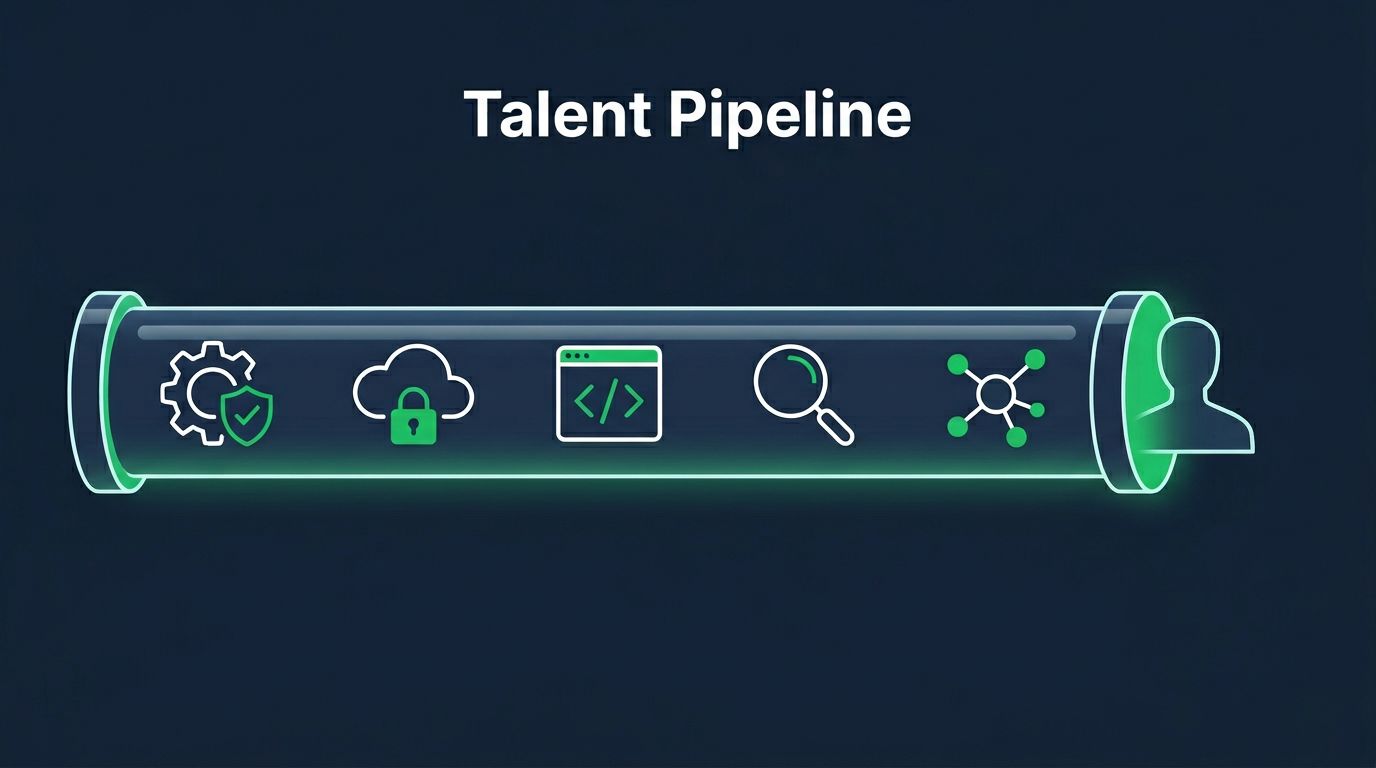
That means a cybersecurity talent pipeline needs more than a requisition and a recruiter. It needs planned sources, clear skill signals, and a way to keep people once you find them.
Why rare roles need a different hiring model
Some jobs are hard because they sit at the edge of several disciplines. An OT security lead needs plant floor awareness, network depth, and risk judgment. A reverse engineer needs low-level coding, patience, and strong labs. A cloud security architect needs identity, policy, and platform knowledge.
That mix is why standard hiring funnels break down. PwC’s 2026 OT survey, summarized by Industry4-1, found that 47% of OT leaders cite a lack of qualified personnel as their biggest barrier. In other words, the market is not short on applicants alone. It is short on people who can do the work on day one.
This is also why title matching fails. A detection engineer may come from a SOC team, a platform group, or a data role. An identity security specialist may start in directory services, IAM ops, or cloud access management. The old habit of searching for perfect job titles shrinks the field too much.
Source beyond traditional security resumes
The best talent pipeline strategy starts with adjacent pools. If a person already knows 70% of the job, you can train the rest faster than you can hire a unicorn.
A simple mapping helps hiring teams see where to look next.
| Rare role | Best adjacent pool | First skill to build |
|---|---|---|
| OT/ICS security | Plant engineering, reliability, industrial networking | Segmentation, asset visibility |
| Detection engineering | SOC analysts, SIEM admins, platform engineers | Detection logic, telemetry quality |
| DFIR | Incident responders, sysadmins, eDiscovery teams | Evidence handling, triage |
| Reverse engineering | AppSec engineers, low-level developers, hobby analysts | Assembly, debugging |
| Cloud security architecture | Cloud engineers, DevOps, platform teams | Identity, policy-as-code |
| Identity security | IAM admins, SSO engineers, directory teams | Lifecycle design, PAM |
| Threat intelligence | SOC analysts, research-heavy analysts, OSINT talent | Collection plans, prioritization |
This is where many hiring teams gain speed. They can hire for most of the job, then train the gap. It also widens the search to people who are harder to spot with keyword filters.
You should also source outside security-first channels. Industrial engineering groups, cloud meetups, open-source projects, incident-response communities, and internal referrals often surface stronger candidates than broad job boards.
A job description doesn’t build a pipeline. A training path does.
Make skills-based hiring the filter
Skills-based hiring works best when it is concrete. Replace vague screening with tasks that mirror the real job. For a detection engineer, that could mean writing a query, explaining false positives, and improving a rule set. For a DFIR candidate, it could mean walking through evidence handling and containment steps. For a cloud security architect, it could mean reviewing an IAM design and spotting exposure.
This matters more in 2026 because AI is changing the skill mix. Teams still need human judgment, but they also need people who can evaluate AI output, spot bad detections, and understand model-driven risk. SANS’ 2026 Cybersecurity Workforce Research Report points to that shift clearly.
Build scorecards for each role. Ask reviewers to grade accuracy, speed, and explanation, not just certs. A strong portfolio, a lab write-up, a GitHub repo, or a post-incident review often says more than a long resume. That is especially true for reverse engineering and threat intelligence, where visible work can replace a missing title.
Treat internal mobility and retention as part of the pipeline
A cybersecurity talent pipeline does not end at hire. It leaks if people cannot move, learn, and stay.
Internal mobility often solves the rarest roles faster than the open market. A cloud engineer can move into cloud security architecture. A SOC analyst can grow into detection engineering. An OT engineer can step into OT security after a focused training path. That is cheaper than starting over, and it keeps context inside the business.
Plan rotations before people ask for them. Let an IAM admin shadow a cloud security architect. Let a SOC analyst spend two days a month with threat intel. These moves build a bench and make career paths visible.
Retention matters for the same reason. When people leave, you lose knowledge, trust, and time. Skills-based cyber talent practices boost retention because people can see a path forward instead of waiting for a title change.
If you need help mapping these roles or vetting senior candidates, Book a Discovery Call with Bud Consulting.
Measure pipeline health with the right KPIs
Good talent planning needs numbers. Otherwise, teams argue from instinct. Track the metrics that show whether your pipeline is filling the right roles, not just openings.
- Qualified slate rate shows whether sourcing is finding people who can do the work.
- Time to first interview shows whether screening is too narrow.
- Offer acceptance rate shows whether pay, scope, and team story are credible.
- Internal fill rate shows whether mobility programs are working.
- 12-month retention shows whether the role and manager match the promise.
- Time to competency shows how long it takes a new hire to become useful.
Use those metrics by role. A DFIR team should not be measured like a cloud architecture team. Rare roles need their own benchmark, because their learning curves differ. If the qualified slate rate stays low, widen adjacent pools. If offer acceptance drops, revisit compensation or role scope. If time-to-competency drags, improve onboarding and shadowing.
The teams that do this well are building capacity, not chasing panic hiring. They know the market is still tight, especially for OT, detection engineering, and cloud security architecture. So they build early, train across functions, and keep talent moving inside the business. That is how a cybersecurity talent pipeline stays healthy when the market stays short.