table of contents
Open source work can reveal how a security candidate thinks under pressure. It can also mislead you, because stars, forks, and a busy profile do not always mean strong judgment.
For cybersecurity hiring, the real task is to read the signal without punishing people who work behind NDAs, inside regulated teams, or in private repos. That takes a sharper lens than a quick scan of GitHub.
Spotting genuine contributions on GitHub and GitLab
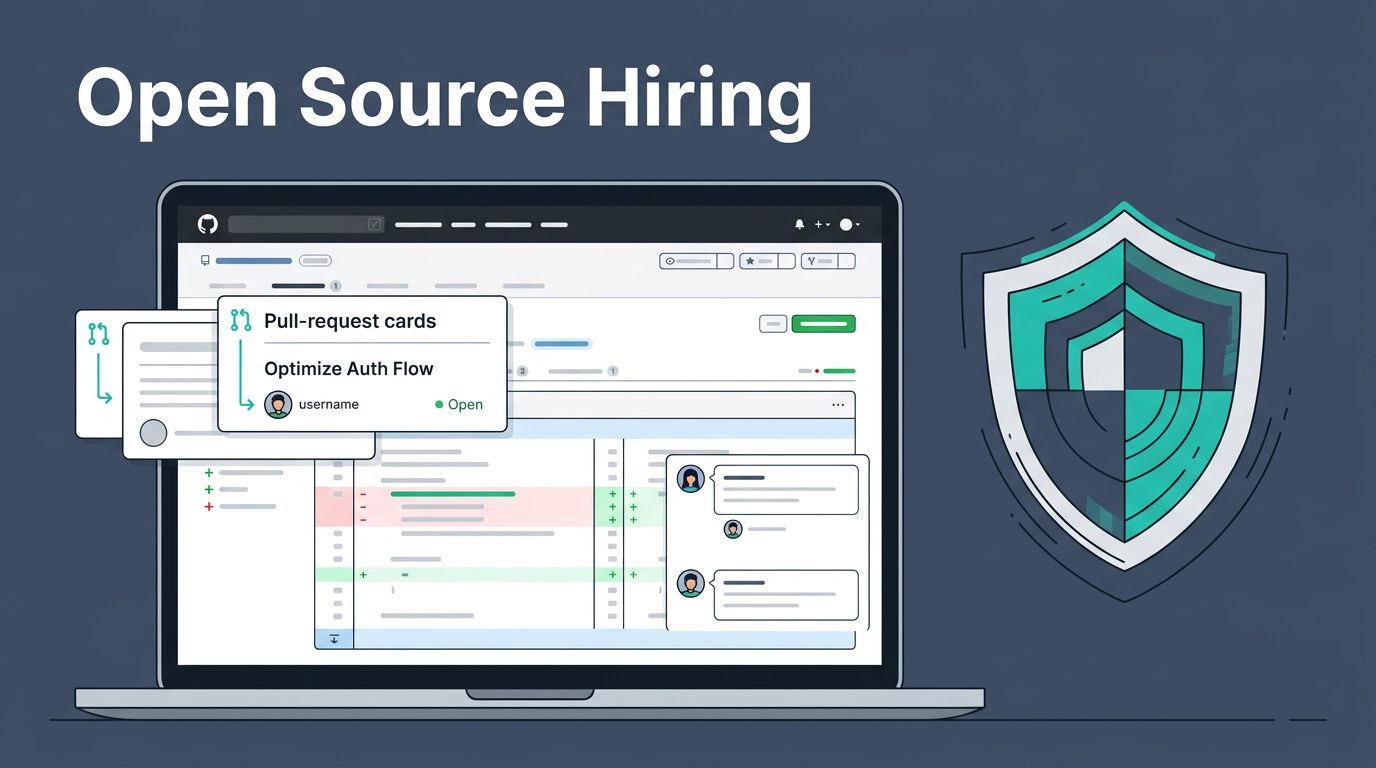
Strong evidence shows up in pull requests, issue threads, release notes, tests, and review comments. On GitHub and GitLab, look for patterns over time, not one flashy repo.
A candidate who fixes a parser bug, adds regression tests, and responds well to review feedback tells you more than someone with 3,000 stars on a repo they never touched. The best contributions also show judgment, because they solve a real problem without creating three new ones.
For a recruiter-facing view of the same idea, daily.dev’s guide to open source hiring puts quality ahead of vanity metrics. If you want a broad view of security work in public repos, browse the GitHub cybersecurity topic and then inspect the maintainer habits, not the star count.

Give candidates with limited public history a fair read
Public work is uneven for good reasons. People in regulated industries, government roles, or critical infrastructure often cannot publish code. Others contribute through private forks, internal reviews, security advisories, or vendor programs.
That matters for underrepresented candidates too, because public visibility often tracks time, access, and social capital as much as skill. Don’t treat a thin profile as a weak profile.
GitLab has warned that hiring based only on open source activity can be harmful, and that warning still holds up today. Public contribution is one signal, not the whole story.
A small public footprint can hide strong security judgment and good teamwork.
Ask for sanitized work samples, design notes, architecture diagrams, or references from maintainers. If the candidate cannot share code, they can still explain how they think.
Use a simple rubric so reviews stay fair
A shared rubric keeps one loud interviewer from overruling the rest of the panel. It also helps you compare candidates who contributed in different ways.
| Criterion | Strong evidence looks like | Score |
|---|---|---|
| Relevance | Fixes, tools, or reviews tied to real security work | 1-5 |
| Depth | Design discussion, tests, and follow-up fixes | 1-5 |
| Consistency | Steady work across months, not a short burst | 1-5 |
| Collaboration | Clear review history and calm responses to feedback | 1-5 |
| Impact | Merged work, reuse, or measurable downstream value | 1-5 |
A score above 20 usually means the work is worth serious interview time. Scores in the middle need more context. Low scores often point to noise, not weakness.
In 2026, hiring still leans toward AI security, supply chain protection, and tools developers will actually use. So the best rubric rewards work that is useful, maintained, and easy for others to trust.
Match the evidence to the role
Role fit matters more than raw activity. A great detection engineer and a great AppSec lead may leave very different traces.
Security engineers
Look for fixes to auth, secrets, CI, dependency handling, and regression tests. Strong candidates improve reliability and security at the same time.
AppSec engineers
Look for vuln triage, secure code review, threat modeling, rule tuning, and developer docs. Good AppSec work makes it easier for teams to ship safely.
Detection and content engineers
Look for detections with test data, ATT&CK mapping, and false-positive tuning. Strong contributors explain why a rule fires, then prove it with examples.
Cloud security engineers
Look for Terraform, policy-as-code, workload hardening, admission controls, and dependency checks. Work around supply chain defense, such as Syft, can be a strong clue when it includes tests and clear docs.
Researchers
Look for reproducible findings, responsible disclosure, and proof-of-concepts that survive peer review. A copied PoC with no new analysis is weak.
Ask interview questions that expose depth
Open source history should lead to a better interview, not replace it. The best questions pull apart judgment, tradeoffs, and follow-through.
- “What was the hardest review comment on this contribution, and how did you handle it?”
- “What did you choose not to build, and why?”
- “How did you test for false positives or regressions?”
- “What changed after the maintainer review?”
- “If this repo disappeared tomorrow, what part of your work would still matter?”
Good answers sound specific. They mention constraints, failures, and iteration.
Red flags that deserve a closer look
Some signals should make you pause.
- Stars, forks, or followers with no useful discussion behind them.
- Tiny commits that arrive in a burst right before a job search.
- Copy-pasted PoCs that mirror a blog post without new insight.
- Repos with hype-heavy READMEs, but thin tests or broken docs.
- Claims about private work with no way to explain scope or impact.
None of these are automatic disqualifiers. They just mean you need more evidence before you trust the profile.
Hiring well means reading context, not chasing volume
Open source hiring works when you evaluate judgment, not vanity metrics. The strongest candidates show sustained work, clear decisions, and enough humility to accept review.
That approach helps you spot real talent in GitHub and GitLab profiles, while still giving fair credit to people whose best work stays private. If you want help turning that into a repeatable hiring process, Book a Discovery Call with Bud Consulting.