table of contents
Hiring for security gets messy fast when the brief is thin. A vague request for “a security person” sends recruiters toward the wrong candidates, and the shortlist fills up with people who look close but cannot do the job.
A strong security recruiter brief template fixes that early. It gives recruiters the scope, the domain, the tools, and the non-negotiables before search starts.
Why technical security hiring needs a sharper brief
Technical security roles are narrower than general tech jobs. A cloud security architect, IAM lead, and appsec manager can all sit under “security,” yet they need different proof.
General tech hiring often starts with years of experience and stack fit. Security hiring needs that too, but it also needs exposure to risk, controls, and operating context. One candidate may be great in incident response, while another knows identity systems but has never touched cloud guardrails.

The brief should answer three things fast, what the person owns, which security domain they sit in, and what success looks like in six months.
- Domain matters because cloud, IAM, DevSecOps, SecOps, and offensive security need different depth.
- Constraints matter because remote, travel, time zone, and clearance rules can remove strong people fast.
- Evidence matters because “strong communicator” means little unless you define the work they need to explain.
If the brief is broad, the shortlist will be broad too.
If the role is senior or hard to fill, Book a Discovery Call with Bud Consulting before the search goes live.
Your copy-and-paste security recruiter brief template
Before you send anything to recruiters, fill in the fields below.
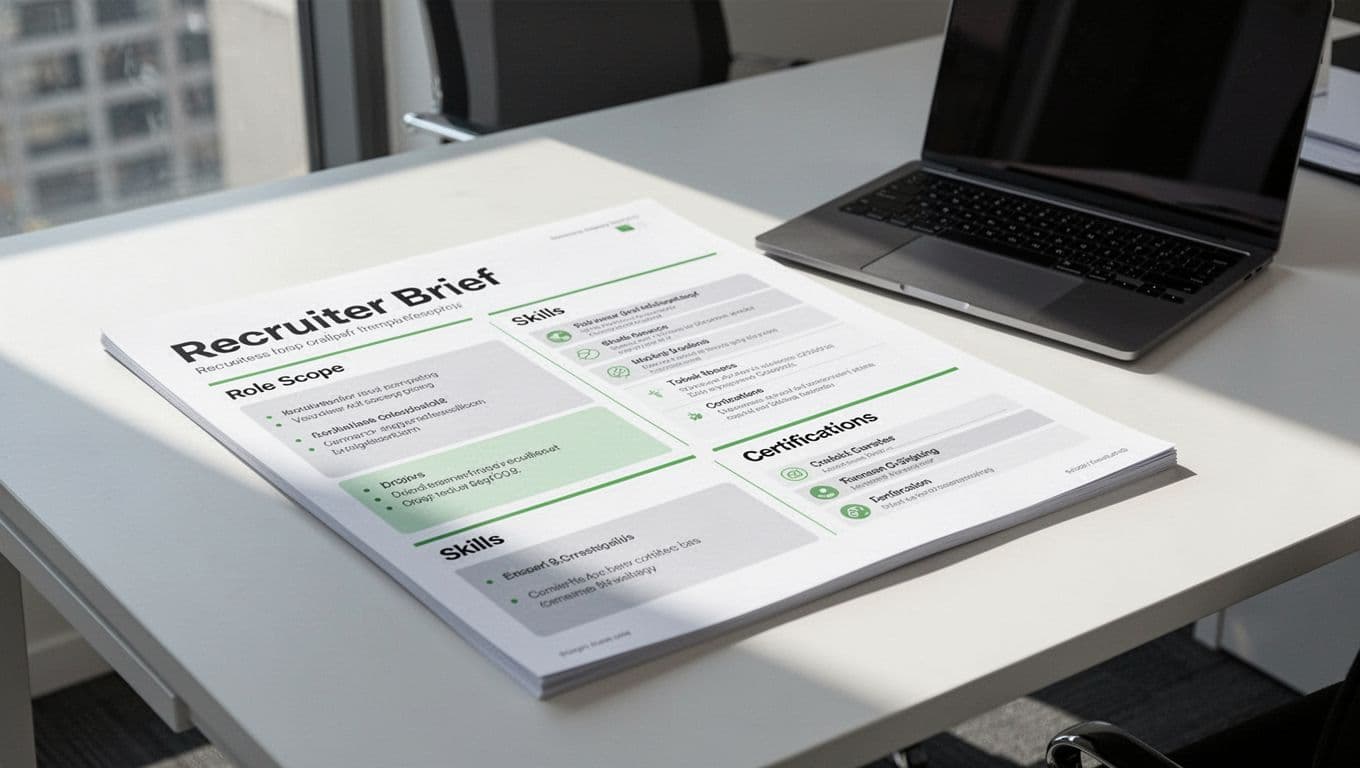
| Field | Include this |
|---|---|
| Role title | Exact title plus level, for example Staff Cloud Security Architect. |
| Role scope | The systems, teams, and risks this hire owns. |
| Security domain specialization | Cloud security, IAM/PAM, AppSec, DevSecOps, SecOps, GRC, or offensive security. |
| Required skills | Concrete skills the candidate must already have. |
| Preferred skills | Useful extras that help, but do not block a good fit. |
| Certifications | Only the certs the team truly expects. |
| Tooling | Cloud platforms, SIEM, EDR, scanners, IaC, PAM, IdP, or CI/CD tools. |
| Seniority | IC, lead, manager, staff, or principal, plus years if needed. |
| Compensation range | Approved base range, bonus, equity, and any flexibility. |
| Location and clearance | Remote, hybrid, travel, time zone, citizenship, or clearance needs. |
| Interview process | Number of stages, who joins, and whether there is a practical exercise. |
| Candidate deal-breakers | The non-negotiables that remove someone from the process. |
A good brief gives recruiters enough detail to screen without guessing. “AWS security” is too broad, while “designing guardrails in AWS Organizations” is clear. The same rule applies to tooling, certifications, and seniority.
Keep required skills tied to real work. If a skill does not change the outcome, it belongs in preferred skills or nowhere at all.
Copy-paste template
Role title:
Team:
Reporting line:
Role scope:
Security domain:
Required skills:
Preferred skills:
Certifications:
Tooling:
Seniority:
Compensation range:
Location and clearance:
Interview process:
Candidate deal-breakers:
Keep each line short. If the answer takes a paragraph, the brief is not ready yet.
Filled example: cloud security architect

A filled brief gives recruiters the picture in minutes.
| Field | Sample answer |
|---|---|
| Role title | Cloud Security Architect, senior individual contributor |
| Role scope | Set cloud guardrails, review architecture, and advise engineering on secure designs. |
| Security domain specialization | Cloud security with some IAM and DevSecOps overlap. |
| Required skills | AWS or Azure security, Terraform, identity design, threat modeling, and control mapping. |
| Preferred skills | CISSP or CCSP, regulated-industry experience, and prior work with large engineering teams. |
| Certifications | CISSP preferred, not mandatory. |
| Tooling | AWS Security Hub, Azure security services, SIEM, IaC scanning, and ticketing workflows. |
| Seniority | Staff level, able to work with architects and lead reviews without a manager title. |
| Compensation range | $180k to $220k base, plus bonus, adjusted for location. |
| Location and clearance | U.S. remote with quarterly travel, no clearance required. |
| Interview process | Recruiter screen, hiring manager interview, technical architecture review, and panel. |
| Candidate deal-breakers | No hands-on cloud security experience, no current AWS or Azure depth, or no ability to partner with engineers. |
This example is specific enough for sourcing. It also leaves room for good candidates who fit the job in different ways.
Cut vague requirements before they waste time
Many briefs fail because they read like wish lists. “Strong security background” and “must know everything” give recruiters no usable signal.
Replace fuzzy language with proof. Instead of asking for “experience with security tools,” name the tools and the decisions the person must make with them. Instead of “5+ years,” describe the work history that matters, such as building cloud controls, responding to incidents, or leading access reviews.
Three edits usually improve the brief fast.
- Turn opinions into requirements, then cut anything that does not affect success.
- Separate required skills from preferred skills, so the search does not shrink too soon.
- Remove certs unless the business truly screens for them.
Technical security hiring also differs from general tech hiring because the cost of a bad fit is higher. A developer can learn a tool on the job. A security hire also needs judgment, calm, and a clear grip on risk.
A tight brief helps recruiters, hiring managers, and interviewers stay aligned. That makes the search faster, and it lowers the odds of hiring someone who sounds right but cannot do the work.
A good security recruiter brief template does one job well. It turns a fuzzy need into a search that recruiters can run with confidence.