table of contents
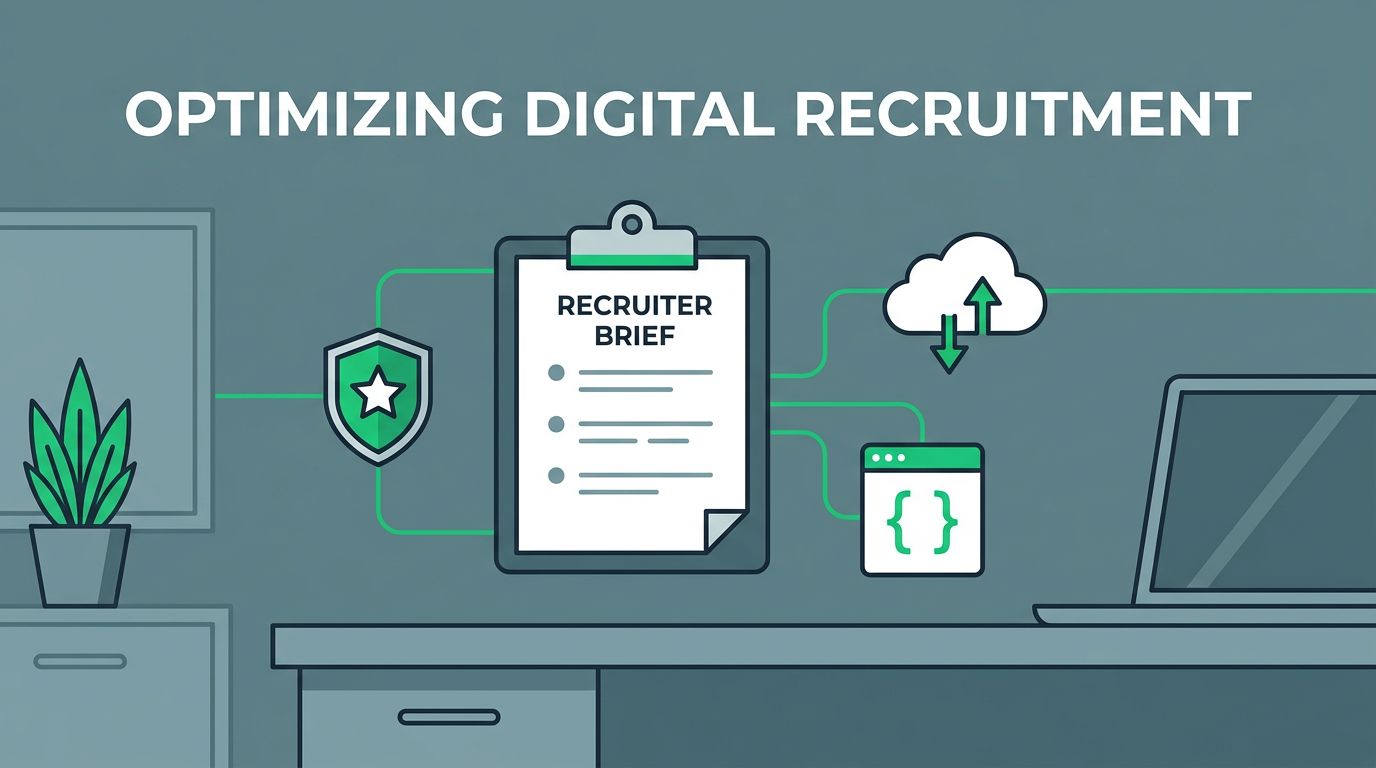
Hard-to-fill security roles rarely fail because talent does not exist. They fail because the brief is vague.
A recruiter can only target what the brief explains. If the role mixes app sec, cloud security, and product work, that mix needs to be spelled out in plain language. Otherwise, you get résumés that sound close and miss the mark. A strong security recruiter brief turns specialist jargon into usable signals.
Start with the security problem the hire must solve
Begin with the business problem, not the job title. A cloud security architect, detection engineer, and GRC lead may all sit under the word “security,” but their day-to-day work looks very different.
Write a short mission statement for the role. Then define what success should look like in the first 6 to 12 months. If the person needs to reduce cloud misconfigurations, support secure code reviews, or tighten audit readiness, say that directly. Recruiters screen better when they know the real outcome.
Also name the work setting. Will the hire sit with engineering, support many product teams, or advise from a central security group? That context changes the kind of candidate you should target.

Translate security jargon into recruiter-friendly criteria
The cleanest briefs replace labels with evidence. A recruiter does not need every technical detail, but they do need a clear picture of what “good” looks like.
Use language that points to work done, tools used, and outcomes delivered. That gives the search real shape.
| Security term | Better brief language |
|---|---|
| Application security | Has reviewed code, found real issues, and worked with engineers on fixes |
| Cloud security | Has secured AWS or Azure environments, IAM, logging, and guardrails in production |
| Detection engineering | Has written detections, tuned alerts, and reduced false positives |
| GRC | Has built controls, tracked risk, and supported audit evidence with clear owners |
This wording helps recruiters spot fit faster. It also keeps them from sending people who know the vocabulary but not the job.
You can go one step further by naming the tools only when they matter. A brief for a cloud role might mention Terraform, IAM, and CSPM tools. A brief for product security might mention threat modeling, code review, and API testing. The point is to keep the language tied to actual work.
Separate certifications from real experience
Certifications can help, but they should not carry the whole brief. A badge may show study and baseline knowledge. It does not always show judgment, scale, or ownership.
A better recruiter brief says what the certification means in context. For example, a CISSP or CISM can make sense for leadership or GRC roles. A cloud cert can help when the role is deeply tied to one platform. Offensive certs can matter for testing roles, but they do not replace proof of real assessments.
Use this kind of framing.
| Credential | Helpful signal | What not to assume |
|---|---|---|
| CISSP or CISM | Security leadership, governance, policy, and risk language | Strong hands-on engineering depth |
| Cloud security certs | Platform familiarity and baseline cloud knowledge | Experience with complex production scale |
| Offensive security certs | Structured testing skills and technical discipline | Broad product security or blue-team experience |
Then ask for proof of work. A good brief asks for a control they built, a detection they tuned, a risk they closed, or a review they led. That tells recruiters far more than a list of letters after a name.
List adjacent backgrounds that count
Adjacent backgrounds often produce strong hires for niche roles, but only when you define the bridge. If you leave that open, recruiters guess. Guessing wastes time.
Spell out which nearby paths are welcome.
- A software engineer fits AppSec when they review code, fix risky patterns, and work with product teams.
- An SRE fits cloud security when they own IAM, logging, incident response, or guardrails.
- A compliance analyst fits GRC when they write controls, collect evidence, and support audits.
- A network engineer fits detection work when they understand traffic, alerts, and incident triage.
This kind of guidance widens the pool without turning the search random. It also helps recruiters explain why a candidate belongs in the process, even if the title is unusual.
Align stakeholders before the search starts
A strong brief needs one version of the truth. If the hiring manager wants a builder, the CISO wants a policy thinker, and HR wants a broad title, recruiters get mixed signals.
Run a short alignment meeting before the search opens. Agree on must-haves, nice-to-haves, salary range, location rules, and which experience gaps you can accept. Write down the red lines too. If the team wants a senior hands-on cloud leader, say so. If the role can flex on industry background, say that as well.

If the role is especially senior or niche, Book a Discovery Call with Bud Consulting before the brief goes out. A quick review can catch mixed signals early.
Use this security recruiter brief template
Keep the final document short. One page is enough when the sections are sharp.

| Section | What to include |
|---|---|
| Role mission | The problem the hire must solve and who they support |
| Must-have experience | 3 to 5 proven skills, written in plain language |
| Nice-to-have background | Adjacent paths, domain knowledge, tools, or certs |
| Proof points | Outcomes, examples, or work samples that show real ability |
| Deal breakers | Non-negotiables such as location, travel, shift, or clearance needs |
| Screening focus | The first questions recruiters should use to test fit |
This format gives recruiters a clear path. It also helps hiring managers see where they are strict and where they can flex.
Conclusion
A great brief does one job well. It tells recruiters what the role really needs, without forcing them to decode internal jargon.
When you define the work, translate the language, and align the stakeholders, the search gets sharper fast. That is the difference between a pile of close-enough profiles and a shortlist that fits the job.
For niche security hiring, clarity beats volume every time.