table of contents
Legacy systems keep your business running. But they create big security gaps. Attackers love them because old setups trust too much and segment too little. You need zero trust implementation without ripping everything out.
Many enterprises face this now. Factories run 30-year-old PLCs. Hospitals rely on ancient EHR software. Full replacement costs millions and risks downtime. So you phase in controls that fit reality.
This guide shows practical roadmaps. It draws from 2026 updates like CISA’s Zero Trust Maturity Model and NIST SP 800-207. You’ll get steps, controls, and pitfalls to avoid. Start protecting high-risk spots today.
Challenges of Securing Legacy Systems
Old systems resist change. They often lack modern features like API support or encryption. You can’t patch them easily. Downtime hurts operations, so teams delay updates.
Attackers exploit this. Once inside, they move sideways through flat networks. A breached admin account hits everything. In 2026, CISA reports show OT environments face growing threats from supply chains and unmonitored devices.
Legacy gear runs critical tasks. Think manufacturing lines or medical imaging. You must keep them online while adding security.

Common issues include no native MFA support. Devices use static credentials. Networks blend IT and OT without boundaries. Budgets stay tight because modernization waits years.
Yet you can contain risks now. Isolate legacy zones first. Use proxies for access. This buys time for full upgrades. For details on adapting zero trust to these setups, check CISA’s guidance on operational technology.
Start with inventory. Map every asset. Tag crown jewels like core controllers. This reveals hidden flows. Without it, efforts fail.
Teams often overlook dependencies. Service accounts bypass checks. Vendors connect directly. Address these early.
Core Principles of Zero Trust for Legacy Environments
Zero trust assumes breach. Verify every access. No implicit trust based on location.
For legacy, adapt smartly. You can’t rewrite code overnight. Focus on layers around systems.
Identity leads. Know who accesses what. Use central sources like Entra ID or Okta. Ditch local logins.
Context matters. Check device health, location, time. High-risk sessions get extra scrutiny.
Least privilege rules. Grant just enough, just in time. Access expires fast.
Networks segment finely. Microsegmentation blocks lateral moves. Tools like Illumio work without agent changes.
Monitor always. Log flows. Detect anomalies quick.
NIST SP 800-207 outlines this. It covers hybrid setups where legacy persists. See the full NIST draft on zero trust architecture for steps to introduce it.
Apply principles gradually. Protect data first. Then apps. Devices last if needed.
This approach fits enterprises. It reduces blast radius without full rip-and-replace.
Frameworks to Guide Zero Trust Maturity
Frameworks provide structure. They match your starting point.
CISA’s Zero Trust Maturity Model version 2 suits OT-heavy ops. It has pillars: govern, identify, protect, detect, respond, recover. Rate yourself traditional to optimal. Start initial: basic MFA, inventory.
For legacy OT, it stresses visibility without disruption. Passive monitors first.
NIST SP 800-207 gives policy baselines. 81% of firms aim for full rollout by late 2026. It handles hybrids.
Healthcare follows CISA OT guides with HIPAA ties. Prioritize IoMT devices.
Choose based on sector. Government or critical infra? CISA ZTMM. General IT? NIST.
CISA’s Zero Trust Maturity Model page maps examples per pillar.
Assess quarterly. Track progress. Adjust for legacy limits.
These avoid vendor lock. They focus outcomes over tools.
Phased Roadmap for Zero Trust Implementation
Break it into 12 months. Test on one area first, like a server cluster. Scale after.
Phase 0: Prepare (Weeks 1-4)
Inventory assets. List users, devices, flows. Risk-tag high-value ones.
Align leaders. Define no-downtime rules. Pick identity tools.
Phase 1: Identity and Access (Months 1-3)
Roll MFA everywhere. Use FIDO2 keys.
Enforce least privilege. PAM for admins. Just-in-time access.
Device posture checks. Block non-compliant gear. For legacy, network proxies.
Phase 2: Network Controls (Months 4-6)
Microsegment. Isolate legacy islands.
Swap VPN for ZTNA like Zscaler. App-level only.
Add deception: honeypots catch movers.
Phase 3: Verify and Monitor (Months 7-12)
Continuous auth. Risk-based every time.
SIEM for fast alerts. Auto-quarantine.
Drills and backups. Policy as code.
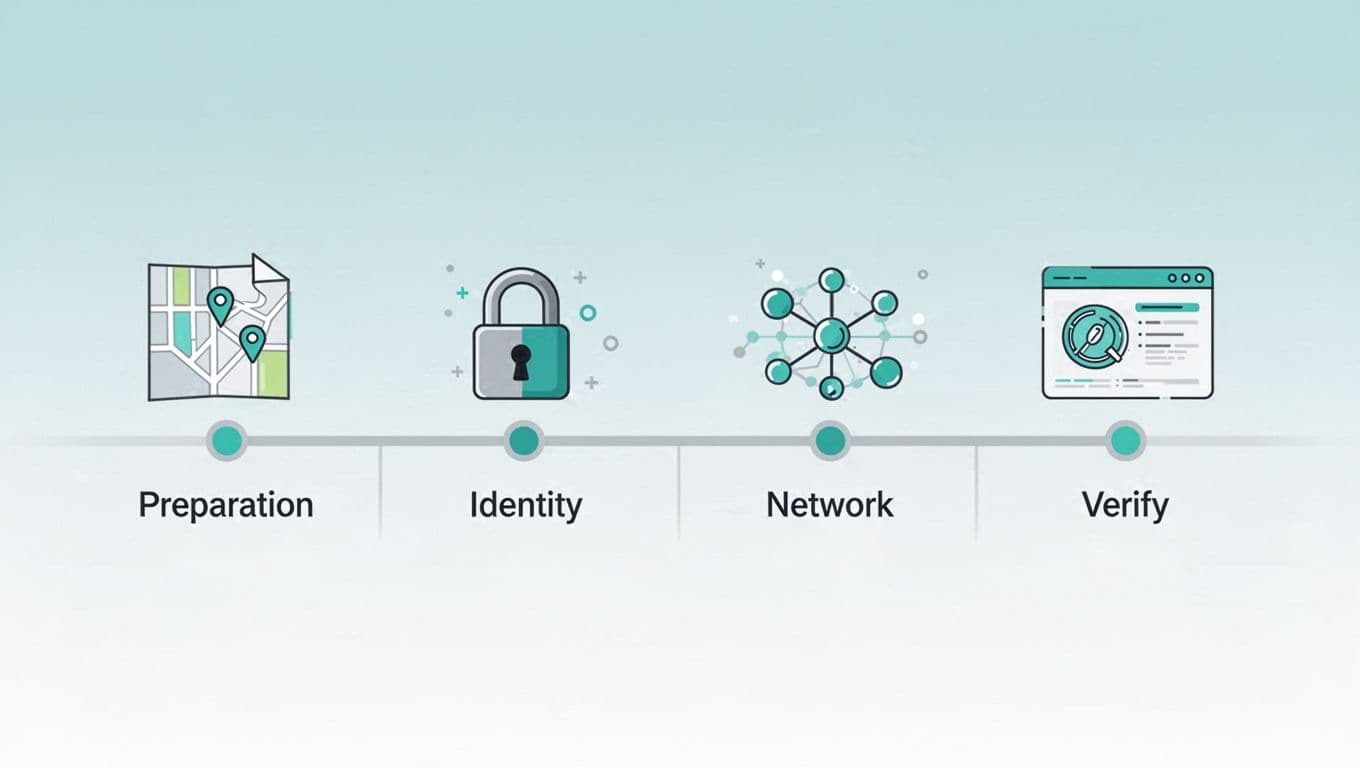
This NIST-CISA hybrid cuts risks fast. For a vendor-agnostic timeline, see the Zero Trust Roadmap site.
Adapt per needs. OT skips agents; use diodes.
Measure success. Aim hours for detection. Full MFA by month 3.
Essential Controls to Implement First
Pick controls that bolt on.
MFA and Identity
Require it all logins. Hardware keys beat SMS. Central IAM federates legacy apps via proxies.
PAM
Privileged accounts get vaults. Sessions record. Approve access real-time.
Microsegmentation
Software-defined walls. No east-west travel. Legacy stays in cells.

Device Trust
EDR agents where possible. Posture signals deny bad devices. Legacy? Network access control.
Continuous Monitoring
XDR unifies logs. Behavioral baselines spot odd flows.
Start high-risk. MFA first; it stops 99% phishing.
Tools: CrowdStrike for EDR, CyberArk for PAM, Zscaler ZTNA.
For practical steps in legacy, review Tuned Security’s guide.
Layer them. One fails; others catch.
Governance, Monitoring, and Pitfalls to Avoid
Governance sets rules. Define policies. Audit compliance. Cross-team ownership.
Appoint owners per pillar. Review monthly.
Monitoring runs 24/7. Dashboards show risks. SOAR automates responses.

Pitfalls: Skipping inventory leads to blind spots. Overlooking service accounts invites bypasses. Rushing segments causes outages; test in labs.
Budget traps: Tools alone fail without people. Train teams.
Legacy can’t do everything. Compensating controls bridge: gateways for air-gapped.
Track metrics: Access denials, mean-time-to-detect under 4 hours.
For balancing ideals with reality, see Mandos’ post on pragmatic security.
If skills gap hits, book a discovery call with Bud Consulting for talent in IAM or cloud security.
Conclusion
Zero trust implementation transforms legacy risks into managed ones. Phase it right: inventory first, MFA next, segments after. Frameworks like CISA ZTMM keep you on track.
You protect without disruption. Gains compound over 12 months.
Focus on high-value assets. Measure progress. Your operations stay secure and compliant.